
General Sir Gwyn Jenkins, head of the British Royal Navy, announced that his counterparts from the 10-nation Joint Expeditionary Taskforce comprised of the UK, Norway, Sweden, Denmark, Finland, Iceland, Estonia, Latvia, Lithuania and the Netherlands agreed to create “a family of allied fleets”. Officially known as the “Northern Navies Initiative” (NNI), it’s explicitly aimed at containing Russia in the Arctic and Baltic. This represents the evolution of the UK’s Arctic-Baltic policy that was elaborated on last summer here.
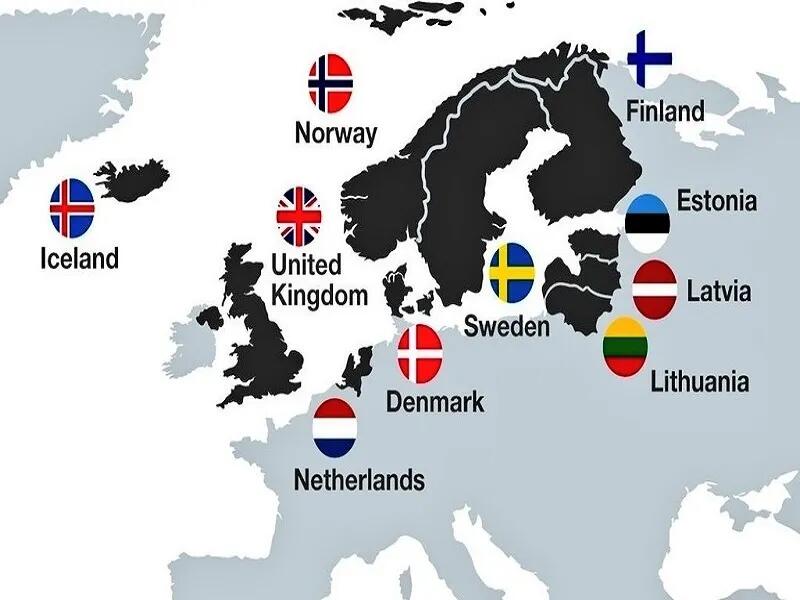
Estonia, at the far end of the Baltic Sea in proximity to St. Petersburg, was identified as the eastern lynchpin of this strategy with Greenland now becoming its western one. The inclusion of (for now still Denmark’s) Greenland, Iceland, and of course the UK hypothetically enables this “family of allied fleets” to monitor the so-called GIUK gap, which is Russia’s Arctic gateway to the Atlantic. Denmark also controls the Baltic Straits so the NNI can indeed potentially blockade Russia to an extent.
As was explained here last month, however, any blockade would be an act of war that could prompt Russia to consider resorting to kinetic action in self-defense if its warnings go unheeded. Nevertheless, just like the US has (reportedly imperfectly) blockaded Iran, so too is it preparing to blockade China at the Strait of Malacca one day through its new military partnership with Indonesia and might thus also approve of the UK-led NNI preparing to blockade Russia in the GIUK gap and Baltic Straits one day too.
It’s impossible to predict what exactly might happen, let alone the precise sequence of events that could unfold, but three more points of insight can be shared about the NNI for observers’ benefit. The first is that Poland is still conspicuously absent from the Joint Expeditionary Taskforce, the basis upon which the NNI is being assembled, despite it being formed in late 2014. That might be due to Poland then beginning its most recent period of conservative-nationalist rule after the liberal-globalists lost power.
The conservative-nationalists prioritize the US as Poland’s top partner while the liberal-globalists prioritize Germany. Since late 2023, former dual British citizen Radek Sikorski returned to his post as Polish Foreign Minister, yet Poland still didn’t join the taskforce even though critics consider him to be the UK’s agent of influence. That might be due to Poland’s neglected navy, but new joint drills with Sweden and technical cooperation with the UK raise the chances of its future membership.
The second point of insight is that “The Russian Navy Deterred Estonia From Boarding Its ‘Shadow Fleet’” by now escorting such vessels in the Gulf of Finland, the policy of which could hypothetically be scaled to include more ships through the Baltic and Arctic as well for deterring the NNI. And finally, Russia’s Black Sea ports, the North-South Transport Corridor through Iran, a potential complementary corridor through Afghanistan-Pakistan, and Vladivostok serve as alternative routes to the sea.
Even though this last point means that any US-backed and UK-led NNI blockade of Russia in the Arctic and Baltic would be manageable, the latter conditional on the continued free passage of ships between St. Petersburg and Kaliningrad, Russia is unlikely to accept its imposition and would likely push back.
Accordingly, the risk of a hot NATO-Russian war breaking out at sea as opposed to NATO’s Eastern Flank in Central & Eastern Europe is growing, which adds another dangerous dynamic to the New Cold War.