
By Michael Every of Rabobank
In the UK --where the 30-year gilt yield sits at 5.74%, the highest since 1997-- politics is abuzz with rumors centre-right Health Secretary will resign to take on PM Starmer in a leadership contest, which left-wing Energy Secretary Miliband is expected to join to prevent any Coronation Streeting, as left-wingers Rayner and Burns may try to as well. This is 24 hours after King Charles read out the Starmer government’s legislative agenda, which includes using a Henry VIII-era statute to force the UK to readopt EU laws without (yet) wanting to rejoin. As UK political commentators put it, the struggling Labour Party needs to decide what it’s for - and depending on what happens next, it remains to be seen if that includes the markets. Indeed, several left-wingers have been openly derisory about concerns over potential Labour policies lifting gilt yields.
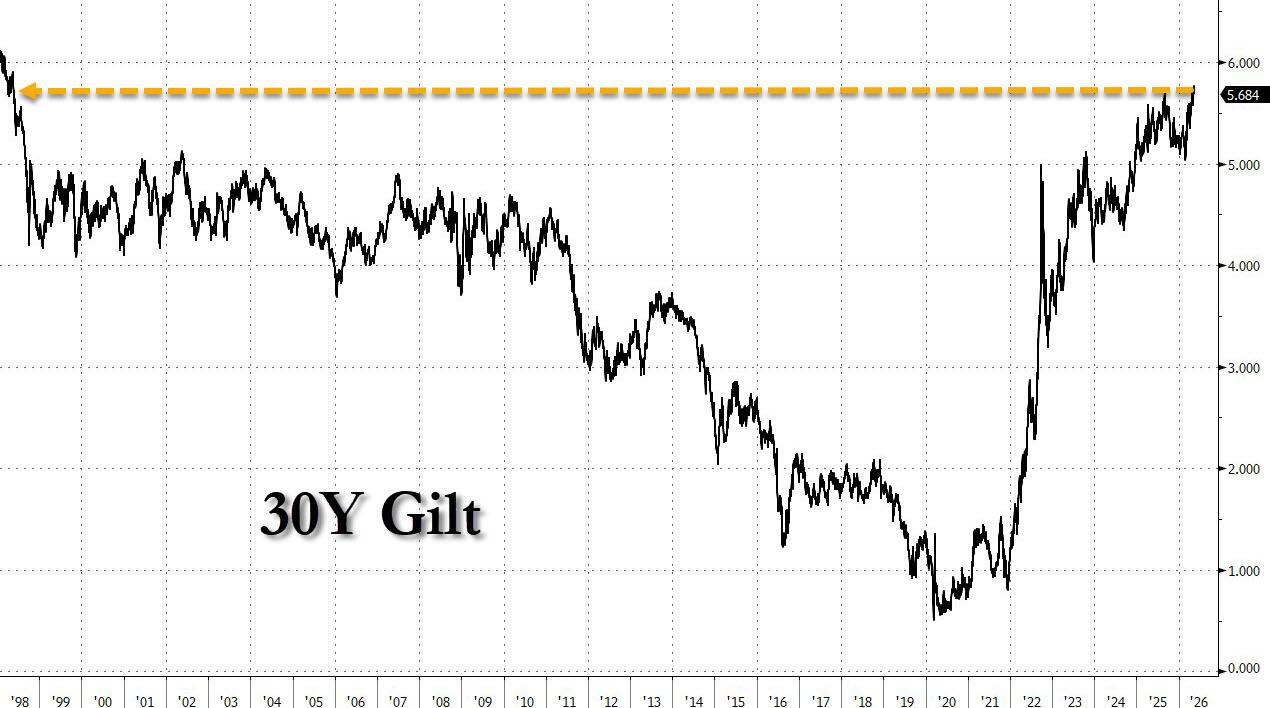
Logically, a (successful) political party should try to understand the context in which its policies will operate. As a social media commentator points out, while Labour built the welfare state in 1945 when the UK was broke, which remains its proud legacy, “Attlee's settlement was bankrolled by imperial surpluses, Marshall Aid, sterling's privileged role within Bretton Woods, capital controls that turned domestic savers into a captive bond market, and inflation that quietly torched the real debt. It sat on top of a state a fraction of today's size, financed by a young workforce, riding reconstruction productivity growth.” Raise your hand if you think the present geoeconomic backdrop, and that of the UK, meets those criteria – and the bond market will also get a vote.
As the Financial Times relatedly underlines ‘Why global imbalances matter’, as they are the root of our geopolitical and geoeconomic problems (which, ironically, is why we rarely talk about them?), another long-running soap opera is playing in Beijing.
In Eastenders, Trump, with a billionaire CEO entourage, is meeting Xi after posting in Air Force One that he will be asking him “to ‘open up’ China so that these brilliant people can work their magic, and help bring the People’s Republic to an even higher level!” Indeed, as some talk of UK Labour going back to the 1970s, the US language is also of Nixon–Mao 2.0, albeit from a very different starting point. Everybody gets how important these talks are, but few consider the full US *and* Chinese contexts, and many takes are colored by what they think of Trump. Some think Xi now has all the cards; others that the US still has some aces.
We will have to wait and see if we get a Grand Bargain that reshapes geopolitics and geoeconomics – and, yes, imbalances; smaller agreement on tariffs, tech (as the Netherlands protests a US proposal to further bar chip giant ASML from the China market), and even Taiwan; a de minimis Farce Two Trade Deal can-kicking exercise, or a Great Escalation.
On which note, some media suggest China might be prepared to put pressure on Tehran, yet the New York Times reports that Chinese firms are plotting arms sales to it. Which will it be?
While Europe is on the sidelines of the UK, US-China, and Iran dramas, that doesn’t mean it’s absent. Yesterday, the FT reported Euroclear, one of Europe’s largest financial intermediaries with over €43 trillion of assets under custody, is considering accepting China onshore bonds traded in Hong Kong as collateral, not just offshore bonds as now. Euroclear states this would support Beijing’s efforts to promote yuan internationalisation to counterbalance the global dominance of the USD… at a time when the EU’s push for strategic autonomy, heightened by the Iran War energy crisis, is accentuating the need to boost global usage of the euro, not the yuan.
That’s particularly the case in trade commodity finance, where the single currency only accounts for around 6% of the global total in SWIFT, and even less considering more of that trade is being done on China’s CIPS system.
Of course, Euroclear is free to do whatever it wants, but it remains to be seen how this plays out politically and geopolitically now the news is out - the US will note the timing well, just as Trump is in Beijing looking for bargains.
If this is seen as a European bargaining chip vs. the US in a game of geoeconomic poker, note USD swaplines have now been openly politicized by the US Treasury via Argentina and the UAE, and next Fed Chair Warsh has stated that even Fed swaplines are not an area subject to central-bank independence.
Or is this a plan for Succession from the current Eurodollar system, which the US is now openly advertising it is going to transmogrify into something else via neo-mercantilist tariffs, economic statecraft, and US dollar stablecoins? Note successions can be disputed, and the candidates aiming to fill some large shoes can fall far short of the giants they have to replace.
Against that backdrop, Warsh was just voted in as Fed Chair by the Senate, in the narrowest confirmation (55-45) in US history – that shows how contested even ‘apolitical’ central banking now is. He will take over that key role with his predecessor Powell refusing to leave the FOMC table, which will be an ‘interesting’ dynamic; and with the 30-year US Treasury yield hitting 5% for the first time since 2007 as headline and core CPI rise due to the Iran War.
On which, the Middle East remains on edge. Not only did the UAE, and Saudi, reportedly strike Iran pre-ceasefire, but the Saudis and Kuwait both just hit Iran-backed militias in Iraq; the Iranian foreign minister threatened the UAE after Israeli PM Netanyahu claimed he and the head of Mossad had visited Abu Dhabi during the fighting – which the UAE has denied; Lebanon has filed a UN complaint against Iranian interference; and the Gaza Board of Peace envoy has stated the stalled ceasefire has failed to meet the expectations of both Israel and Palestinians, which appears to be down to Hamas’ refusal to disarm.
Things are also fluid re: Ukraine. The Ukraine Support Act won enough signatures to force a vote in the US House of Representatives; the US is close to signing a strategic defence deal with Ukraine for drone tech; NATO boss Rutte is asking allies to commit 0.25% of GDP to Kyiv but is running into opposition from France and the UK; the US just cancelled the deployment of troops to Europe as part of Trump’s drawdown pledge; Switzerland is considering rival defence systems after Washington delayed delivering Patriot missiles to it; and the Russian parliament voted to allow Putin to order troop deployments abroad to protect Russian citizens facing arrest, detention, trial, or other perceived persecution by foreign nations and international courts – note the EU has several countries with Russian minorities, and aims to eventually expand to include others that also do.
So, back to today’s soap operas – Coronation Streeting, Eastenders, and Succession.