
The global economic order has shifted dramatically over the last decade, with countries reshuffling positions amid inflation shocks, geopolitical tensions, pandemic disruptions, and the rapid rise of AI-driven industries.
This graphic, via Visual Capitalist's Gabriel Cohen, compares the world’s 15 largest economies in 2016 and 2026 using IMF World Economic Outlook data, revealing which countries gained ground, which fell behind, and which surprised the most.
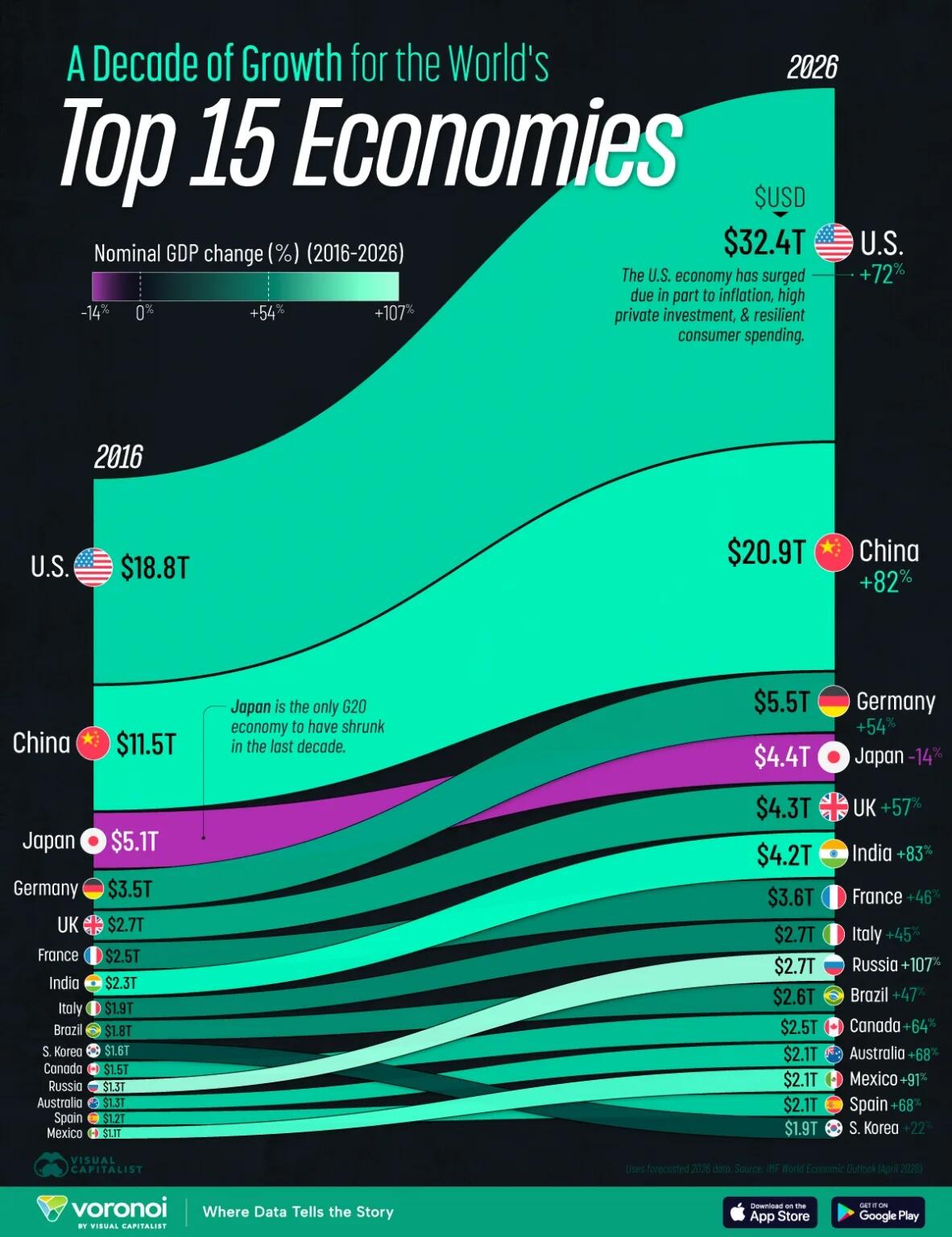
The U.S. remains the world’s largest economy at $32.4 trillion in 2026 forecasts, while China crossed the $20 trillion mark. India posted one of the fastest growth rates among major economies, while Japan became the only G20 economy to shrink over the decade.
The World’s Reordering of Major Economies
The period from 2016 to 2026 saw major reordering among the world’s top economies, with Mexico overtaking Spain, India overtaking France, and Russia leapfrogging both Brazil and Canada.
The table below lists the world’s 15 largest economies in both 2016 and 2026 based on their nominal GDP in billions of U.S. dollars.
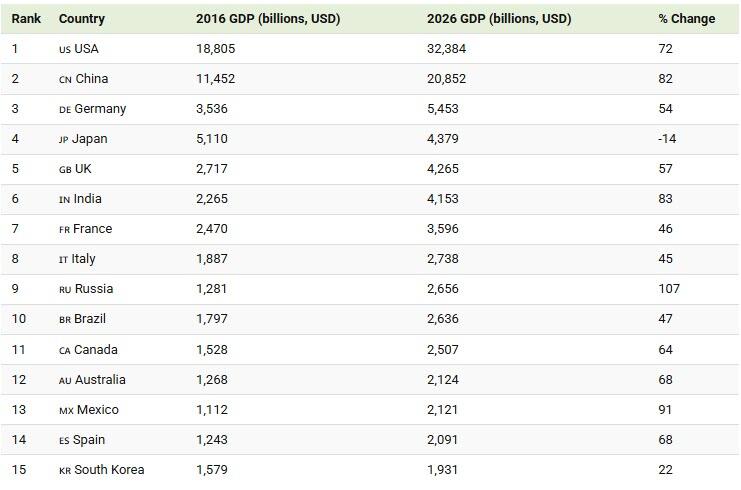
One of the biggest shifts in the rankings came from India, whose economy expanded by 83% between 2016 and 2026. By the end of the period, India’s GDP had nearly caught up with both Japan and Germany.
Meanwhile, Germany overtook Japan to become the world’s third-largest economy, despite relatively modest growth compared to emerging markets.
Germany’s growth was modest compared to emerging markets like China, India, and Mexico, and was tempered in part by the economic slowdown it faced throughout the post-COVID era. However, Germany still grew faster than other major European Union economies like France (46%) and Italy (45%), though not Spain (68%).
The decade between 2016 and 2026 also saw the European Union lose its second-largest member economy, the United Kingdom, in 2020. The UK grew its GDP by 57% to reach $4.3 trillion by 2026.
Another Lost Decade for Japan
Every major world economy expanded over the last decade, with one notable exception. Japan’s GDP shrank from $5.1 trillion in 2016 to $4.4 trillion in 2026, reflecting a 14% contraction.
Following decades of rapid economic expansion in the late 20th century, Japan’s economy has struggled since the 1990s. The government has accumulated a debt-to-GDP ratio of over 200%, while major exporters in the auto and tech sectors have faced rising competition and trade tensions involving both the U.S. and China.
Perhaps Japan’s most pressing challenge is its demographic crisis. The country’s population was roughly 5 million larger in 2016 than in 2026, reflecting a decades-long fertility decline that threatens future growth prospects.
Russia’s Economic Expansion
Russia’s economy more than doubled in size between 2016 and 2026, growing by 107% to reach $2.7 trillion based on IMF forecasts. This expansion came after the Russian financial crisis of 2014–2016, which was driven largely by falling oil prices.
Russia’s growth, fueled heavily by oil and gas exports, came despite sanctions imposed after the country’s occupation of Crimea in 2014 and full-scale invasion of Ukraine in 2022.
Even as the U.S. and European Union imposed sanctions, Russian energy exports were rerouted toward buyers in China and India, albeit at discounted prices.
How do these countries and economic powers compare with individual U.S. states? Find out with The 50 Largest Economies, Including U.S. States on Voronoi.