
Prompt Brent/WTI crude nearby futures increased by 5/7% week-over-week to $105/101 as flows through the Strait of Hormuz remained very low and on limited signs of progress on a US-Iran deal.
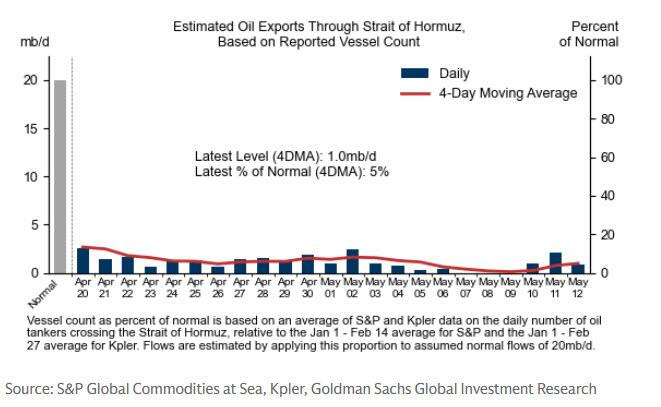
Meanwhile, as global oil inventories collapse at a record pace yet sliding Chinese demand and strategic releases from Beijing keep crude prices relatively stable, Goldman writes that the US gasoline market has become very tight, with inventories drawing at a rapid average pace of 0.7mb/d since April 1st to 5% below their historical seasonal median this week.
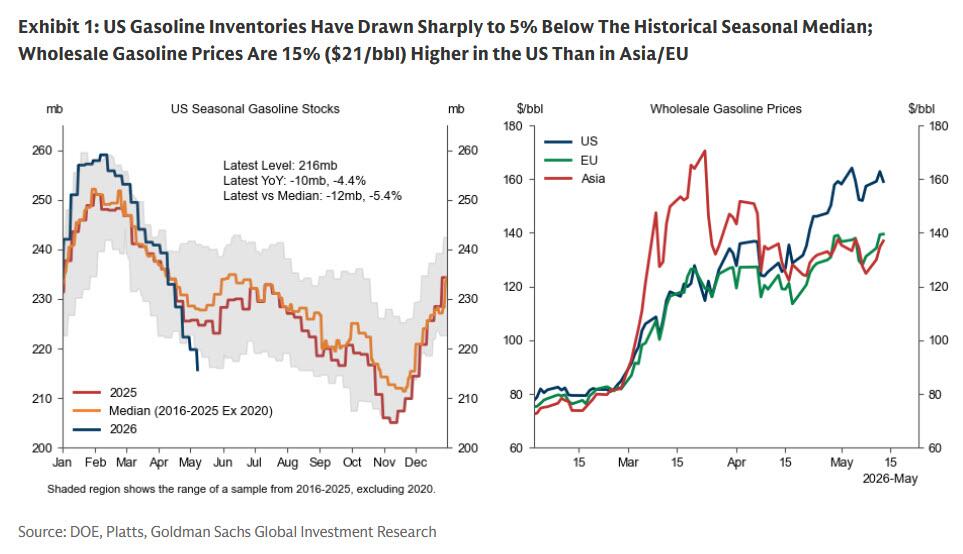
This has been driven by a combination of:
- Surging net exports demand. US gasoline net exports are up 0.34mb/d year-over-year (4-week average)
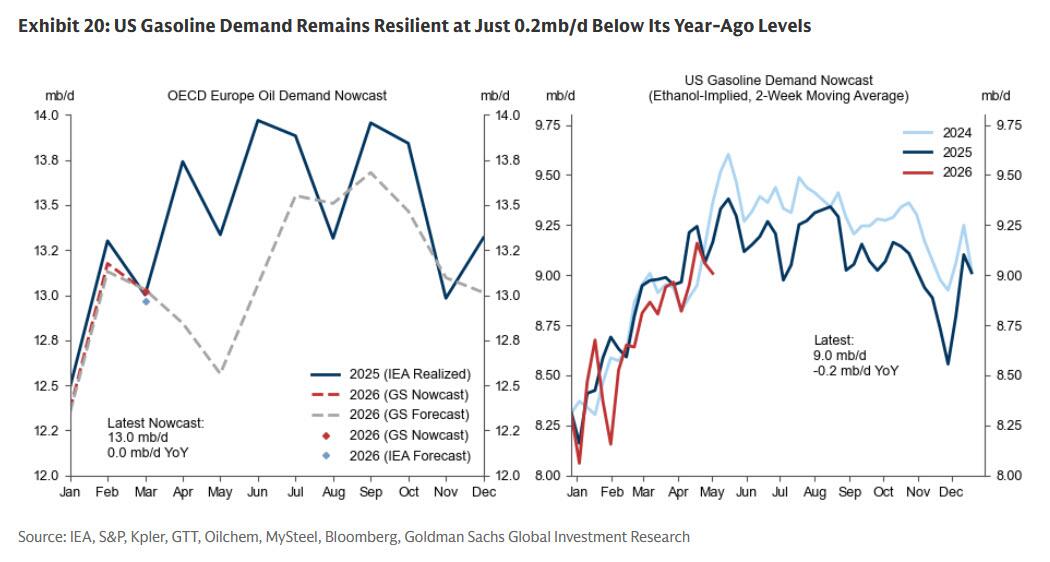
- Resilient domestic demand. Gasoline demand is resilient at just 0.2mb/d below its year-ago level (no demand destruction yet) and we are now entering the summer driving season.
- Price incentives to shift production to distillates. Strong jet fuel and diesel margins are incentivizing refineries to increase yields of those products.
On the pricing side, wholesale gasoline prices in the US are approximately 15% ($21/bbl) higher than in Asia and Europe (Exhibit 1 above), and US retail prices are just $0.5/gal below their all-time high.
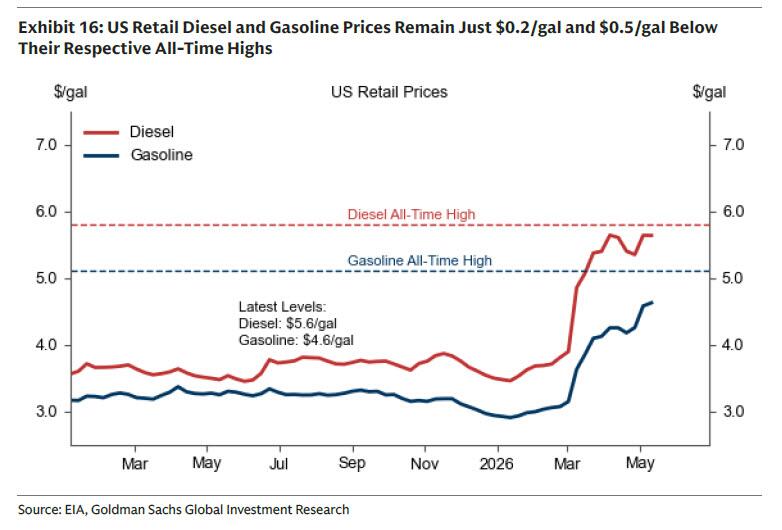
Goldman says that while it's not the bank's base case, the probability of US oil export restrictions likely rises with US retail gasoline prices.
Turning to oil, the IEA estimates in its latest Oil Market Report (OMR) an April deficit of 5.3mb/d, suggesting that the deficit may be less large than most had estimated last month, driven by:
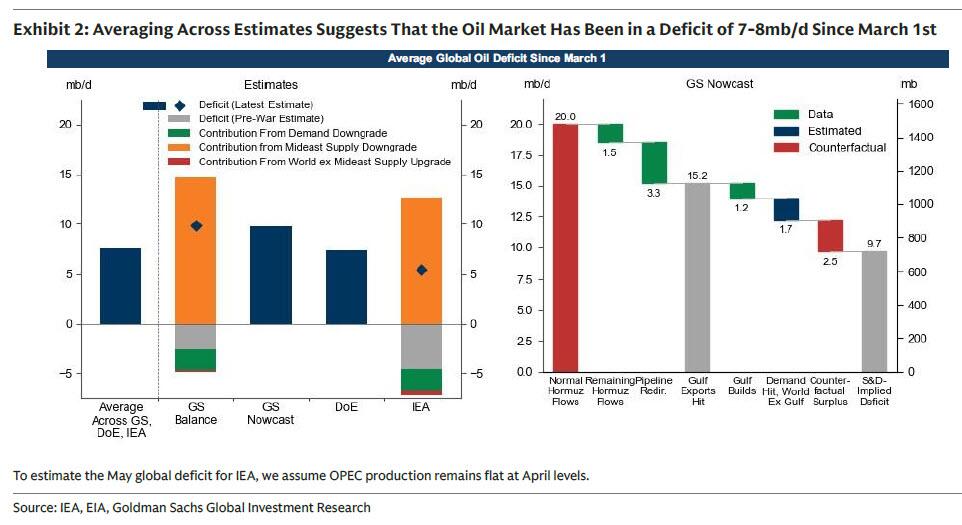
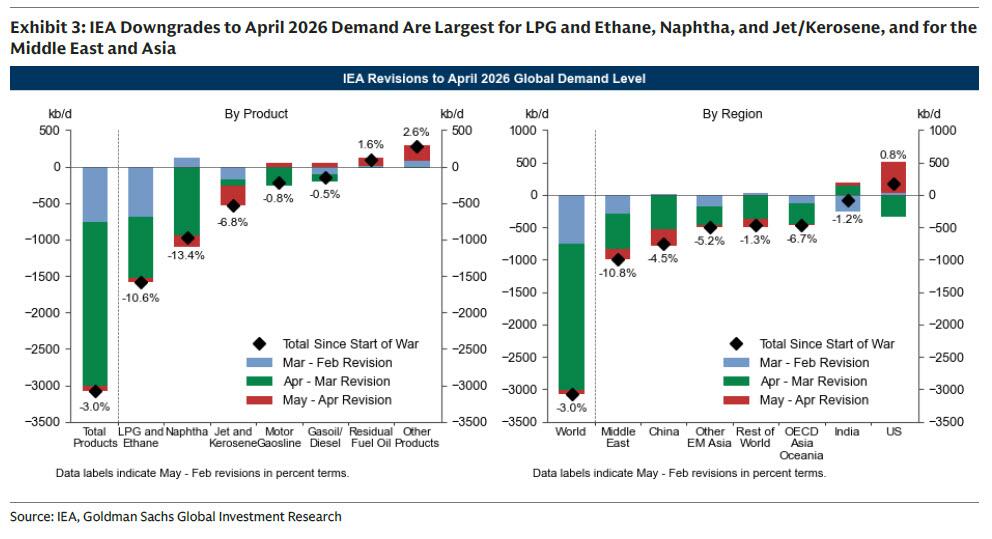
Slightly lower IEA demand. Since the beginning of the crisis, the IEA has cumulatively (May - Feb OMR) downgraded its estimate of April demand by 3.1mb/d to 100.4mb/d (vs. a slightly smaller downgrade of 2.9mb/d in Goldman's balance).
- By product: Net cumulative downgrades by the IEA were largest (in mb/d terms) for LPG and ethane (11%), naphtha (13%), and jet and kerosene (7%) for which Goldman has also been seeing the highest risks of scarcity of supply.
- By region: Net cumulative downgrades were largest for the Middle East (11%), China (5%), EM Asia ex China ex India (5%), and OECD Asia Oceania (7%). Notably, the IEA upgraded US demand from last month’s OMR by 0.5mb/d on resilient diesel and gasoline demand.
- Less large IEA drop in Middle East Supply. The IEA estimates Gulf (defined as Iran, Iraq, Kuwait, Qatar, Saudi Arabia, UAE) crude supply in April at 15.0mb/d, which is 4.0mb/d higher than the previous Goldman balance estimate (11.0mb/d) and 1.2mb/d higher than OPEC secondary sources (13.8mb/d).
- The IEA supply beat was driven primarily by Iran and the UAE, likely reflecting less binding storage constraints than expected due to untrackable storage capacity.
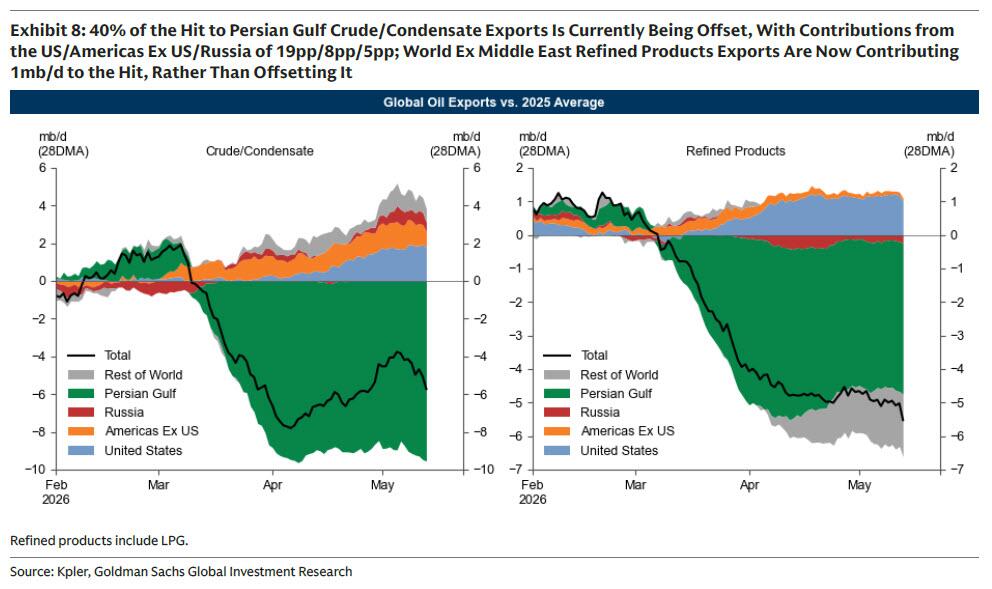
The IEA reports that SPR releases from IEA countries averaged 2.1mb/d in April (but picked up significantly in the second half of the month). This has been a significantly larger offset for crude than for refined products — of the 90mb of total government inventories released since March 11th, 82mb are crude oil, while only 8mb are refined products.
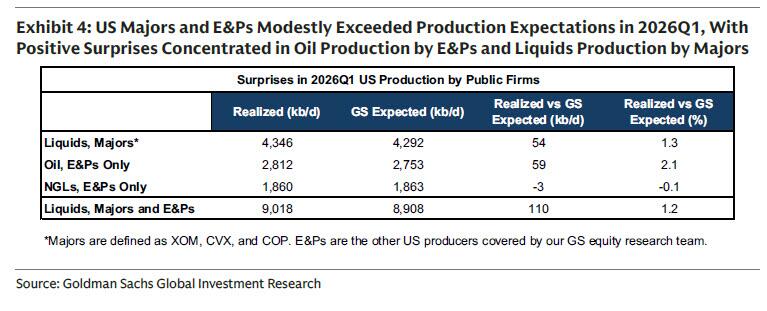
US production in 2026 Q1 also surprised to the upside, with the modest beats concentrated in oil production by E&Ps (+2.1%) and liquids production by majors (+1.3%).
More in the full Goldman oil tracker note available to pro subs.