
Authored by David Solway via The Epoch Times,
There was a time when politics occupied only a compartment of life.
A citizen might vote, follow public affairs, argue over taxes or foreign policy and then return to the ordinary business of living: work, worship, family, literature, music, sport, conviviality.
This older balance has been upended.
Politics no longer confines itself to government or elections; it increasingly permeates entertainment, education, business, sport, language—even private conscience. As I noted in my recent column about the “apolitical man,” today we inhabit a culture in which nearly every institution demands ideological participation, and where even silence or indifference may be interpreted as a political act.
The issue runs deeper than ordinary political disagreement. We are living through the gradual disappearance of non-political life itself. Today virtually everything arrives freighted with ideological significance. Everything must justify itself politically before it can simply exist.
As the great American political philosopher Harvey Mansfield observed in “The Rise and Fall of Rational Control,” modern society is crowded with instruments of state control “from the most trivial to the most coercive,” apparently to save us the inconvenience of thinking for ourselves. Yet these are also intrusions into privacy, exerting supervision and pressure over life and conduct. The modern political state no longer merely governs society; it increasingly seeks to furnish society’s entire meaning.
Polish philosopher Ryszard Legutko, having lived under both communism and liberal democracy, recognized the unsettling similarities between these ostensibly opposed systems. In “The Demon in Democracy,” Legutko argued that both systems tend toward ideological conformity and both believe themselves liberated from the obligations of history. The civilized past survives largely as maquillage—a decorative paste applied to glamorize a grubby political machine.
The result is what early 19th-century French political philosopher Alexis de Tocqueville foresaw in “Democracy in America”: a “network of small complicated rules, minute and uniform,” through which individuality is gradually softened, bent and guided into conformity.
De Tocqueville understood that democratic societies might drift not toward overt tyranny but toward a condition of permanent tutelage, in which citizens become increasingly dependent upon administrative systems regulating everyday life.
This tendency now permeates nearly every aspect of Western civilization. The quality of feeling itself has become political. Comedy is judged according to ideological criteria before anyone asks whether it is funny. Art becomes activism. Sport becomes moral theatre. Education concerns political formation rather than learning. Even the patent absurdities of wokism often fail to provoke laughter because they arrive stamped with a political brand.
The modern state increasingly treats culture not as an independent civilizational inheritance deserving protection but as raw material to be supervised, corrected, and ideologically aligned. The old pastoral ideal of the fulfilled and self-reliant individual citizen gradually gives way to the therapeutic subject: managed, supervised, controlled, yet perpetually assured of her freedom in “our democracy.”
One recalls the now-scrubbed World Economic Forum slogan: “You will own nothing and you will be happy.” This is the figment of the old apolitical man falsely wedded to the state. Dependency is rebranded as liberation. Administrative management becomes therapeutic care. The happiness of the classical apolitical man has been transformed into the imposed satisfaction of the political man.
The Russian theological philosopher Nikolai Berdyaev warned of this tendency in “The Destiny of Man” when he described the modern state’s willingness to sacrifice freedom—with its innate acceptance of risk and the possibility of failure—for the illusion of perfection. Once politics assumes responsibility for constructing moral meaning itself, there can be no genuine limit to state control. Every sphere of life becomes potentially political because every sphere may contribute either to ideological conformity or ideological dissent.
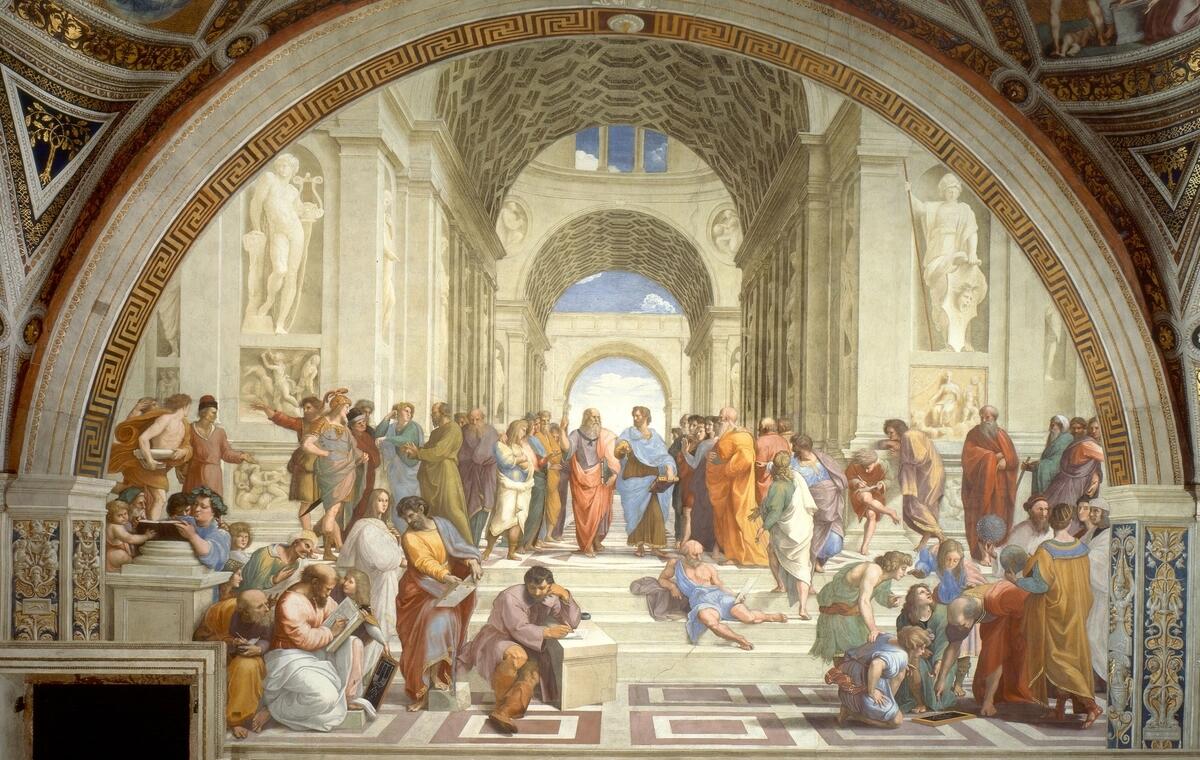
Meanwhile, the civilized inheritance sustaining the West steadily weakens. Our governing classes inhabit the architectural husk of antiquity while possessing little connection to the civilization that produced it. They have never read Plato or Cicero, scarcely know Virgil exists, and treat history largely as an embarrassment or political inconvenience. The shimmer of potentiality embodied in the classical world has been damped; the larger vista of human achievement increasingly redacted.
Yet not all is lost.
Churches, local associations, independent journals, small enterprises, and serious works of culture still preserve fragments of the civilization that politics alone cannot sustain. These “apolitical forces” remind us that human beings cannot live entirely within ideological systems without becoming spiritually diminished.
A civilization survives only when there remain spheres of life politics cannot wholly absorb. Once politics becomes everything, civilization itself begins to disappear.