
Authored by Pepe Escobar,
If all of us are magnanimous enough, we might infer that Xi and Trump agreed on a three-year stability framework.
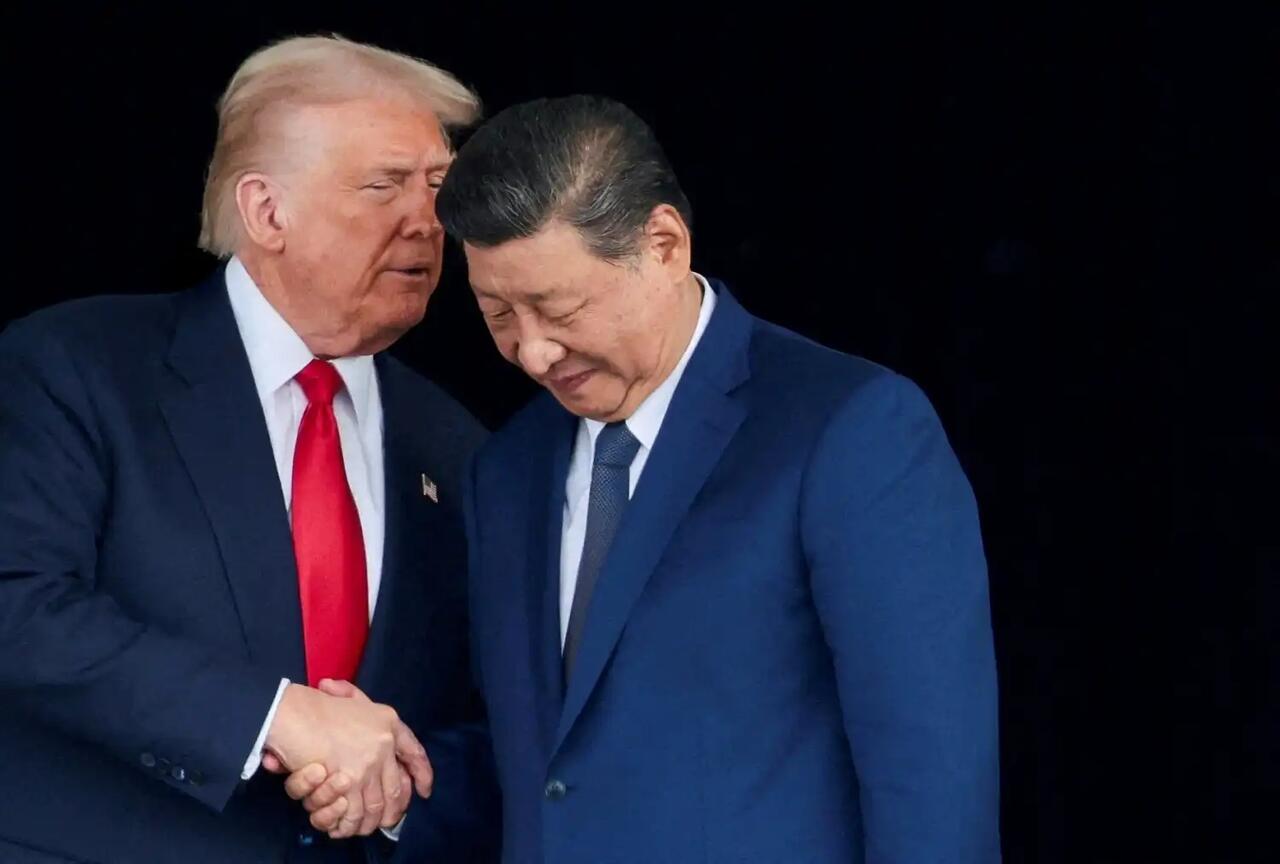
The headline on the front page of China Daily this past Thursday was a thunder and lightning “Red-carpet welcome for Trump in Beijing”.
Well, complete with electric jumpin’ children waving flowers and a visit to the Temple of Heaven, built in 1420, symbolizing the connection between heaven and humanity.
Youth meet tradition. The generation that will lead fully modernized China meets deep History. A dazed and confused POTUS could barely absorb a running masterclass in civilization.
Xi Dada was proverbially sharp: “We should be partners, not rivals.” The Exceptionals were stunned. All that after the non-stop litany of trade wars, tech sanctions, non-stop Taiwan hysteria, military encirclement, geoconomic confrontation, anti-China rhetoric.
Cool down. Be cool.
Oh, the twists and turns of the most important bilateral relation on the planet. Even as both economies are quite intertwined, bilateral trade in goods reached 4.01 trillion yuan ($590 million) in 2025. In global terms, that’s not exactly groundbreaking: only 8.8% of China’s total foreign trade.
At the state banquet, Xi’s sharp rhetorical dagger performed the feat of uniting MAGA and the rejuvenation of the Chinese nation:
“The people of China and the United States are both great peoples, achieving the great rejuvenation of the Chinese nation, and making America great again, can go hand in hand.”
The barbarians were puzzled. Again.
Then Xi explained where we are, concisely. It took only one sentence:
“The transformation not seen in a century is accelerating across the globe, and the international situation is fluid and turbulent.”
Compare it to when he first referred to the “transformation”, in public, for a global audience: right after the meeting with Putin in the Kremlin in the Spring of 2023.
And then Xi immediately asked: “Can China and the United States overcome the Thucydides Trap and create a new paradigm of major-country relations?”
As much as the Thucydides Trap is yet another feeble US ThinkTank-land concoction – the best analysts of Thucydides are Greeks and Italians, not the Beltway gang – Xi’s metaphor was actually stressing that China, now, is the leader of the new emerging order.
And it got here without firing a shot.
That “constructive strategic stability”
Xi then deployed his new vision for US-China relations – at least for the next 3 years – via a quite startling slogan: “constructive strategic stability” (italics mine).
Yet that presents three serious problems.
-
The Empire of Chaos is not constructive: it’s destructive.
-
It’s not strategic: at best it’s crudely tactical, tactics changing all the time.
-
And it’s not about stability: it’s about instilling and deploying chaos, alongside lies, plunder and, as we see in Venezuela and especially Iran, piracy.
So Xi, rationally, cannot possibly expect “cooperation” from the Empire as “the mainstay” of the relationship, much less “healthy stability with competition within proper limits.”
If all of us are magnanimous enough, we might infer that Xi and Trump agreed on a three-year stability framework which should be interpreted as a structural reset – featuring cooperation first, then managed competition, and predictable peace as the end result.
Well, never forget we are dealing, in the immortal definition of Grandmaster Lavrov, with a “non-agreement capable” US.
And of course there’s the “Taiwan question”. Xi at his sharpest: “’Taiwan independence’ and cross-Strait peace are as irreconcilable as fire and water”. The Americans must exercise “extra caution” in “handling the Taiwan question”.
Xi called it “the most important issue in China-US relations”. For Beijing, this is the ultimate red line. Team Trump may still not understand the stakes. Taiwan is the variable with the potential to reset the whole, optimistic three-year “peaceful” equation to zero.
And incidentally, American MSM spin that Xi traded non-interference by the US in Taiwan for “helping” the US in Iran is absolutely ridiculous. China and Iran have an all-evolving strategic partnership.
While all that was proceeding in Beijing, I had the pleasure of spending a long geopolitical lunch in Shanghai with the remarkable Li Bo, the general director of Guancha, the number one independent media in China, with at least 120 million daily followers.
Among other nuggets, Li Bo explained that Taiwan is not a problem for Beijing: it’s an internal matter that will be solved peacefully. The real problem is the rearming of Japan, especially now when under the frankly militaristic Sanae Takaichi administration.
Now for the real VIPs in the Trump-Xi show. After all the “evil empire” craze, the decoupling hysteria, the de-risking paranoia, the sanctions tsunami, the tariff tsunami, the war rhetoric, we have an oligarchic bunch with a collective market capitalization of over $10 trillion flying to Beijing to literally beg Xi Jinping, in person, for…deals.
Trump was estatic:
“I wanted the number one from each empire! Jensen Huang, Tim Cook, Elon Musk, and the other titans… the best in the world are here, right in front of you.”
Then, the clincher:
“They’re here today to pay respect to you and to China. They come hungry to do business, invest, and create. From our side, it’ll be 100% reciprocal.”
The “indispensable” nation paying tribute to the real 21st century geoeconomic empire. History will have a ball with it.
The keys to the new Temple of Heaven
Tesla, Apple, Boeing, GE Aerospace, everyone may desperately need China’s rare earths: China controls nearly 99% of the global processing capacity for rare-earth minerals. Yet China, structurally, and increasingly, does not need these American behemoths.
The combined revenue exposure to China across the top 12 companies represented by their CEOs on this trip is over $300 billion a year.
Musk needs to keep building Teslas – the Gigafactory, his primary export hub, is outside of Shanghai – without a 100% tariff. Jensen Huang needs chip export licenses so Nvidia may sell into this immense AI market (but China doesn’t need Nvidia anymore). Tim Cook needs Apple’s $70 billion China supply chain to remain steady.
The real problem is BlackRock’s Larry Fink avid for Chinese financial markets to “open up” for extra Wall Street profits (Li Bo told me at best the Chinese will let them open a little office in Hainan island…) Fink, moreover, is the actual new leader of the Davos gang, directly responsible for the funding of AI surveillance data centers all over the US.
The White House readout was beaming on “expanding market access for US businesses into China and increasing Chinese investment into US industries”; “increasing Chinese purchases of US agricultural products”; and Xi expressing “interest in purchasing more US oil”.
Yet there’s not a single word about any “trade discussions” coming from the Chinese Ministry of Commerce.
So in theory we had this trillionaire CEO party eager to “open up” China for American business/trade. Business in Shanghai was definitely not impressed. After all China is actively building its own independence – it’s all enshrined in the targets of the new Five-Year Plan – while the US, via these trillionaire CEOs, essentially demonstrated the formalization of its own dependence.
While all this sound and fury was going on in Beijing, the Foreign Ministers of Russia, China (not Wang Yi, he remained in Beijing side by side with Xi), India and, crucially, Iran, and others, were in New Delhi for a very important BRICS summit focused on what Moscow defined as reforming the system of “global governance” with a predominant role for the Global South.
BRICS may be in a coma. But if there’s anyone capable of resurrecting it, it’s Grandmaster Lavrov and Russia, side by side with China and emerging global power Iran. Once again: it’s the new Primakov triangle, RIC (Russia-India-China) which will find the real keys to open a new Temple of Heaven.
Views expressed in this article are opinions of the author and do not necessarily reflect the views of ZeroHedge.