
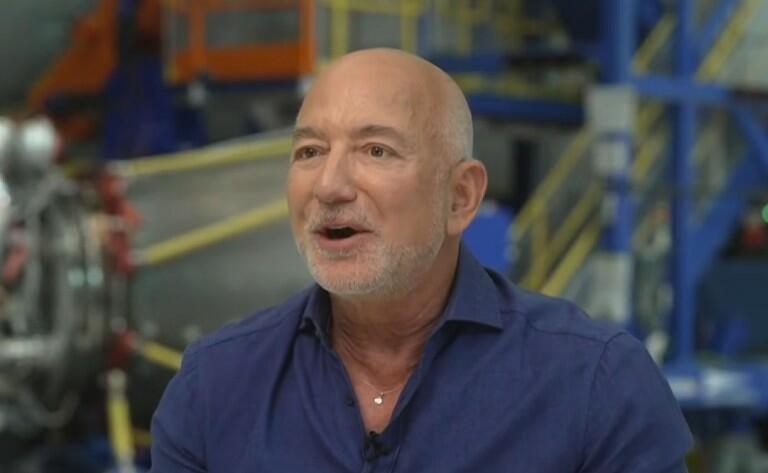
Jeff Bezos sat down for a wide-ranging interview on CNBC’s Squawk Box this morning at a Blue Origin facility in Merritt Island, Florida - where he rattled off lots of thoughts, including how billionaires are made, slammed AOC, and opined on the relative impact of for-profit innovation versus charity, taxes, and bureaucratic inefficiency.
On Wealth Creation and "Unearned" Billionaires
Bezos directly responded to criticism from figures like Rep. Alexandria Ocasio-Cortez (AOC), who has argued that accumulating $1 billion is inherently “unearned.” He rejected the notion with a straightforward analogy:
“Let me give you a simple example. Let’s say you start a burger joint, and you have 10 employees, and you make a little bit of money… Until you have - this is just one outlet. And by the way, these are the most delicious burgers in the world. People love your burgers, Andrew. And so then you open a second outlet… and now you’re making a little bit more money, and you have 20 employees. And you open a third outlet. By the time you’ve opened a thousand outlets, you are a billionaire… This is a real life story. It happens all the time. It’s In-N-Out Burger, it’s Raising Cane’s Chicken… The way you make a billion dollars, or a hundred million dollars, or 10 million dollars, or anything, is you create a service that people love. And if millions of people choose your service, you’re going to end up with a billion dollars… But your chicken has to be good.”
For-Profit Companies vs. Charitable Giving
Bezos argued that the societal impact of successful businesses far outweighs traditional philanthropy when done right:
“If I do my job right, the value to society and civilization from my for-profit companies will be much, much larger than the good that I do with my charitable giving.”
He pointed to customer testimonials, including letters from new mothers who relied on Amazon as an essential service—especially during the pandemic—and noted that innovations like fast delivery and broad access create broad-based value that philanthropy alone cannot match. Bezos added that he plans to give away the vast majority of his wealth during his lifetime.
A Sharp Critique of Government Efficiency
In one of the most quoted lines of the interview, Bezos drew a stark contrast between Amazon’s operations and public-sector bureaucracy, using New York City’s school system as an example:
“If we ran Amazon the way New York City runs their school system, the packages would take 6 weeks to arrive, we would charge you a $100 delivery fee and when the package did finally arrive, it would have the wrong item in it anyway.”
Taxes, the “Tale of Two Economies,” and Fixing Root Causes
Bezos touched on tax policy and inequality, noting that the bottom half of earners pay only about 3% of all federal income taxes and arguing it “should be zero.”
“We shouldn’t be asking this nurse in Queens [making $75k] to send money to Washington. They should be sending her an apology.”
He described the current economy as a “tale of two economies,” where some thrive while others struggle, and urged policymakers to focus on root causes and skills development rather than “picking villains.”
He criticized crony capitalism, corporate welfare, and loopholes, saying the system needs fixing at its foundation. On his own taxes, he noted he pays billions and that even doubling that wouldn’t solve broader fiscal issues.
Other Notable Takes
- AI and Innovation: Bezos expressed optimism, saying he’s not overly concerned about an AI bubble because even a correction would still drive healthy investment and productivity gains that could lead to abundance and address labor shortages.
- The Washington Post: He defended recent changes at the paper, stressing it must be run as a profitable business, not a charity.
- Space and the Future: He highlighted Blue Origin’s work on data centers in space and lunar missions as realistic and exciting.
Bezos came across as measured and optimistic about American ingenuity while acknowledging real struggles for many workers. He repeatedly stressed accountability, customer value, and practical solutions over rhetoric.
Full interview here.