
Over the past two decades, ageing populations, rising retirement ages and higher education levels have contributed to rising employment rates among workers aged 55 and over across OECD countries. Yet many workplaces are still designed around shorter careers, leading many people to leave work earlier than they need or want to. This deepens the demographic pressures facing ageing societies, including labor shortages, as early exits reduce the number of employees and inflate public welfare and healthcare costs.
The OECD argues that employers play a decisive role in enabling longer working lives through hiring practices, access to training, job quality and workplace conditions. To help organizations assess and improve their approach, the OECD recently launched a Longevity Readiness Tool, which benchmarks policies and practices across sectors and countries to identify where action is most needed.
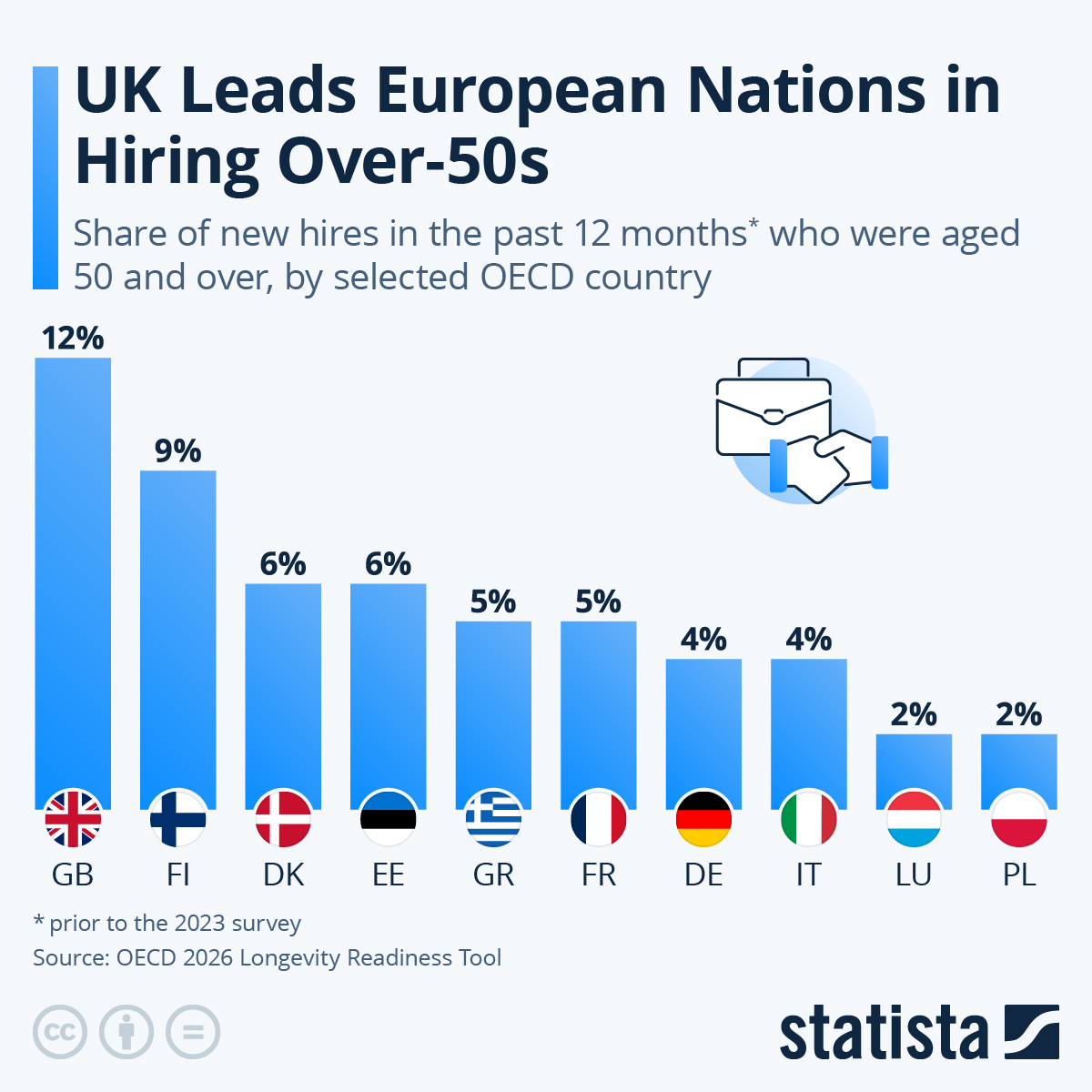
As Statista's Anna Fleck details below, the data reveals wide differences in how countries support older workers. In hiring, the United Kingdom ranked highest in Europe in 2023, with people aged 50 and over accounting for roughly 12 percent of new hires. Finland followed at 9 percent, while Denmark and Estonia each recorded 6 percent. Poland ranked lowest at just 2 percent.
You will find more infographics at Statista
By industry, the category of accommodation and food services hired the largest share of older workers at 11 percent, followed by administration and support services at 9 percent, while education lagged behind at only 3 percent.
Training opportunities also varied significantly across OECD nations.
In New Zealand, 49 percent of surveyed employees aged 50 to 65 said they had participated in employer-funded training programs, marking the highest share recorded. The United States followed at 48 percent and Czechia at 43 percent, while South Korea ranked lowest at just 5 percent.
Job autonomy showed similar disparities. In Japan, 92 percent of workers aged 50 to 65 reported having some control over the pace of their work, compared with only 61 percent in Sweden.
An OECD paper notes that hiring rates among older workers are shaped by several factors. Although wages and benefits often rise with age, productivity does not always increase at the same pace. At the same time, evidence suggests multigenerational workforces can strengthen productivity through knowledge transfer and accumulated experience.
Older applicants also continue to face age discrimination (particularly women), alongside employer concerns about adaptability, tenure and technological skills.
However, the OECD argues these barriers can be addressed through better training, fairer compensation structures and policies aimed at reducing age-related bias in recruitment.