The global consumption of clothing is enormous. However, a significant portion of the textile fibres is lost before the garments even reach the market.
“When we talk about textile waste, the debate often focuses on the clothes we throw away. But the problem starts much earlier,” explained former NTNU master’s student Rakib Ahmed, currently a researcher at SINTEF Industry.
The EU has introduced several initiatives aimed at collecting used clothing and managing the waste, once the garments are no longer in use.
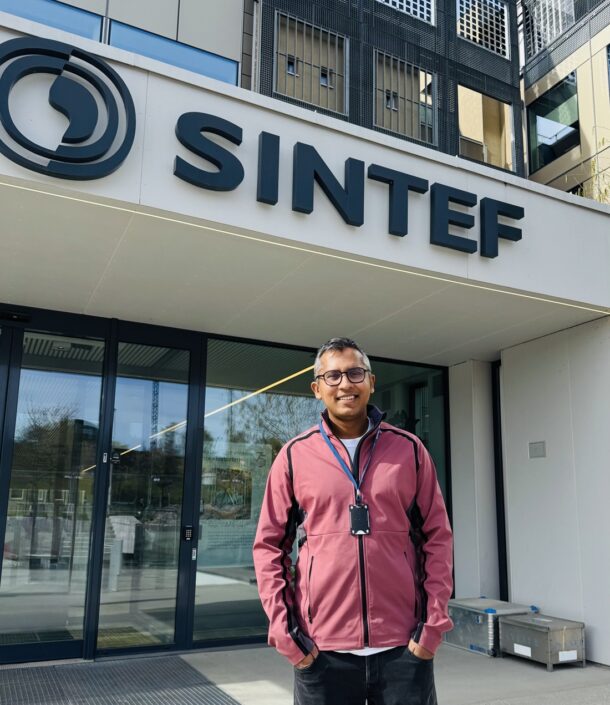
Rakib Ahmed. Photo: Private
“But much of the material used to make the clothes is lost before the garments even reach the consumer. This aspect gets far less attention,” he said.
Ahmed has recently written an article examining what percentage of textile fibres is lost in the process of making a finished garment. The work has been done as part of Associate Professor Johan Berg Pettersen’s research group at NTNU’s Industrial Ecology Programme and in collaboration with Senior Researcher Christina Meskers at SINTEF.
100 billion garments a year?
It is impossible to know exactly how many clothes we buy, and estimates vary widely. However, one thing we do know is that the environmental impact is enormous.
A common estimate is that the fashion industry accounts for approximately 10 per cent of global greenhouse gas emissions, which is significantly more than, say, air travel.
Large amounts of land are used to grow natural materials for clothing, but synthetic materials are far more common. In many countries, used textiles end up in landfill sites, where they take decades to decompose. In some places, the situation is even worse – used clothing is simply discarded in the natural environment. (See the fact box.)
How much clothing do we buy?
- One estimate suggests that just over eight billion people buy a total of between 80 and 100 billion items of clothing a year. At least ten items each, in other words. In addition, perhaps as many as 60 billion items of clothing are never sold, and often end up in landfills.
- Of course, these numbers vary a lot between countries and genders too. Norwegians buy just over 23 items of clothing a year. Americans buy 53 items each.
- On average, we own just over 350 items of clothing each here in Norway, but Norwegian women own about twice as many items of clothing as men do.
However, clothing consumption is a complex issue, and establishing exactly how much each of us actually consumes is very difficult.
“Many life cycle analyses of garments and material flows are based on the assumption that a garment is only used in one cycle and that the materials are not recycled. Focus is also placed on the situation in each individual country, rather than on a global scale. That makes it difficult to get a realistic picture of how much of the fibres we can recycle and reuse,” explained Ahmed.
Investigated a typical example
“We took a closer look at what happens to the fibres in a cotton T-shirt over the course of two consecutive life cycles. We combined a material flow model with a life cycle assessment,” said Ahmed.
The researchers assessed five types of environmental impact:
- Global warming
- Freshwater eutrophication (excess nutrients)
- Ecotoxicity in freshwater (spread of contaminants and environmental toxins)
- Water consumption
- Land use
In the example, production was assumed to take place in Bangladesh, and garment use and waste management took place in Norway. This scenario is considered a typical example.
44 per cent of the material lost before it even reaches the store
Fortunately, it is common for clothes to be reused, but sooner or later they are no longer worn. In practice, less than 1 per cent of used clothing is recycled into new textiles globally. Indeed, not all materials can easily be recycled.
“The results are quite clear. As things currently stand, we are able to recycle and reuse a maximum of 17 per cent of the original fibres in a new T-shirt,” Ahmed said. It is also important to bear in mind that this is for garments that are perhaps the easiest to recycle into new fibres.
You might be surprised to learn where most of the material is lost.

Johan Berg Pettersen. Photo: NTNU
“Most of the loss occurs at an early stage in the value chain. Approximately 44 per cent of the material is lost as early as the production stages,” said Ahmed.
European countries have increased their focus on the collection of used clothing.
“Since last year, Norwegian municipalities have been required to provide facilities for the collection of used textiles,” Berg Pettersen said.
“Here we can clearly see that if measures are going to be effective, they must also take the production process into account. There are significant environmental benefits to be gained by making production more efficient,” he said.
Three key figures from the study
- Less than 1 per cent of used clothing globally is currently recycled back into new textiles.
- A maximum of 17 per cent of the fibers in a t-shirt can be turned into a new t-shirt in today's system.
- 44 per cent of the material is lost during the production of the clothing.
More efficient production can reduce textile consumption
More efficient processes that involve less accumulation of waste and increased recycling of materials can make a big difference. This applies particularly to yarn production, but also to the processing of raw materials into finished textiles and to the production of clothing.

Christina Meskers. Photo: Private.
With improved methods, 44 per cent of the materials could be suitable for recycling, as opposed to the current 17 per cent. The researchers also estimated that greenhouse gas emissions could be reduced by approximately 10 per cent and other environmental impacts by 20 to 25 per cent. The conclusion is therefore straightforward: developing better systems for what happens after the clothes have been used is not enough.
“If the EU is to succeed in recycling a larger proportion of textiles, countries will have to shift their effort further up the value chain. This would lead to less waste and better use of resources in production,” concluded Meskers.
To achieve this, government authorities, brands and manufacturers will have to collaborate. This applies to every step of the flow, from raw materials to the finished garment.
Reference: Rakib Ahmed. Christina Meskers. Johan Berg Pettersen. The Journey of a Norwegian T-shirt: A Case Study of Fibre Material in the Clothing System. Journal of the Circular Economy. DOI: https://doi.org/10.55845/joce-2026-41250