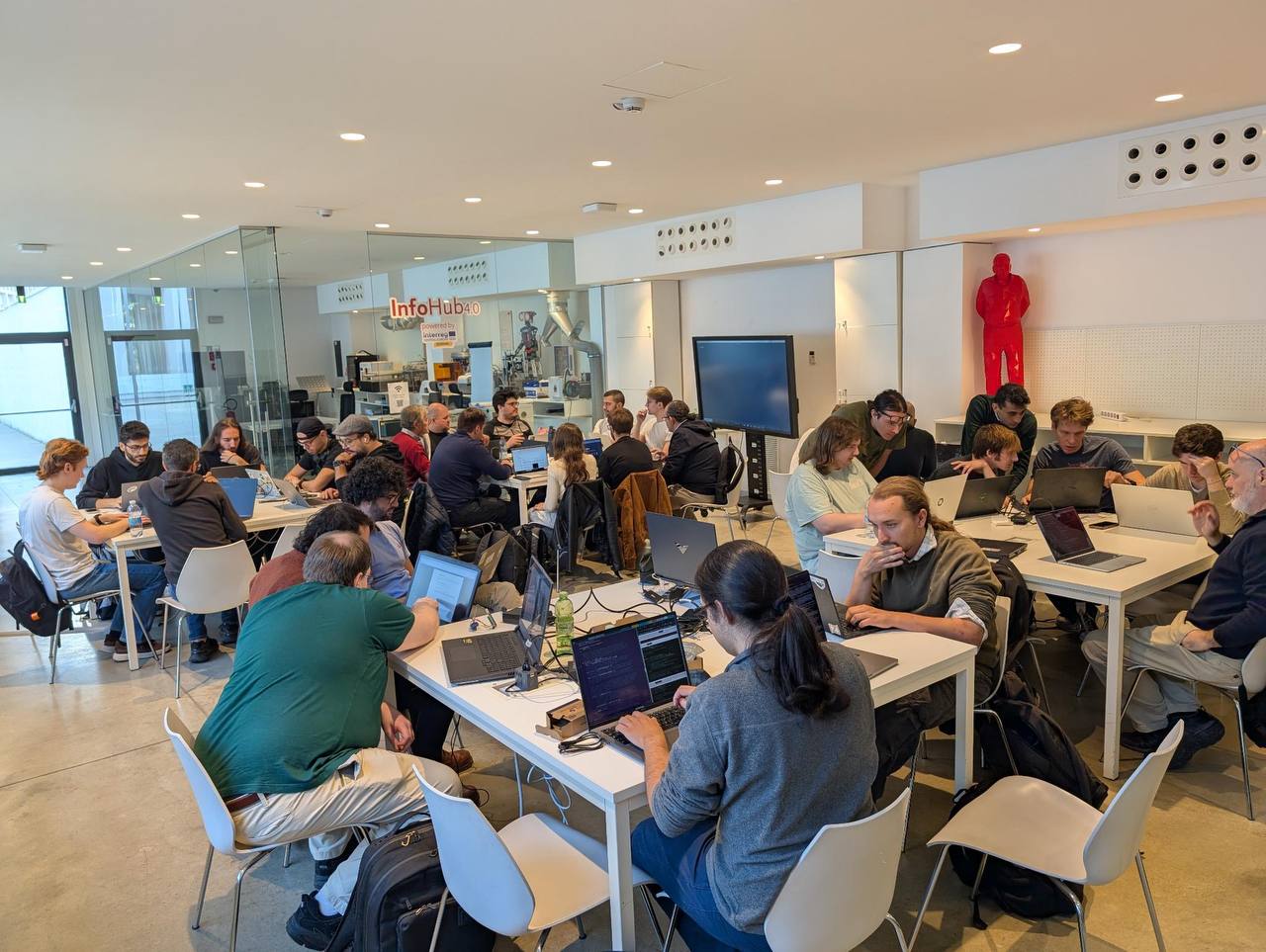
Zig Days are full-day collaborative programming events that usually take place on a Saturday.
People meet in the morning, introduce themselves, and mention what hobby/learning project they want to work on. Everybody is then free to form small groups or to work alone. At the end of the day, some Zig Days let participants demo what they worked on.
All the Zig Days are listed here: https://zig.day.

This is the flagship meetup format of the Zig community, and its main goal is to foster a community that enjoys and cares about applying systems thinking to create software you can love, as we believe it to be a key characteristic for growing a vibrant global Zig community.
These are the only hard rules that Zig Day organizers have to follow in order to be able to brand their event as a Zig Day.
So my advice (i.e. not a rule) is to deliberately try to limit the number of discussions about LLMs at Zig Days. We’re all being affected by what’s happening in the industry in 2026, and it’s totally fair to want to share thoughts and doubts with other people about what’s going on, but LLM-related discourse lately has been sucking all the air out of the room, leaving no space for other exchanges.
Zig Days are somewhat rare occasions to get together with other people who love thoughtful software engineering, don’t waste an opportunity to talk about data structures, algorithms, and approaches to problems that you’ve never seen before.
Additionally, I would also recommend limiting LLM usage during Zig Days. If you have a question, first see if there’s somebody in the room who can help you with it. Similarly, do the coding by hand. Don’t waste all the learning opportunities that you’re getting on an agent that will learn nothing at best, and that will become more effective at doing Amodei’s bidding at worst.
When you had a question at work in the past, you would be encouraged to ask your colleagues, while now these human interactions are being replaced by “just ask the AI”. Similarly, when you were handed a task near the edge of your ability in the past, you had to take your time to learn how to do it, while now you’re just being told to have the LLM quickly slop it up, leaving you with fewer learning opportunities.
Zig Days are your opportunity to help yourself and others near you be a bit less lonely, while deepening together your understanding of software engineering.
Maybe the guy who sells the shovels is right after all, and the best career move is to become proficient at buying more tokens orchestrating agents, but I would still recommend not putting all your eggs in one basket just yet because maybe – just maybe – there will still be some value in knowing how systems work, both to differentiate yourself from other developers career-wise, and as part of effective LLM steering.
And even if you have full confidence that the future of commercial software is strictly hands-off agentic coding, Zig Days are still for people who enjoy the act of programming, even if that were to become just a hobby.
If you’re a Zig Day organizer, my recommendation is to deliberately address this phenomenon at the start of the day. If you leave it completely unchecked, you risk having your Zig Day be inadvertently stripped of what makes it unique and worth getting up for on a weekend morning.
My recommendation is also to not choose an extreme approach (e.g. by completely banning LLM-related discourse) unless you feel very strongly about it. Clarify with attendees what Zig Days are for and ask them to try to make the most of the event (by having enjoyable exchanges that they would not be able to easily have elsewhere), and to protect what makes Zig Days special. That’s probably going to be enough.
