The United Nations estimates that 2.2 billion people lack safely managed drinking water, and communities from California to the Middle East rely on desalination plants to convert ocean water to fresh water. Common desalination techniques, such as reverse osmosis and thermal distillation, are energy-intensive, require pre- and post-water treatment, and leave behind a concentrated saltwater byproduct called brine. The brine byproduct wreaks havoc on sea life when it’s deposited back into the ocean by raising the salt level and lowering oxygen in the water.
But a novel approach developed at the University of Rochester offers a way to overcome these drawbacks. Researchers at URochester’s Institute of Optics developed a new solar-thermal desalination process to produce fresh water in an energy-efficient way that does not leave behind brine and requires no chemical additives to pre-treat the water. A team led by Chunlei Guo, a professor of optics and of physics and a senior scientist at URochester’s Laboratory for Laser Energetics, describes their method in a paper published in Light: Science & Applications.
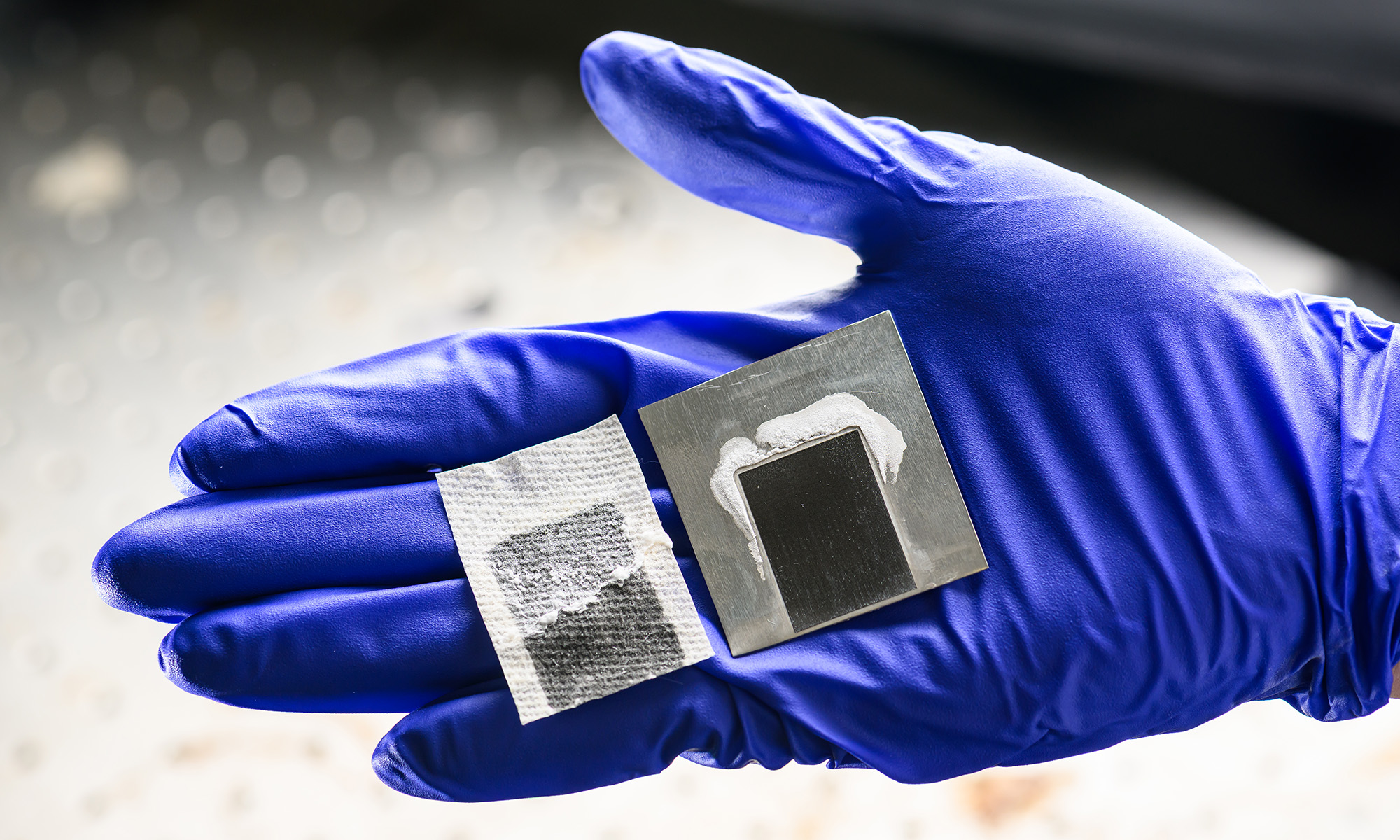
The technology uses solar panels made of black metal etched with femtosecond lasers to make the surface super light-absorbing and superwicking—or extremely attractive to water. The panels have a laser-treated active region that pulls a thin layer of water across the surface, absorbs nearly all solar radiation, distills the water, and deposits the leftover salts and minerals into the panel’s untreated sides or “passive” region so that the salt does not clog the active region and disrupt continuous desalination.
Leveraging the ‘coffee ring’ effect
Guo says other researchers have developed solar-thermal desalination techniques that work well in lab experiments using simulated seawater made of only water and sodium chloride. As the water evaporates, the sodium chloride crystallizes in a grainy and porous fashion allowing water to pass through to dissolve the salt. The solar panels, meanwhile, can be easily cleaned.
But real ocean has a much more complex composition, and these systems tend to encounter issues when tested in the field. Unlike sodium chloride, many other components in seawater, such as magnesium- and calcium-based materials, crystallize in a crusty and non-porous fashion on the solar panel’s surface, clogging it. Eventually, water can no longer seep through. This is the same phenomenon as your shower head clogging over time or your teapot lined with scales, except that seawater contains hundreds of times more salts than your tap water.
“Mining lithium from the earth has proven to be very taxing from an energy and environmental standpoint, so pulling lithium directly from saltwater could be a very important future route.”
To keep their solar panel surface from gumming up similarly, Guo’s team precisely etched the black metal’s grooves so the various salts and minerals in ocean water would simply slough off. They also leveraged a physical phenomenon that has plagued clumsy javaphiles for centuries: the coffee ring effect.
“If you drop coffee on a surface, eventually the water evaporates, and there’s a ring left at the outer edge that is the concentrated coffee particles,” says Guo. “We use that same principle to advance the salts to the passive region.”
Testing their solar-thermal desalination technique using samples of water from the Pacific, Atlantic, and Indian Oceans, Guo and his team were able to make the surface self-cleaning. In other words, it extracted freshwater and directed the remaining salts to the passive region where they could be later collected without reducing the panel’s efficiency.
Turning waste into resources
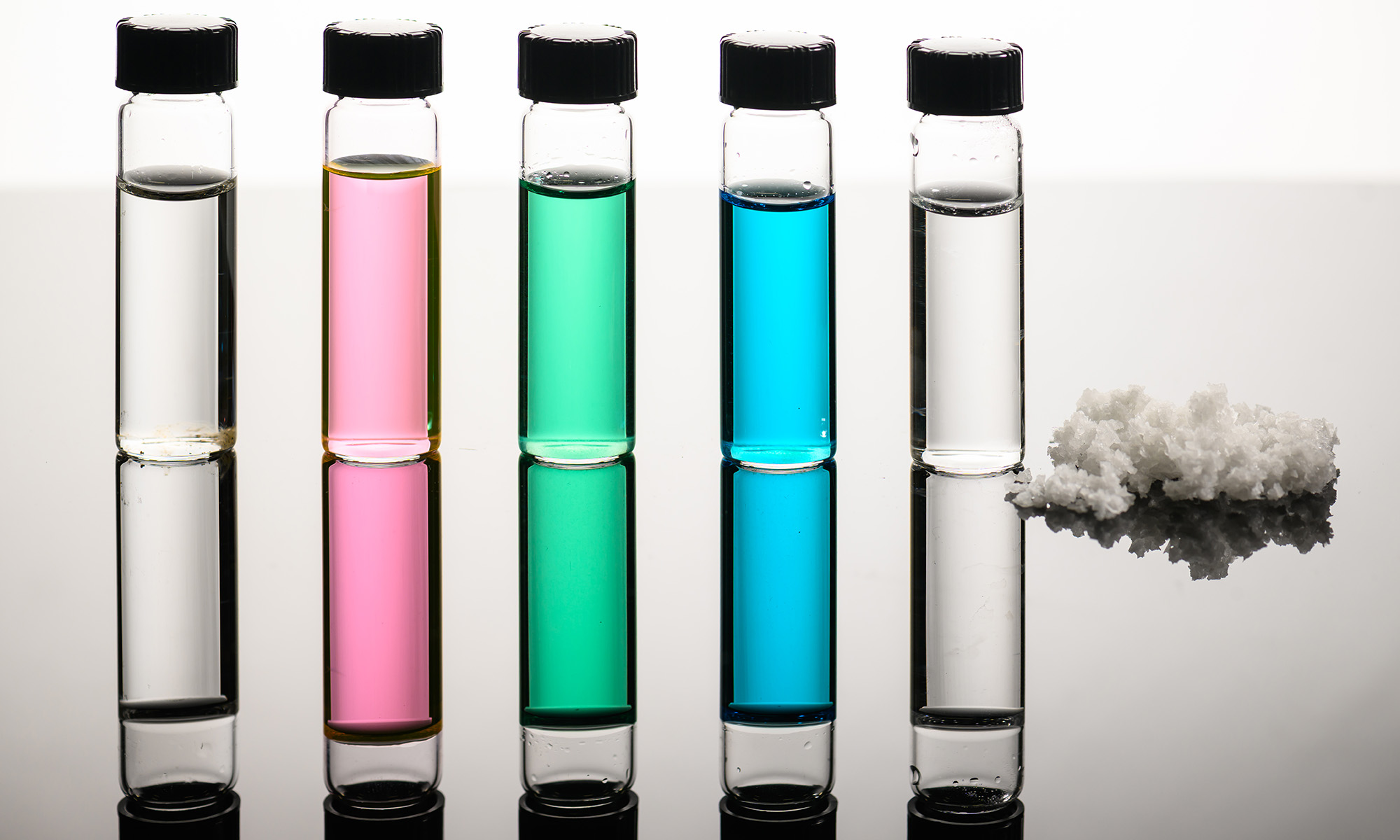
One of the new desalination method’s distinct advantages is that instead of leaving behind brine that must be disposed of or processed, it extracts nearly 100 percent of the salts in solid form. This could not only produce an abundant supply of table salt, but it could also be used to extract more precious minerals, including lithium, which is used in the lithium-ion batteries that power electric vehicles and other electronics.
In a related paper in the Journal of Materials Chemistry A, Guo and his colleagues show how they can use the same superwicking solar panels to separate lithium from the rest of other salts in desalination. Embedding nanoparticles made of hydrogen titanate in the tiny grooves of the black metal surface isolates the lithium from other salts and minerals.
“Mining lithium from the earth has proven to be very taxing from an energy and environmental standpoint, so pulling lithium directly from saltwater could be a very important future route,” says Guo.
Using water samples from Great Salt Lake, the researchers extracted about 50 percent of the lithium from the salts left behind by the desalination process.
Guo says now that the superwicking desalination technology has been demonstrated in proofs of concept on small-scale devices, he sees the technology inherently scalable, capable of improving global access to drinking water and building more sustainable supply chains for precious minerals.
The National Science Foundation, the Bill & Melinda Gates Foundation, and Worldwide Universities Network supported this research. Guo’s colleagues from the Institute of Optics who contributed to the research include Senior Scientist Subash Singh, alumnus Ran Wei ’24 (PhD), PhD students Luheng Tang and Tainshu Xu, and Mingjiang Ma.