On July 26, 2006, CHM curator Dag Spicer received an unexpected email from a freelance tax advisor based in Dortmund, Germany. It described what appeared to be a lost trove of rare computers abandoned in a warehouse in the town of Castrop-Rauxel.
Located in Germany’s industrial Ruhr region, the town was a center of coal mining and fuel production during World War II, and a frequent target of Allied bombing raids. Was it possible anything so important could have survived? The intrepid Spicer aimed to find out.
This is his account of what happened next.
Trip to Germany
Reviewing large-format photos of the site seemed to confirm the presence of several rare computing artifacts, just as the email had claimed. The Museum’s collections committee agreed that a visit was necessary to see exactly what was there and if any of it might be worth adding to the Museum’s permanent collection. After resolving logistical hurdles, fellow CHM curator Alex Bochannek and I flew to Germany. What we found was astonishing.
Inside a three-story warehouse the size of a jet airplane hangar, we encountered hundreds of historical computing artifacts. Spanning from the 1930s punched card era to obscure Cold War-era Eastern Bloc systems to more modern German and European computing systems, the warehouse was a treasure trove, a real-world timeline of computing history.
Overview of artifacts in the warehouse in Castrop-Rauxel.
Uncovering the Treasure
We now believe that much of the collection had been assembled by Professor Walter Ameling, who once held a chair in electronics and data processing at the Rogowski Institute for Electrical Engineering at RWTH Aachen University.
To understand everything that was in the trove, Alex and I implemented a 2m x 2m grid system—starting at “A1″—to organize our work across the warehouse’s 22 m x 50 m footprint (roughly 11,840 square feet). Each square was catalogued in a notebook with details such as manufacturer, model, and any markings from the Computer Museum of Aachen (CMA).
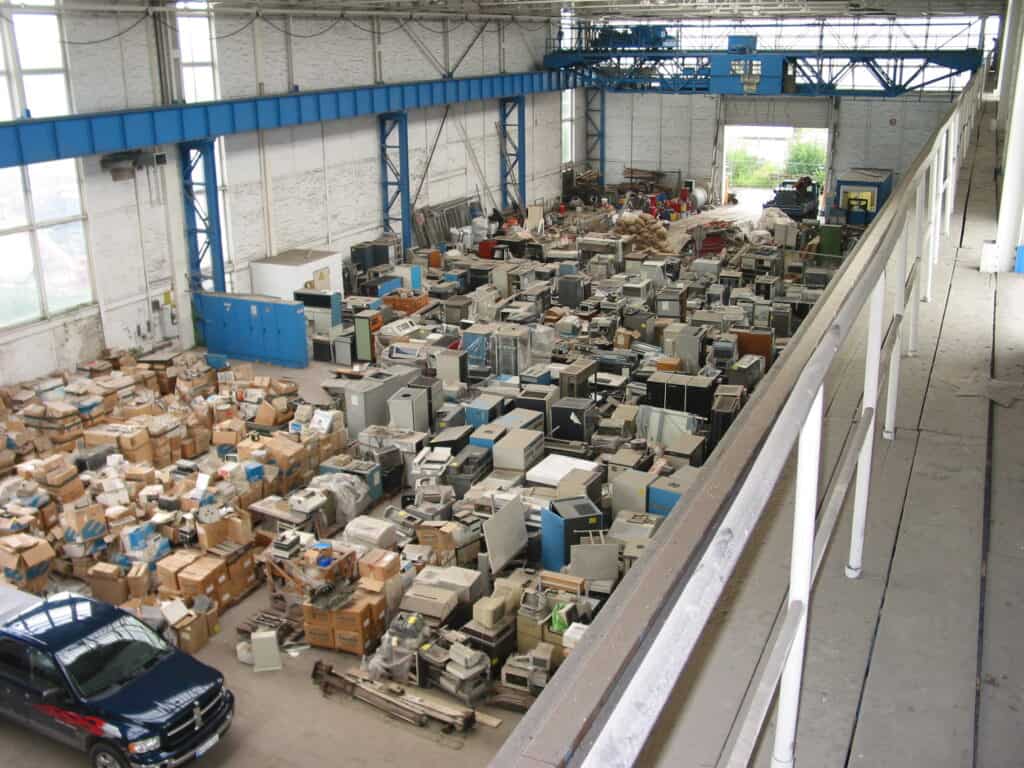
Overview of the collection in storage.
The first rows (A0–C13) mostly contained pallets stacked with documents and media. Despite occupying only 20% of the area, these items consumed nearly 40% of our time. Their condition ranged from water-damaged and moldy to surprisingly well-preserved. We encountered a wide variety of media: large disk packs, Diablo and RK05 types, paper tape, punch cards (both 80- and 96-column), magnetic tape, DECtape, magnetic strips, cartridges, and floppy disks—most of which contained source code or applications, with a few holding data.
The documents were especially rich, often representing complete sets of system documentation. We found engineering manuals, maintenance records, software guides, and marketing materials for systems from IBM, CDC, EAI, Siemens, Telefunken, CII Honeywell-Bull, and ICL. Other non-paper items on the pallets included small mechanical calculators, early business machines, spare parts, cabling, rack-mounted minicomputers, and CRT monitors.
The majority of the collection’s footprint was taken up by large computing hardware—mainframes, minicomputers, disk drives, line printers, and punched card equipment from the 1930s to the 1980s. We even found a cluster of Calcomp plotters with original company tags.
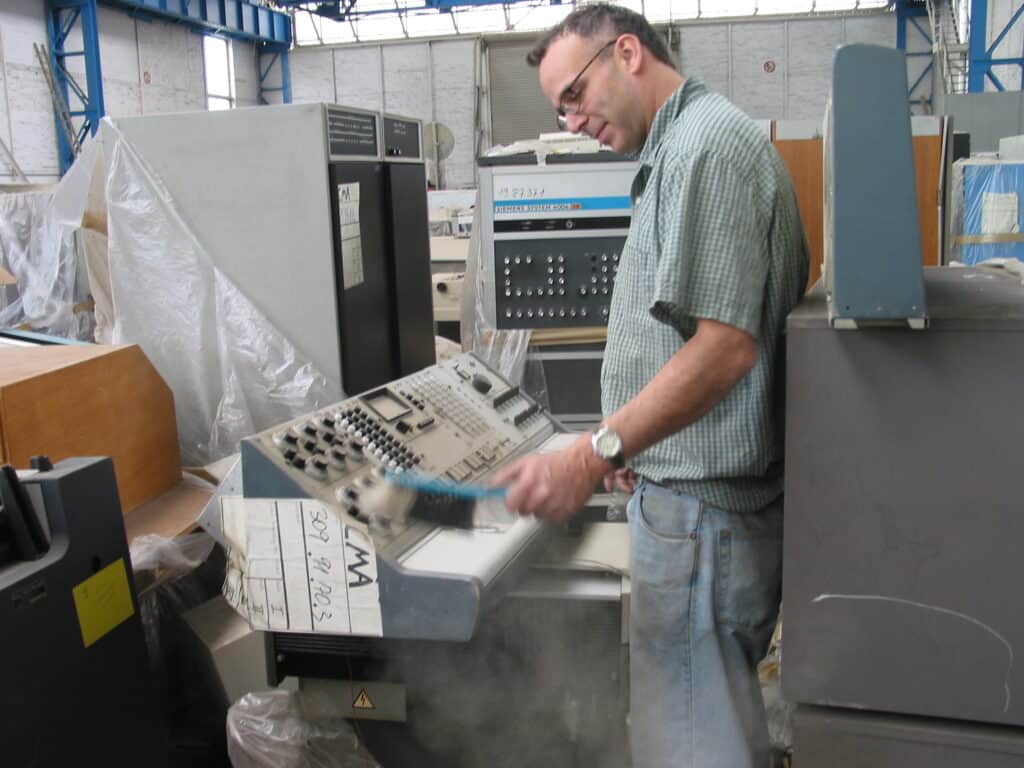
CHM Senior Curator Dag Spicer dusting off the control panel of an analog computer. Dag and fellow CHM curator Alex Bochannek were especially gratified to see several very important analog and analog/hybrid computer systems among the collection.
Assessing the Trove
Over the course of our ten-day visit, Alex and I plowed through the mammoth collection one object at a time, doing real-time history and curation to ensure a good fit with the goals of CHM’s permanent collection. We verified each item against our current holdings to avoid duplication, debated the object’s significance, and—if it passed muster—tagged it for shipment to our headquarters back home in Mountain View, California. We estimated that over 1,000 individual objects needed to be examined, evaluated, and cross-checked against CHM’s holdings.
Check out the slider below to see some of the artifacts we found.