My six-year-old son walked up to me yesterday. “What are you reading?”
At the time, I was reading part of Janis Voigtländer’s habilitation thesis. Unsure where to even start, I decided to just answer straightforwardly: “I’m reading a very long story about free theorems.”
He persisted. “What are free theorems?”
Never one to shrink from a pedagogical challenge, I thought for a moment, then began: “Do you know what a function is?” He didn’t. “A function is like a machine where you put something in one end and something comes out the other end. For example, maybe you put a number in, and the number that is one bigger comes out. So if you put in three, four comes out, or if you put in six, seven comes out.” This clearly made sense to him, so I continued, “The type of a function machine tells you what kinds of things you put in and what kinds of things come out. So maybe you put a number in and get a number out. Or maybe you put in a list of numbers and get a number out.” He interrupted excitedly, “Or maybe you could put words in??” “Yes, exactly! Maybe you can put words in and get words out. Or maybe there is a function machine where you put other function machines in and get function machines out!” He gasped in astonishment at the idea of putting function machines into function machines.
“So,” I concluded, “a free theorem is when you can say something that is always true about a function machine if you only know its type, but you don’t know anything about what it does on the inside.” This seemed a bit beyond him (and to be fair, free theorems are only interesting when polymorphism is involved which I definitely didn’t want to go into). But the whole conversation had given me a different idea.
“Hey, I have a good idea for a game,” I said. “It’s called the function machine game. I will think of a function machine. You tell me things to put into the function machine, and I will tell you what comes out. Then you have to guess what the function machine does.” He immediately liked this game and it has been a huge hit; he wants to play it all the time. We played it while driving to a party yesterday, and we played it this morning while I was in the shower. So far, he has correctly guessed:
I tried 


After a few rounds of guessing my functions, he wanted to come up with his own functions for me to guess (as I knew he would). Sometimes his functions are great and sometimes they don’t make sense (usually because his idea of what the function does changes over time, which of course he, in all sincerity, denies), but it’s fun either way. And after he finally understood 
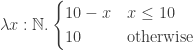
inspired, I think, by his kindergarten class where they were learning about pairs of numbers that added up to 
Definitely one of my better parenting days.