
Google AI better than human doctors at diagnosing rashes from pictures
原始链接: https://www.nature.com/articles/d41586-026-01947-1
随着人工智能日益融入职业工作流程,专家们对“去技能化”的风险表示担忧,即因过度依赖自动化工具而导致人类专业能力的退化。 近期研究(包括一项针对波兰内窥镜医师的研究)表明,这种风险是切实存在的。当经验丰富的医师使用人工智能辅助结肠镜检查工具时,一旦撤去人工智能,他们检测癌前病变的能力显著下降。这种下降表明,对人工智能的持续依赖可能会导致在必要任务中注意力和积极性的降低,以及认知参与度的减少。类似的担忧也出现在计算机科学等领域,相关研究正在考察人工智能助手如何影响软件工程师的问题解决能力。 调查显示,绝大多数医疗工作者担心失去自身技能,这一现象已成为一个重要的研究领域。研究人员强调,尽管人工智能带来了显著优势,但专业人员必须意识到技能退化的可能性。目前,尚无成熟的解决方案来缓解这一影响,因此在未来十年内,如何保持人类的专业能力已成为一项至关重要的研究课题。

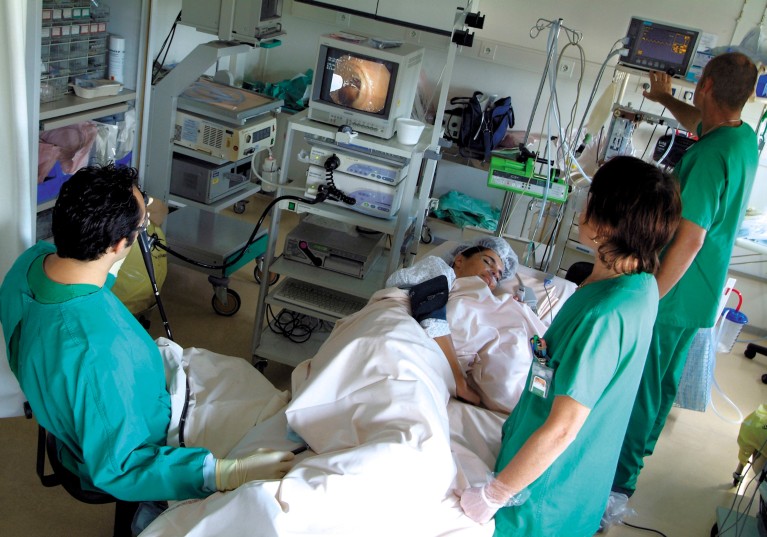
Physicians’ own ability to spot pre-cancerous growths during colonoscopies declined after they had grown accustomed to using an artificial-intelligence tool to help with the task.Credit: Gabrielle Voinot/Look at Sciences/Science Photo Library
As more professionals begin to rely on artificial-intelligence tools in their work, could their hard-earned skills atrophy?
That possibility is a growing concern for medical specialists, computer scientists and other workers. Seventy per cent of nurses and 77% of physicians, for example, are worried about losing their skills because of over-reliance on AI systems, according to a survey of US health-care workers published earlier this month1.
Their fear might be justified. Evidence suggests that AI-driven ‘deskilling’ is starting to happen in medicine, computer science and other fields. Researchers are now discussing how to preserve important human expertise in the age of AI.
“Just being aware that this phenomenon exists hopefully provokes some self-reflection about which skills people want to maintain and which they’re willing to outsource” to AI tools, says Kevin Crowston, an information scientist at Syracuse University in New York.
A study2 of physicians in Poland who specialize in endoscopy — the use of flexible probes to examine the inside of the human body — shows how quickly AI tools can erode human abilities. The physicians, who had all performed at least 2,000 colonoscopies during their careers, were given access to an AI system that analyses colonoscopy images in real time and flags a type of precancerous intestinal lesion called an adenoma. The tool was available to the specialists on some days but not on others.
Once physicians began using it, their performance dropped significantly whenever the system was unavailable. During the three-month period before the AI tool was introduced, the specialists found at least one adenoma during 28.4% of colonoscopies. During the three-month period after the tool was introduced, the adenoma detection rate for colonoscopies performed without AI assistance decreased to 22.4%.
Google AI better than human doctors at diagnosing rashes from pictures
The findings, published last October in The Lancet Gastroenterology and Hepatology, suggest that even highly skilled professionals might get worse at tasks that their job requires as they become more dependent on AI tools, says Robert Wachter, a physician at the University of California, San Francisco, who is the author of a book on how AI tools are transforming health care. The study authors say that continuous exposure to such tools can cause clinicians to become “less motivated, less focused, and less responsible when making cognitive decisions without AI assistance”.
Co-author Yuichi Mori, a physician-researcher at the University of Oslo, says that more studies are needed to confirm the phenomenon. But people who use AI tools should be aware that they risk losing some of their skills, he adds. “There is no established solution against deskilling right now. It should be a very hot research topic in the next decade.”
To investigate whether skills are being lost in the field of computer science, researchers at the AI firm Anthropic in San Francisco, California, designed a randomized controlled trial in which 52 software engineers were asked to perform a basic coding task3. During the exercise, all 52 participants could search the web and access instructions on how to do the task. Half of the participants were prompted to use an AI assistant as well.