Related to RIP software hackathons. Long live the hardware hackathon., I agree most software hackathons are busted, this is how I’m running one anyway.
Running a hackathon, software jam, or some assorted code adjacent competition has gotten significantly more awkward as of late. Stop me if you’ve ever heard of of the story of the AI B2B SAAS winning the competition, as the judges starry eyed fell in love with a ChatGPT wrapper. This sucks, but I still wake up every day and love software. There’s a craft to it, there’s still passion & people pouring hours of their life into making high quality software. I still want to write code. If you work in any field barring webdev it’s clear that software is not a solved problem. You still can’t one shot a good compiler, despite what Anthropic wants you to believe. Game jams still work, why don’t software jams work?
Even if we solve the “How to make software jams not suck?” huge massive problem. We still have have an auxiliary problem of funding prizes, giving people an actual motivation to participate, compete, and try to win. The typical pipeline of a hackathon is: beg enough local companies until they end up giving you money. I don’t know if that pipeline has changed post vibecoding heat death of the tech industry, because I can’t go that route. For some context I work for a charity Hack Club, which is a “nonprofit movement of teenagers making cool projects.” This makes securing funding for jams easier, you would think. Well it’s complicated.
Hack Club works on an hour based funding scheme. To maximize efficiency in running programs, every Hack Club program gets $8.5 per hour to spend on prizes; buy participants things, encourage them to engineer more. How do you find out how long someone’s spending coding? Well in years past it was a self report, give a ballpark estimate of how long you spent. When more hours means more money you can start to see an incentive to lie about time. Hack Club needed a better solution, that solution at least for coding (hardware is a separate mess of it’s own) was Hackatime. A server for wakatime that tracks how long you’re physically typing on your keyboard, then use that data to determine funding.
So the obvious model of a program run with this funding scheme acts like a hip and cool job. You work for X amount of hours on a project of your choosing, and the charity gives you that value as prizes. Sometimes those prizes are flights and events, which are great but you begin to notice another perverse incentive here. In an ideal world a participant would work on projects they’re interested in, those projects would be projects that improve their skill, and Hack Club is paying you to improve your coding. This dream sometimes is reality, but ugly incentives still rear their head. Why not just grind out lazy project after lazy project, rake in cash, learn nothing, and be happy? Yes you can augment hours with voting on a normal curve, so that on average it’s still $8.5/hr but penalize the lowest half and reward the top half. Again this is another solution that does improve things, but still sucks. You still make money working on lazy project after lazy project, and thus cost Hack Club money they’d rather not spend but can’t justify not giving you.
So what’s the solution? You’ve followed the map to this point, now you are here. I don’t know, but we’re trying to kill two birds with a software jam shaped stone. Here’s how:
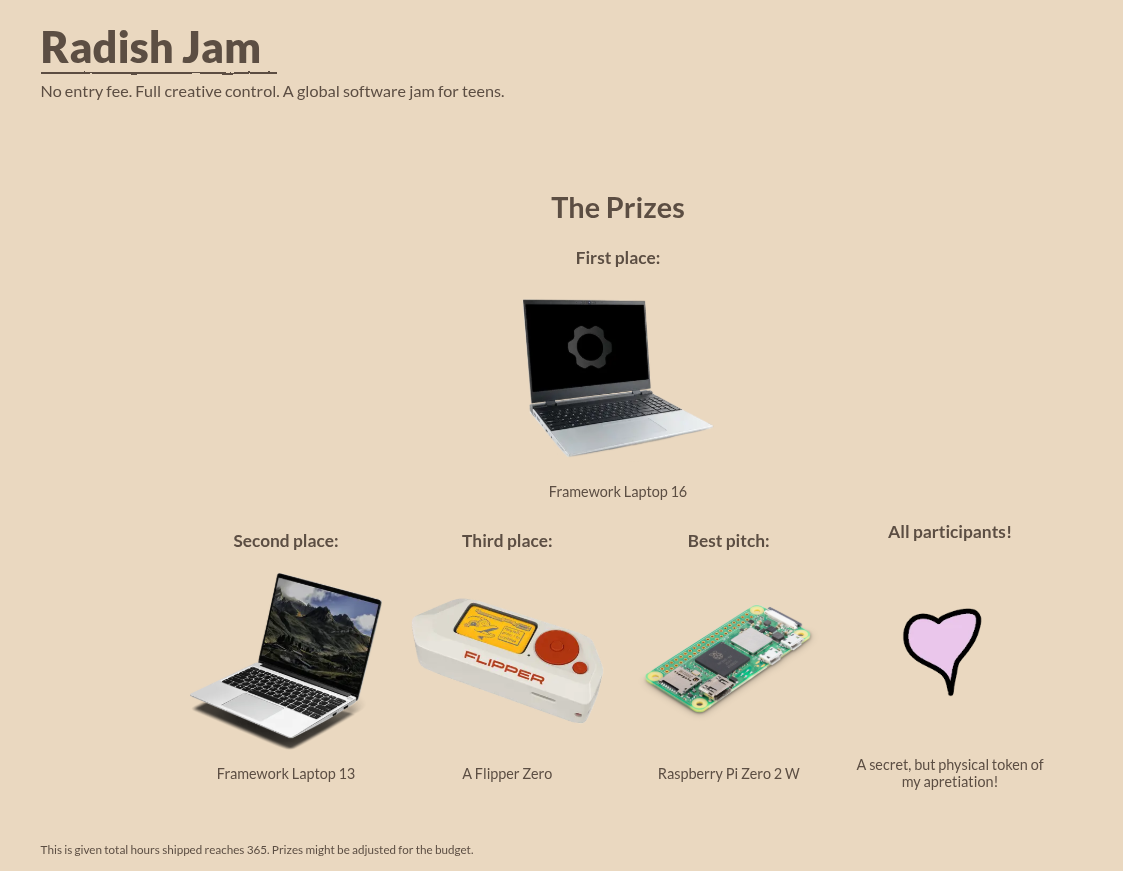
If you just want to cut to the chase you can see the website right now, radish.hackclub.com.
Why don’t people submit low effort games to game jams on mass, if it’s bad there’s still clearly a lot of heart and soul that made it there to the end. Why? Because you get nothing for making a bad game jam game. You get bodied in voting and all you are left with is the game, and you don’t like your own work, or you didn’t learn anything from the experience you wasted your time.
So we can use the jam solution to solve the Hack Club problem, but we’ve come full circle. We still have problems however with making software jams not suck. How do we fix that? Pretty easy, get better judges, be very clear with expectations (ie. Here’s some project ideas, notice none of them involve LLMs!), and the most crucial part, give people time to make nice code. Where we once had spaghetti we now have AI slop, no one wants to write either. We Stockholm syndrome ourselves into being okay with our captors with the sweet sweet phrase, “we’ll fix it later.” Write it good enough from the beginning and you’ll have jumpstarted a real project, something to build a success off of.
The last kink, I hand waived the Hack Club model’s connection to game jams, but now I shall explain. To make the hour model work, you need scaling prizes, the more people participate, the bigger the prizes. The only part of this that’s slightly awkward is that you have to advertise a rough ballpark estimate of the prizes, with a disclaimer that they change based on the budget of the program.
I’m still not quite happy with this, it’s really clunky and without a backing or a loan of hours, it means participants have to engage it a little bit of risky behavior. Ultimately, this is a fine price to pay in my eyes for a significantly better both software jam experience and as well as a more effective Hack Club program.
If you are a teen and have an interest in joining my software jam, you can find more info at radish.hackclub.com.
Feel free to email me at [email protected] if you need any help getting in the Hack Club system :)
