
Seth Stern is the director of advocacy for Freedom of the Press Foundation.

Jeremy Busby is a writer and activist incarcerated in Texas.
The Trump administration attacking the right to publish or report information is a given at this point. The president has threatened journalists for everything from questioning the wisdom of his failed war with Iran to touching the peeled lining of his renovated reflecting pool.
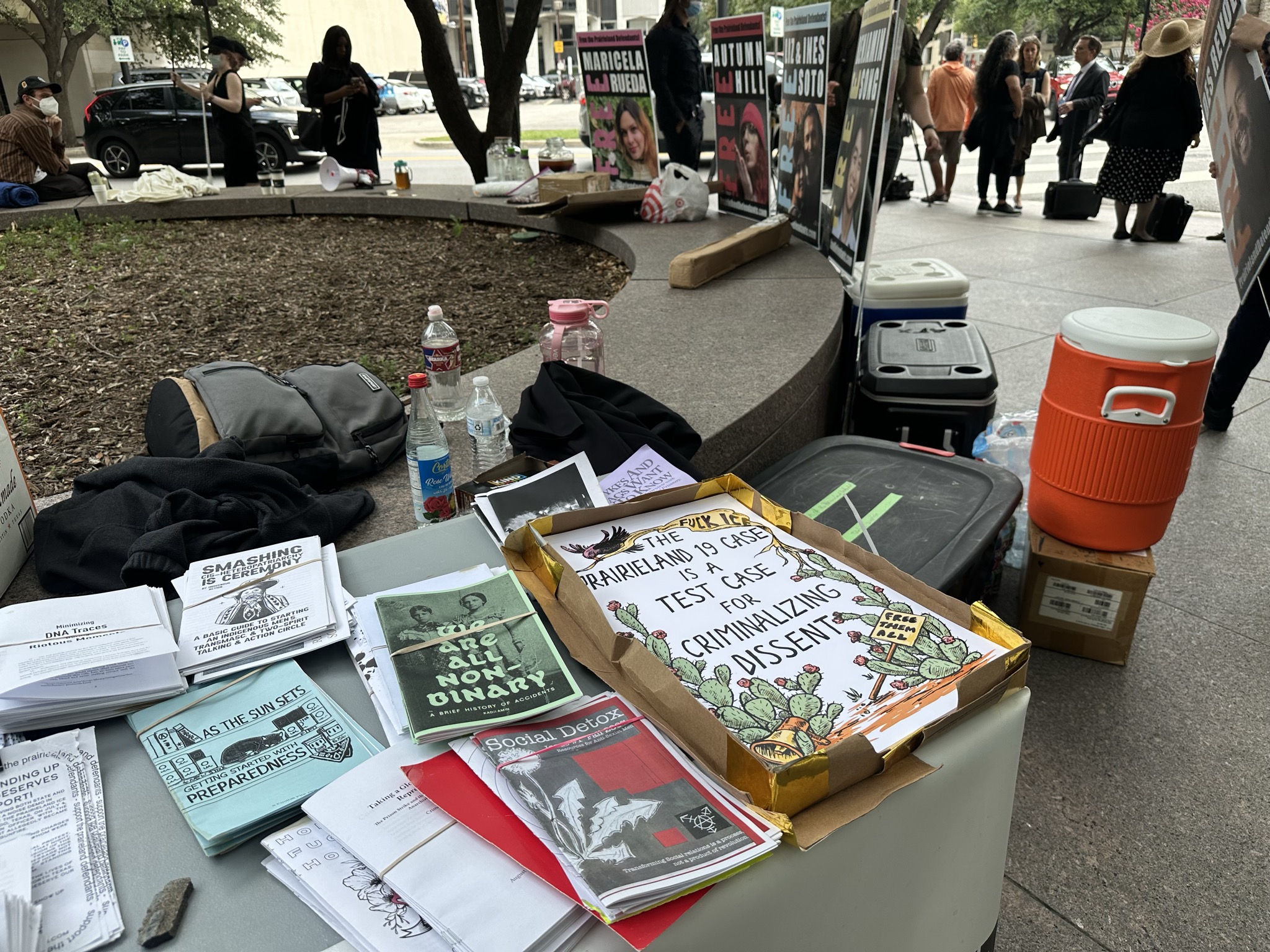
Tantrums like those may now feel routine, but this week marked a new front in Trump’s war on information: Daniel “Des” Sanchez Estrada was sentenced to 30 years in federal prison for transporting a box of zines he didn’t even write. He’s one of eight defendants sentenced on Tuesday to a combined 450 years — the first prison sentences against so-called “antifa” handed down under the framework of NSPM-7, President Donald Trump’s sweeping “counterterrorism” memorandum to clamp down on dissent from the left.
The prosecution’s theory was that Sanchez moved the zines, which discussed anarchism and other anti-government ideas, to conceal evidence in the case against his wife, Maricela Rueda. Rueda attended a July 4, 2025, protest at the Prairieland immigration jail in Texas where a police officer was shot. (She was not accused of shooting him or having anything to do with the shooting but was herself sentenced to 70 years.)
But that nuance is cold comfort: It assumes that simply possessing years-old political pamphlets that said nothing about the protest or shooting could somehow constitute evidence of a crime. Sharing the political ideology of the shooter, the government contended, meant Rueda and her co-defendants were culpable for the shooter’s actions — and by allegedly attempting to prevent officers from finding out about Rueda’s ideology, Sanchez shared in the blame as well.
We’ve reached the point in the erosion of the First Amendment where the government considers possession of anarchist zines and membership in a terrorist cell to be more or less the same thing. Once the box of zines was discovered, there was no need to prove Rueda planned or had any idea that anyone would be shot at the protest.
What’s worse is that this will likely only ramp up the administration’s efforts to criminalize being in possession of information. Whatever you may think of former CNN host Don Lemon, he’s no anarchist or extremist, and the content of his broadcasts bears little resemblance to the zines Sanchez was convicted of transporting. And yet, after indicting him and independent journalist Georgia Fort on frivolous charges relating to their livestreaming of a protest at a Minnesota church, the government sought a warrant to obtain the identities of subscribers to their YouTube channels.
This will likely only ramp up the administration’s efforts to criminalize being in possession of information.
Fortunately, a judge rejected that warrant. But it’s a chilling revelation of the administration’s modus operandi. Lemon and Fort’s YouTube subscribers would, of course, have no knowledge of what happened at the church protest beyond what was publicly broadcast. Their identities are as irrelevant to whether Lemon and Fort committed a crime as the box of zines was to Rueda’s case. The only conceivable reason the government might want a list of YouTube subscribers is to keep an eye on people who watch disfavored shows.
And let’s say someone who’d watched Lemon and Fort’s livestreams and then heard about their arrests had cleared their browser history because they (rightly) feared the administration might target them. Could they then be prosecuted for concealing evidence under the same logic applied to Sanchez? If they’d downloaded the video, could they be accused of possessing contraband? Would forwarding a link equate to trafficking?
It all sounds preposterous, but virtually nothing is too absurd for this Department of Justice. In fact, it’s already argued that documents investigative reporters receive from whistleblower sources can constitute contraband. (It’s worth pointing out that Joe Biden’s DOJ used this same logic when it pursued its own ridiculous “transporting” of information case against Project Veritas for moving Ashley Biden’s diary across state lines).
These frivolous actions create a catch-22 for all Americans. The more people are investigated for engaging with ideas the administration deems dangerously anti-government, the more likely others are to conceal evidence of their own controversial beliefs — not because they are evidence of any real crime but because prosecutors are out of control. But if they do so, they risk incriminating themselves.
NSPM-7, which was issued last September, tasks federal agencies with dismantling networks of “anti-fascist” actors, a purposely overly broad term since expanded to include those with “extreme viewpoints on immigration, radical gender ideology, and anti-American sentiment.”
Given that antifa, as a singular, cohesive organization, is a figment of the right’s imagination, agents cannot accomplish that task by uncovering a membership registry. They can only do so by identifying people with viewpoints they consider “extreme,” like anti-ICE protesters officers have told they’re being added to watchlists, or pro-Palestine opinion writers they’ve sought to deport.
In Chicago and other cities ICE invaded, activists and organizers packaged whistles and zines to distribute to residents. Under the logic of NSPM-7 and Sanchez Estrada’s conviction, that is a network of actors engaged in organized political violence. If you read one of their zines, you could be deemed a member of an illicit enterprise, and if you hide one, you’re covering for criminals.
The government argued that the Prairieland defendants are different. One prosecutor said: “People with that kind of extremist beliefs need extra time in prison. They believe violence is justified.” U.S. District Judge Reed O’Connor, in handing down the sentences, reportedly said he wanted to “send a message to anyone who shares a similar ideology.” But lots of people believe political violence is sometimes justified. If someone who believes punching Nazis is justified attends an anti-Nazi protest where someone else punches a Nazi, are they at risk of being convicted of assault alongside the actual assailant, particularly if they have some anti-Nazi literature on their bookshelf? The answer is far less obvious than it used to be.
The administration has vowed the Prairieland case “will not be the last” of its kind. We must take it at its word. The next one might also involve protesters from the political fringes rather than ordinary Americans reading, say, The Intercept, or watching Don Lemon on YouTube. But what about the one after that? We’re not as far away as you might think. Stephen Miller has called the whole Democratic Party a “domestic extremist organization” — clearly invoking the language of NSPM-7. Trump has labeled his political opponents “the enemy within” and the press “the enemy of the people.”
Whoever said slippery slopes are a fallacy never met Donald Trump. If Sanchez Estrada indeed moved the zines because he foresaw their being used to tie his wife to a nonexistent terrorist network and a shooting, he should be commended for his prescience. Maybe more of us should think like Sanchez Estrada.
Or would that be a crime?