The world’s tallest tropical trees have no trouble pumping water to their topmost branches, new research reveals.
Conventional scientific theory suggests that as trees grow, it becomes harder to transport water from roots to leaves – limiting growth and making trees more vulnerable to drought.
But the new study – led by the University of Exeter and Cardiff University and published in the journal Science – finds that adjustments to water transport inside giant Dipterocarp trees “fully compensated” for the challenges of drawing water to the top.
As a result, the height of these trees does not make their water systems more vulnerable to drought compared to shorter trees, and separate testing found they suffered no height-related loss in growth (compared to smaller trees) during a severe drought.
“Trees contain lots of thin, hollow vessels and they suck water upwards by creating low pressure at the top,” said Professor Lucy Rowland, from the University of Exeter.
“These vessels have evolved intricate adaptations that can maintain the water in liquid form, even under the extreme low pressures required to move to the top of trees which can reach over 80 metres.
“However, a widely accepted theory suggests that in tall trees, the sheer length of vessels and the effects of gravity limit water transport, photosynthesis and growth.
“Our results challenge this by showing that the hydraulic systems of very tall Dipterocarp trees are perfectly evolved for their height, and should not suffer more than small Dipterocarp trees exposed to the same drought conditions.”
Dipterocarp species are the tallest flowering trees in the world and dominate Asian rain forests.
The researchers examined Dipterocarp trees ranging from 7 to 71 metres tall in Malaysian Borneo, and measured a variety of traits at multiple positions along each tree.
They found that taller trees compensate for their height in various ways, including water-carrying vessels that grow wider nearer the ground and leaves which have adapted to withstand greater water stress before wilting. They also measured trunk growth rates before, during and after the strong El Niño drought period of 2023-2024.
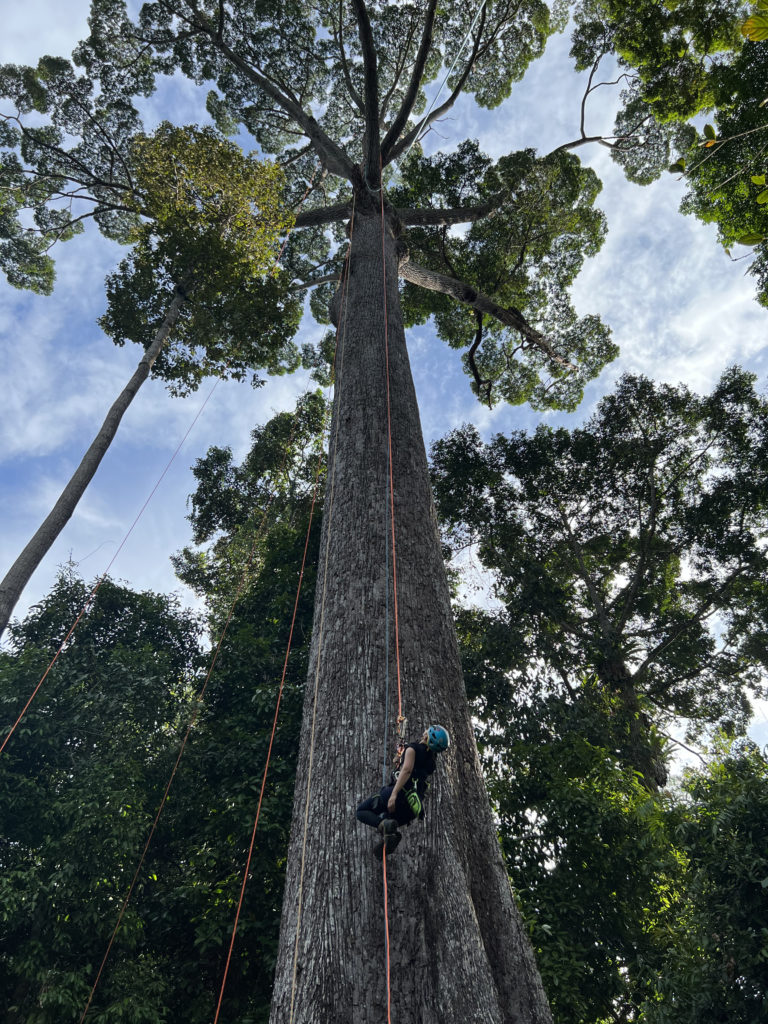
“Understanding tall trees is vital because the tallest 1% of trees store more than half of above-ground carbon in forests,” said Dr Paulo Bittencourt, now at Cardiff University.
“These trees are rare and important, and existing predictions suggest a weaker hydraulic system places them at higher risk of dying due to drought.
“That prediction is included in some models of climate-change impacts, and our study suggests this may not be correct.
“More research is now needed to investigate the hydraulic systems and drought resilience of other tall trees.”
Co-author Palasiah Jotan, a Malaysian PhD student studying in The Czech University of Life Sciences, said: “Dipterocarp trees dominate the rain forests of Malaysian Borneo and are central to the region’s ecology and biodiversity.
“As a Malaysian researcher co-authoring this study, showing that even the tallest of these trees are hydraulically resilient to drought is a finding I hope will strengthen the case for protecting these forests under a changing climate.”
The research team included Sabah Forestry Department (Malaysia), the UK Centre for Ecology & Hydrology and the University of Aberdeen, as well as institutions from the Czech Republic, Germany, Spain, Brazil and the USA.
The study was funded by the Natural Environment Research Council.
The paper is entitled: “Height does not impair the hydraulic system of the tallest tropical Dipterocarp trees.”