My book club is reading Abundance by Ezra Klein and Derek Thompson this month. The core idea fits on a napkin, so before the meeting I decided to actually check it against real data. Here's what I found, and where it fell apart.
The idea, in one picture
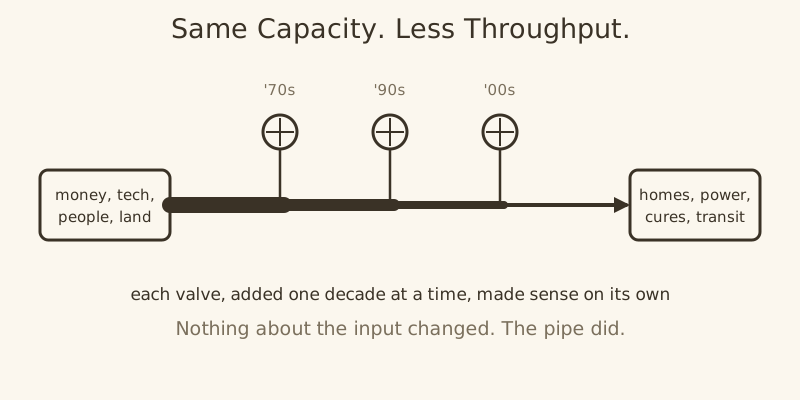
Housing, clean energy, cures for disease. The inputs to all three haven't really moved. Money's there. Technology got cheaper, not more expensive. Roughly the same number of people know how to build this stuff as always did.
What changed is the pipe between the inputs and the output.
Over the decades, every time something went wrong, somebody added a valve. A highway almost bulldozed a neighborhood in the '70s, so now there's a checkpoint for that. An environmental study got added in the '90s. By the 2000s you needed a public comment period too, sometimes more than one. None of these were dumb decisions in isolation. Each solved something real. But stack enough of them and the pipe might as well be shut, even though nothing on the input side changed at all.
Klein and Thompson call this chosen scarcity. Anyone who's inherited a legacy codebase already knows the pattern under a different name: unaddressed technical debt. A pile of individually-reasonable shortcuts, left unrefactored for so long that the system's throughput has almost nothing to do with its actual capacity anymore.
I liked the idea. I also didn't fully trust it. So before the meeting, I ran the numbers.
Test one: does the throughput number actually check out?
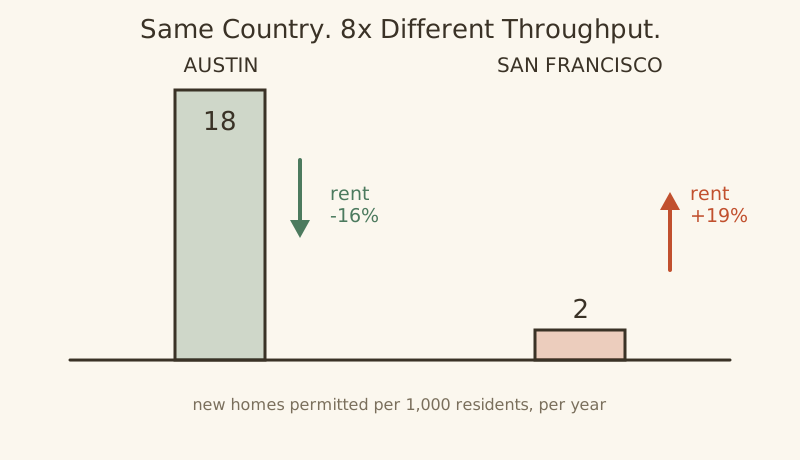
I compared two U.S. cities that get cited constantly in this debate: Austin, which started clearing its own valves out around 2015, and San Francisco, which mostly didn't.
The gap is not small. Austin permits roughly 18 new homes per 1,000 residents every year. San Francisco permits about 2. Eight times the throughput. Same country. Same everything, really, except the rules.
I ran the actual arithmetic using an elasticity number borrowed from a housing study out of Auckland, New Zealand, where a comparable policy change happened and got carefully measured.
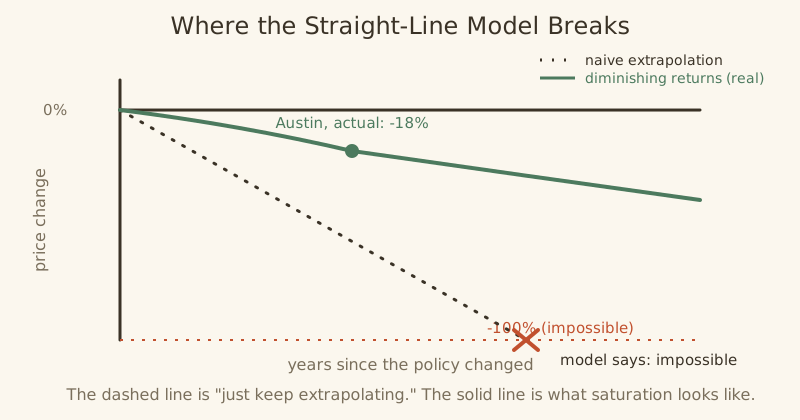
Extrapolated ten years out, Austin's predicted price effect blew past -100 percent, which is obviously impossible. That's useful, actually — it means you can't stretch a small, well-measured experiment out to ten years and still trust the exact number it spits out. Markets saturate. Construction costs and demand put a floor under how far prices can fall, and Austin landed on that curve instead of the dashed line.
San Francisco's model predicted something like an 11 to 19 percent rent decline. Instead, rent there is rising faster than almost anywhere else in the country right now, up nearly 19 percent over the past year. Turns out an AI hiring boom rolled through right when the small supply gains were supposed to show up, and a model that only tracks supply has no way of seeing that coming.
Test two: the case that broke my model completely
Then I checked a pair I expected to tell the same story: Vienna versus London.
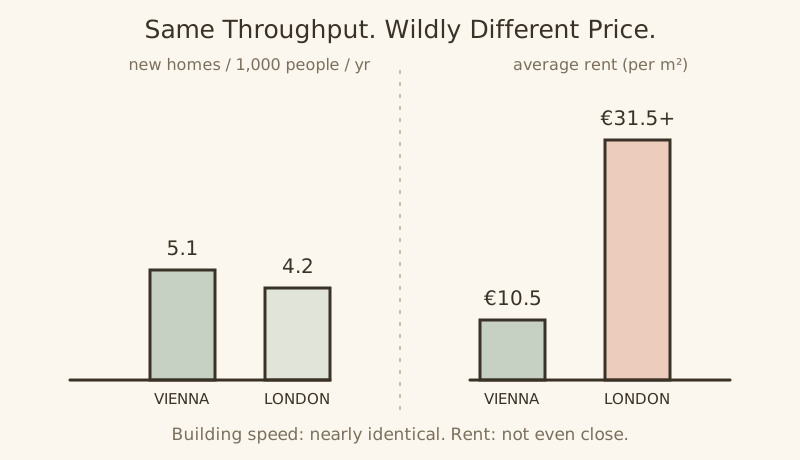
Here's where it got weird. Vienna and London build housing at almost the same rate, barely a 20 percent difference. If clearing the pipe were the whole mechanism, their prices should look almost identical.
They don't. Vienna's rent is roughly a third of London's, and has stayed flat for two decades.
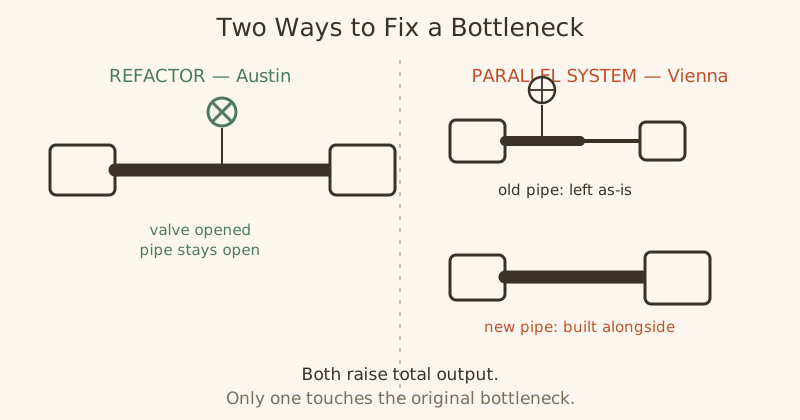
The reason has nothing to do with permitting speed. Forty-three percent of Vienna's housing stock is public or nonprofit housing, running alongside the private market instead of depending on it to eventually get fixed. It's the housing-policy version of the strangler-fig pattern: instead of refactoring a legacy system riddled with a decade of shortcuts, you stand up a clean system next to it and let it carry the traffic that matters most. Combined with old rent-control rules on the pre-1945 stock, that parallel system is what actually holds prices down. London never built a second pipe. It just kept adding valves to the one it already had.
This matters more than it looks. The book's whole argument is: clear the pipe, let the existing system move faster. Vienna barely touches that lever. It built a second system that doesn't need the first one fixed to work at all. Both approaches raise total output, but only one of them shows up in the book.
What I'm actually taking into the meeting
So what's the actual takeaway here?
Mostly this: the mechanism is real, but only when you can isolate it cleanly. Austin shows that. So does the documented policy change in Auckland and Minneapolis. Clear the pipe, throughput goes up, and prices come down in a way you can actually measure.
But Vienna is the one that's going to stick with me, because it's proof this isn't the only lever available. Anyone telling you a genuinely messy problem has exactly one fix is skipping a step, even when the fix they're describing is real.
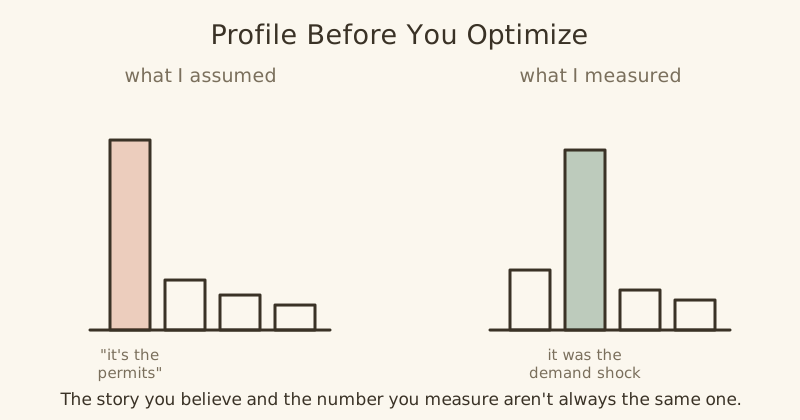
And honestly, the habit I want to keep out of all this has less to do with housing than with how I plan to evaluate the next big claim somebody hands me. Profile before you optimize. Don't assume you already know which function is slow, check. Before a compelling story gets to explain what you're seeing, spend two minutes running rough numbers on it yourself. You won't always get proof out of that. But you'll see fast which parts of the argument are load-bearing and which ones just sound right.
Less “was the book correct” and more “what's the cheapest way to check whether a claim is even the right order of magnitude.” Most of the time, that's enough to tell you which parts to trust.