
IBM shares plunged almost 20% in premarket trading, putting the stock on track for its worst intra-day collapse since Oct. 19, 1987.
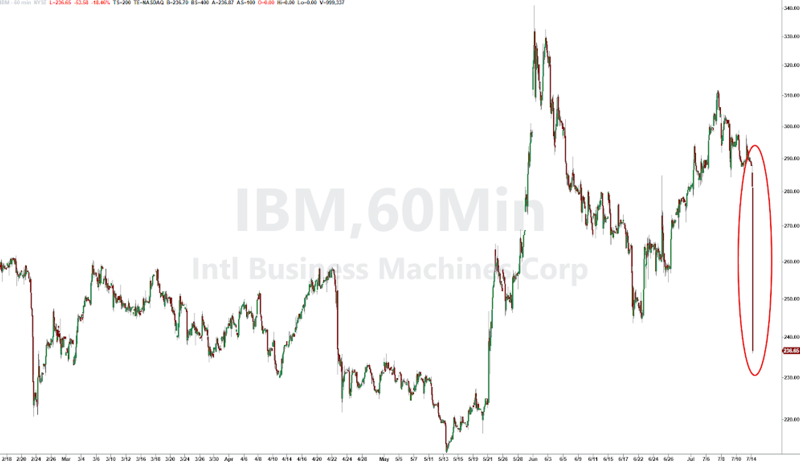
Worse than the Dot Com crash...
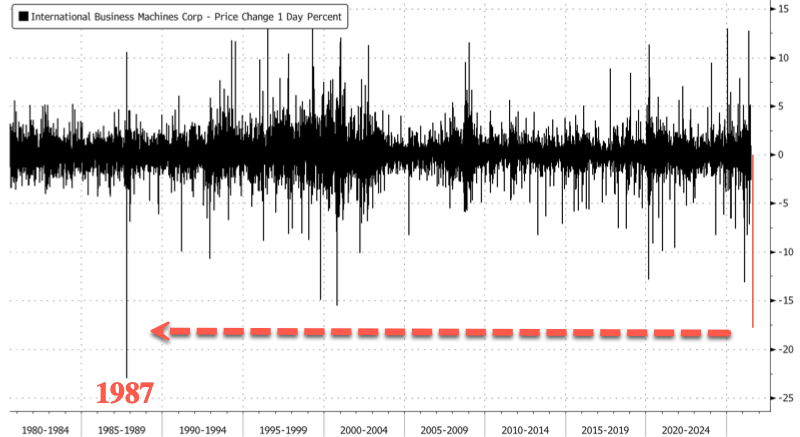
The catalyst for the selloff was IBM CEO Arvind Krishna's letter to investors outlining preliminary second-quarter results.
Here is what's key:
- IBM CEO: DID NOT ANTICIPATE MAGNITUDE OF CAPEX REPRIORITIZATION
Traders were likely caught off guard by a 7% decline in infrastructure revenue, raising new concerns about demand across one of IBM's key business segments.
Here are the preliminary 2Q results:
-
Revenue of $17.2 billion, up 1 percent
-
Software revenue up 5 percent
-
Consulting revenue flat, up 1 percent at constant currency
-
Infrastructure revenue down 7 percent
Krishna detailed in the letter to investors that customers unexpectedly redirected their June technology budgets toward servers, storage and memory to secure scarce equipment before anticipated price increases.
In return, that left less money and management attention available for IBM's z17 mainframes and related transaction-processing software. Deals IBM expected to close during the quarter were delayed or pushed into later periods, rather than necessarily canceled outright.
Here are Bloomberg headlines:
Signaling a return to the SaaSpocalypse (client spend shifting from commoditized software to constrained hardware), Krishna wrote:
When we discussed our expectations with you in April, we noted that we would be wrapping on the launch of z17 in the second quarter.
Given this was the strongest start to a mainframe program in our history, we expected Infrastructure revenue to decline low-single digits for the year, beginning this quarter.
What played out was worse than our expectations, driven by a shortfall in our Z performance and the associated software stack, primarily in Transaction Processing.
In the last few weeks of June, we saw clients shift their quarterly capex spend toward servers, storage, and memory purchases to secure supply-constrained infrastructure ahead of expected price increases.
This dynamic impacted client buying patterns. While we anticipated some supply chain related impact in our expectations, we did not anticipate the magnitude of the capex reprioritization.
In addition, clients were distracted with rapidly-evolving, industry-wide cybersecurity concerns in the quarter.
Krishna also admitted: “We did not adapt and move quickly enough,” with large deals failing to close on expected timelines."
The key question is whether IBM is emerging as an early warning sign that the AI boom is beginning to crack, with a potential "token revolt" taking shape as customers push back against surging AI costs.