“Billionaires could fund cures for cancer — so why are they funding glasses for perverts instead?" asked the protest group Everyone Hates Elon.
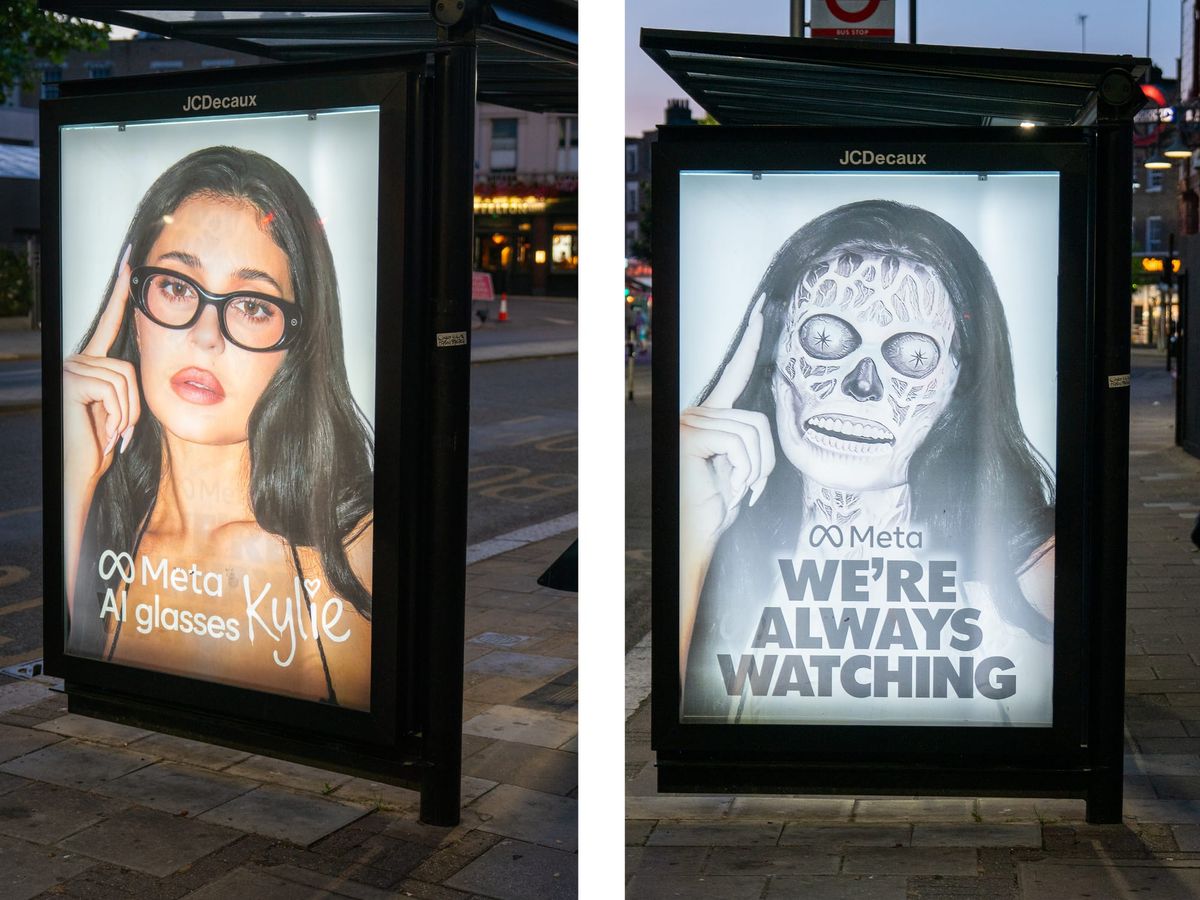
The social media giant Meta partnered with controversial TV personality and cosmetics mogul Kylie Jenner for the design and marketing of an “entry-level” line of its widely criticized camera glasses late last month. The collaborative campaign quickly provoked a wave of public backlash over unresolved concerns about privacy, consent, and personal safety as surveillance technology rapidly evolves.
Based in the United Kingdom, the class-based activism group Everyone Hates Elon (EHE) visualized those concerns in a lenticular spoof ad that, based on where a viewer is standing, flips between a branded marketing photo of Jenner wearing a pair of Meta glasses and a black-and-white image showing a skeletal, X-ray version of her with the tagline “We're always watching.”
The transformation element and the poster design appear to reference the politically charged sci-fi film They Live (1988), in which the main character encounters a pair of sunglasses that not only expose the extractive messaging of advertisements but reveal that humanity is being controlled, subdued, and exploited by a secret population of aliens masquerading as people. In the film, it's later revealed that some humans have accepted monetary bribes to collaborate with the aliens.
Known for its public interventions on both sides of the Atlantic, EHE had its affiliated activists install the mock advert at a bus stop near Meta's London headquarters as a sardonic confrontation of the company's encroaching surveillance mechanisms.
A visual depiction of the ad's transformation from different angles
Meta launched its first Ray-Ban smart glasses line, which allowed for up to 30 seconds (later one minute) of camera recording, in 2021. Now, the product's latest generation allows for three minutes of consecutive recording, leaving more people wary about unknowingly being recorded in public, as well as what that footage could be used for.
“Meta has spent years tracking us online,” said a spokesperson for EHE in an email to Hyperallergic. “Now it wants to track us in the real world too.”
In an effort to assuage concerns about the glasses secretly recording people, Meta said it would roll out a software update that would disable the camera if the built-in LED recording light was obscured or damaged. However, the product has already been derided extensively online, especially because of its recent popularity with “Manosphere” content creators who post point-of-view recordings of them cold approaching (see: sexually harassing) various women in public without their knowledge.
“Meta and Ray-Ban’s new AI glasses can be used to secretly record women and young people for sexual reasons,” the EHE spokesperson continued in their statement to Hyperallergic. “Simply put, that’s abuse.”
The chasm between legality and ethics continues to widen as the use of smart glasses poses additional risks at sites of expected privacy, including hospitals, restrooms, fitness spaces, locker rooms, and private businesses. In 2024, Harvard researchers were able to run facial recognition software on recorded footage from Meta's Ray-Ban glasses to successfully locate the names, addresses, and other personal information of passersby from public databases.
Morality aside, privacy law also hasn't kept up with the speed at which the smart glasses and other AI technology that processes and learns off of biometric data are evolving, let alone hitting the market.
Therefore, EHE poses one simple question: “Billionaires could fund cures for cancer — so why are they funding glasses for perverts instead?"