We built a drawing arena: hand a model a blank white canvas and a set of colored-pencil tools, then get out of the way. The model sets a color, tip width, and pressure, lays down batches of strokes, smudges to blend, erases, and calls view_canvas to see its own work and decide what to fix. It either reproduces a target image or draws from a text prompt.
We ran four vision models, GPT-5.6 Sol, Claude Fable 5, Grok 4.5, and Gemini 3.6 Flash, across two targets (the Mona Lisa and Van Gogh's Starry Night, both scored objectively) and five open-ended prompts, for 28 drawings total. We'll cover tool use, cost, output, and whether the models actually improved their work, with our opinion at the end.
Why we run these
A quick note on why we're doing this, because our last one of these (models making music videos) kicked off a good discussion where some folks read it as us promoting the creativity or artistic ability of models. These are not objective tests of model capability. They are deliberately open-ended, fuzzy tasks. Here is why we personally keep running them:
- They are fun, and genuinely informative. Watching a model tackle a loose, open-ended task is a more interesting visual indicator of capability than yet another benchmark number.
- They expose the real frontier-vs-open gap. Cheaper open-weight models can absolutely replace the frontier for a lot of execution work, and we will keep reporting on that. But there is also a lot of benchmaxxing out there, and tasks like this cut through it. They genuinely separate frontier capability from the rest. Grok 4.5, as you will see, was rough at this "basic" drawing task, and the open-weight models we tried were not even usable, several just returned a blank canvas. (That may change with Kimi K3 which we will report on once it is fully open-sourced)
- They show what long-running tasks actually cost. Claude Fable 5 almost always took much longer than the others, for far more money, and here produced worse output. Fable has beaten GPT-5.6 for us on plenty of tasks, including the music-video challenge, but on this one it was worse for a lot more overhead. Depending on your use case, that trade-off matters.
- We're loving the discussions. The discussions have genuinely been interesting, and if you have suggestions for the setup or new tasks, we will take them into account. These have been a blast to run, and the outputs are super exciting to see.
Every model worked with the exact same colored-pencil toolset:
- plan: a no-op scratchpad for thinking and planning between steps.
- view_target: look at the target image again.
- view_canvas: render the current page and see it. This is also when we score the drawing against the target.
- set_color / set_brush / set_pressure: the current pencil color, tip width, and pressure (0 to 1 opacity, low pressure for softer tone).
- draw: lay down a batch of marks (strokes, lines, shape outlines, dots) in one call. There are no solid fills, tone and color are built by layering, like a real pencil.
- smudge: blend/soften a rectangular region, like a blending stump.
- erase / clear_canvas: lift a region back to white / reset the whole page.
The whole harness is open source at github.com/hershalb/canvas-arena. Point it at any target image or a text prompt and run it yourself.
The two target reproductions
The models could see the target the whole time and were scored on structural similarity (SSIM) to it. We show the SSIM scores below.
Full transcripts: GPT-5.6 Sol · Claude Fable 5 · Grok 4.5 · Gemini 3.6 Flash
Full transcripts: GPT-5.6 Sol · Claude Fable 5 · Grok 4.5 · Gemini 3.6 Flash
The five prompt drawings
No target, no score, just a text brief and a blank page.
"An elderly fisherman's weathered face, warm late-afternoon sun, deep wrinkles and stubble"
Full transcripts: GPT-5.6 Sol · Claude Fable 5 · Grok 4.5 · Gemini 3.6 Flash
"A beautiful sunset over a calm ocean, orange-to-violet sky, silhouetted horizon"
Full transcripts: GPT-5.6 Sol · Claude Fable 5 · Grok 4.5 · Gemini 3.6 Flash
"A single red rose in a glass vase against a dark background, dramatic Rembrandt lighting"
Full transcripts: GPT-5.6 Sol · Claude Fable 5 · Grok 4.5 · Gemini 3.6 Flash
"A tabby cat curled asleep on a windowsill in afternoon sun"
Full transcripts: GPT-5.6 Sol · Claude Fable 5 · Grok 4.5 · Gemini 3.6 Flash
"A cozy cabin interior with a lit fireplace, warm amber light and soft shadows"
Full transcripts: GPT-5.6 Sol · Claude Fable 5 · Grok 4.5 · Gemini 3.6 Flash
The headline numbers
Averages and totals across all seven drawings per model.
| Model | |||||||
|---|---|---|---|---|---|---|---|
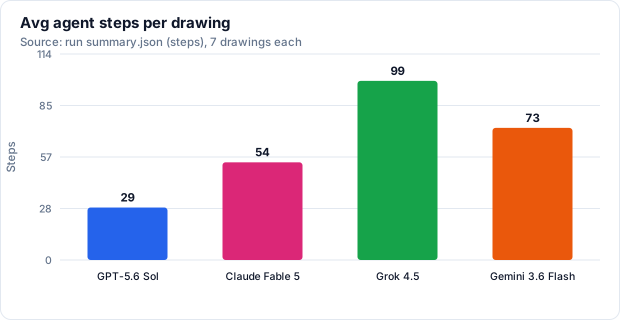
| GPT-5.6 Sol | 7 | 29 | 6.2 min | 3.4M | $7.74 | 6.0 | 116 |
| Claude Fable 5 | 7 | 54 | 12.5 min | 14.6M | $160.58 | 15.6 | 207 |
| Grok 4.5 | 7 | 99 | 4.8 min | 34.0M | $9.21 | 4.3 | 354 |
| Gemini 3.6 Flash | 7 | 73 | 6.9 min | 27.7M | $12.87 | 22.6 | 190 |
The four models used the exact same toolset in completely different ways.
GPT-5.6 Sol never called set_color, set_brush, or set_pressure once, it set those inline on each draw call instead, so its calls are almost all draw, smudge, and view_canvas. Grok 4.5 did the opposite: 65% of its 1,349 tool calls were set_color / set_brush / set_pressure, which is why it averaged 99 steps per drawing. Claude Fable 5 leaned on smudge (123 calls) and reviewed constantly. Gemini 3.6 Flash was the most obsessive reviewer of all, nearly a third of its calls were view_canvas (about 23 self-reviews per drawing), and like Sol it never touched the set_* tools.
Cost and tokens
Claude Fable 5 cost an estimated $160 for its seven drawings, roughly 20x GPT-5.6 Sol ($7.74), Grok 4.5 ($9.21), or Gemini 3.6 Flash ($12.87). This shouldn't really be a surprise by now. Grok used by far the most tokens (34M) but stayed cheap because ~98% were cached reads at a fraction of the input rate, and Grok's rates are the lowest of the four. Gemini also leaned heavily on cached reads, so even at 27.7M tokens it stayed modest.
Did the models actually improve?
Every view_canvas re-scored the canvas against the target, so we can watch progress over a run. Two patterns held across both targets:
First, they plateau early. Claude Fable 5 reviewed its Mona Lisa 27 times, but its similarity was essentially flat after about the fifth review. Second, in all eight target runs, the final drawing scored below the best the model reached mid-run. GPT-5.6 Sol's Mona Lisa peaked at 0.352 SSIM and ended at 0.325; its Starry Night peaked at 0.179 and ended at 0.130. Gemini 3.6 Flash reviewed the most (about 23 times per drawing) and reached the highest peak of the whole batch, 0.449 on the Mona Lisa, then slid all the way back to 0.337 by the end. More reviewing did not translate into a better finish. The models kept editing past their own best performance.
Objective similarity (target runs)
SSIM is 0 to 1, higher is closer to the target. RMSE is 0 to 255, lower is closer to the target.
| Model | |||||||
|---|---|---|---|---|---|---|---|
| GPT-5.6 Sol | Mona Lisa | 44 | 8m41s | 7 | 0.325 | 0.352 | 54.2 |
| Claude Fable 5 | Mona Lisa | 86 | 18m58s | 27 | 0.286 | 0.289 | 56.9 |
| Grok 4.5 | Mona Lisa | 106 | 4m30s | 5 | 0.151 | 0.152 | 95.6 |
| Gemini 3.6 Flash | Mona Lisa | 60 | 5m31s | 22 | 0.337 | 0.449 | 51.1 |
| GPT-5.6 Sol | Starry Night | 23 | 5m47s | 4 | 0.130 | 0.179 | 37.8 |
| Claude Fable 5 | Starry Night | 43 | 11m30s | 12 | 0.153 | 0.176 | 40.9 |
| Grok 4.5 | Starry Night | 58 | 5m51s | 3 | 0.039 | 0.039 | 104.9 |
| Gemini 3.6 Flash | Starry Night | 74 | 6m36s | 24 | 0.172 | 0.190 | 42.8 |
On raw SSIM, Gemini 3.6 Flash scored highest on both targets, on final score and on peak, though it also swung the most between its best frame and its final one. Gemini 3.6 Flash looked decent, but definitely does not look the closest to the target output. Very interesting that the raw score turned out to be higher though. As always, SSIM measures structural closeness, not how good the drawing looks to a person (see our take below).
Method notes
- Four models, two scored targets plus five prompts each, 28 drawings total. All runs used the same colored-pencil toolset. Reasoning was set to high for every model.
- SSIM/RMSE are computed by resizing both images to 256x256 and comparing. They measure structural/pixel closeness, not artistic quality, and only apply to the target runs (prompts have no reference to score against).
- Wall-clock time includes the model's own thinking and tool round-trips.
Our take
GPT-5.6 Sol was the runaway leader. Its Starry Night and its rose were our favorites of the whole batch, which is wild considering it drew them stroke by stroke on a blank canvas. It also beat the other two on detail in almost every drawing, the one exception being the elderly fisherman.
Grok 4.5 was basically garbage here. It rarely produced anything usable, and despite its frantic tool use I would not trust it to reliably understand or judge visual output yet.
Gemini 3.6 Flash was definitely better than Grok at a slight cost increase, but comparing the Flash model to frontier versions seems a little unfair. I'm definitely excited to see how Gemini 4 will perform. We also already knew this, but the token output speed is just so impressive.
Claude Fable 5 landed second on quality but at the far end on cost and time. For this task it was the least appealing trade-off of the three: much slower and far more expensive (about 20x the others) for output that did not keep up with Sol.
Try it yourself
Every model mentioned here is available on TryAI with one account, pay-as-you-go, no subscription.
Start free