The story is the most important part of an anime. Bad story-bad show that's it.
Why We Do This
Why not just hire real animators? Why skimp out on anything at all?
The core reason: Entertainment is constrained financially, and that shapes creative decisions. When Hollywood underperforms, we see more layoffs and in our view more generic shows. Our bet is that if we can make anime financially feasible, we can do two things.
One, fans here actually get to make anime in the US. Instead of needing to fly to Japan, speak Japanese, and preferably be Japanese to break into the industry.
Two, pay the employees(artists) better. Look up the production committee system in Japan and how it treats artists if you want the details.
But TLDR; anime studios are broke, the system isn't changing anytime soon, and it pushes independent contractors into working for dirt poor wages.
We think a an AI studio fixes many problems in the industry. Smaller and faster means more financially feasible so we can give better wages for artists and enable a new industry to thrive in the US.
1. Story Writing & Adaptation
When we choose a story, or write one ourselves, we always have to think about the consumer. That usually means writing for the standard anime watcher, typically Gen Z or Gen Alpha, around universal experiences like high school and exams. Most stories we write target a younger audience, male leaning(we're dudes) and follows similar problems and struggles we had when we were younger.
If there's an existing story, like a Korean comic, we have to figure out how to adapt it into an anime. For us, it's quite a big of pre production work because there's just so much content and detail in a story, and we have to bring it down to a 20 minute episode. Otherwise the pacing gets too slow and we never get to the juicy scenes (the fight scenes, the first kiss,etc).
Before anything gets prompted or we start thinking about shots, someone reads the whole source straight through, or at least what counts as one season. We're hunting for the one thing that made a reader keep scrolling at 2am. Why did they like this story? Good visuals? Good writing? Good character relationships?
Whatever it is, that's the "meat" the adaptation gets built around. Everything else, subplots, side characters, slower arcs, gets tested against it: does this scene serve the meat, or is it just there because the original had room for it? If the latter, we cut that content. Less is more.
We often have to change pacing and density too. When you read or scroll through a comic, you go at whatever pace suits you. We force everyone to go at a pace we decide due to the nature of the animation medium, and some people are inevitably going to feel like a story is too slow or too fast either way. So we try to protect the core story-that might mean cutting side characters or skipping subplots entirely. In adapation work, it's an unavoidable part-budgets do not get to explore every single side story.
How we use LLMs here
We don't. It's really, really bad. Super mediocre, super generic. It's not even slop, it's more like bad Hollywood writing combined with Chatgpt 3.

2. The First Draft
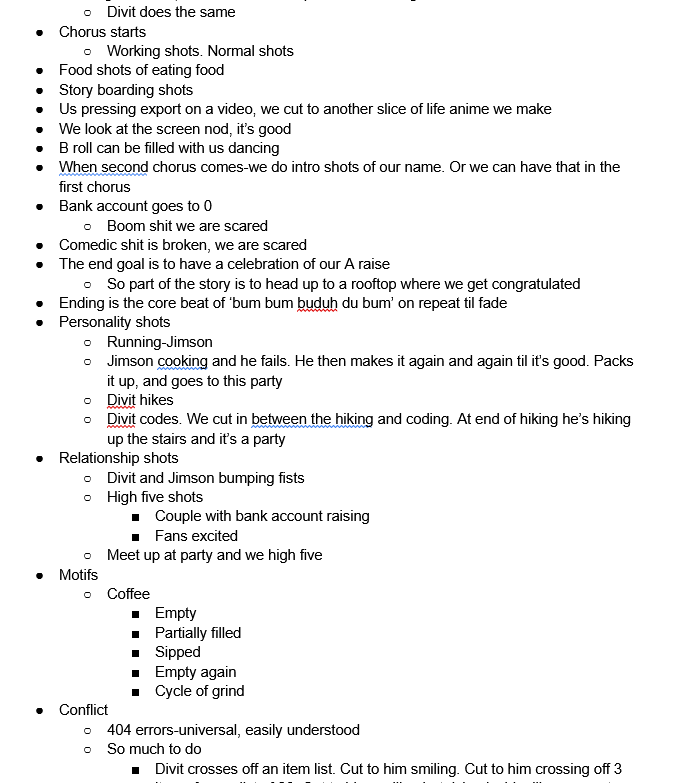
Once we're happy with the story, we build something we call a "beat sheet." It's another script, but this one details the action and the shot, instead of a broader story. Note that calling it a beat sheet is technically wrong, but it stuck because we're naming the 'beats' of a story.
After the beat sheet, we get a first draft going. We figure out what the characters look like, then use a cheap model to generate fast, rough clips just to see the pacing of the animation.
Making the animation itself as a first draft lets us iterate quickly on the action and the feel of each scene. Does it fit? Does the emotion land? Does it make sense for the character to do this? And it allows us to get the visuals and styling of a episode. What does it look like. What mood do we want to evoke with the lighting, etc.

3. Animation
AI AnimationOnce we're happy with the first draft, we take every shot and regenerate it in 720 quality. For the animation, we use a variety of prompting techniques including character references, environment references, extending videos, etc to get the same character and environmental consistency.
The hard part, getting the draft right, is already done, so this ends up being the least time consuming stage. We literally have an agent rerun all the earlier prompts for us, and we only check in to rerun the occasional shot that didn't follow the draft.
4. Post Production
Raw generations get upscaled and cleaned up
Upscaling means making the resolution bettter. While we generate at 720p, most platforms expect 1080p, so we bump up the resolution using DaVinci Resolve or Topaz Labs (now part of Adobe).
Cleaning up is a newer task that AI animation studios specifically have to deal with. Pause on almost any AI generated clip and you'll spot something off: colors morphing strangely, lighting that doesn't stay consistent, mouths moving in ways that don't quite make sense. Fixing that is our job, mostly done by opening photoshop/photo editor and fixing these AI artifacts.
There's also a handful of things we still have to handle(detailed below in post like sfx and voices)

-
Voices
Dialogue gets recorded/prompted and tested against visuals that are now locked in. A human voice actor records it in a session, or an AI voice generates the performance, depending on the character, the budget, and the timeline. Either way, it has to feel emotionally right. Two laughs from the same character shouldn't sound the same twice, and each one has to carry the emotion underneath it.
-
Music
We use AI generated music. We're not musicians, and making good original music is an enormous amount of work. We could license good music, but it's not worth the hassle for something that plays for 10 to 15 seconds at most. In most anime, music shows up in short segments just to evoke a specific feeling, and outside of the opening and ending songs, few fans pay close attention to it, so it's not worth the investment for us right now.
Down the line, once we're making a full length film, hiring a composer will make a lot more sense, a longer runtime justifies a longer soundtrack, though from what we've seen, a lot of shows just reuse the opening or ending theme instead.
-
SFX
Sound effects (footsteps, impacts, magic, ambient environment sound) are almost entirely AI generated at this stage instead of pulled from a library. We can create exactly the sound we need, and honestly, it's just easier for us.
-
Room tone for dialogue
A thin, consistent layer of ambient noise sits under every line of dialogue, so the dialogue doesn't feel empty. We've found ElevenLabs works really well for this.
By the time editing is done, we've probably watched the content 100+ times. We hit export. Then do this over again
That's the whole process, from idea to final export. I've probably skimmed a few stuff, so if you have questions, feel free to reach out. I would love to yap