The UK Artificial Intelligence Security Institute (UK AISI) and the U.S. Center for AI Standards and Innovation (CAISI) (UK AISI / CAISI) conducted a joint evaluation of Moonshot AI’s latest model, Kimi K3 (released on July 16, 2026 and slated for open-weight release by July 27, 2026). This evaluation focused on Kimi K3's cyber capabilities and found that:
Figure 1: Performance of Kimi K3 and other models on an exploit development benchmark (ExploitBench). Higher success rate indicates greater cyber capability. Error bars represent 95% confidence intervals. ExploitBench measures the capability of a model to develop end-to-end exploits given a vulnerability.
These results represent preliminary evaluations on a small set of public and private benchmarks. U.S. closed-weight models were evaluated with system-level safeguards disabled to reduce refusals and enable measurement of maximal capabilities. Publicly available versions of these models have these safeguards enabled. Due to the specifics of Kimi K3’s hosting setup, UK AISI / CAISI ran a selective set of cyber evaluations. Detailed methodologies are provided in individual sections.
Cyber Capability Trends
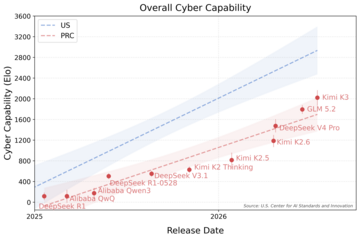
The cyber capability of models is aggregated across multiple tasks from multiple benchmarks using an approach inspired by Item Response Theory (IRT). For details of the methodology please see prior published reports. Kimi K3’s overall cyber capability has a larger confidence interval than other models because it was estimated from a single benchmark (ExploitBench, which has 41 tasks focused on exploit development). ExploitBench is a leading benchmark to measure a model’s ability to progress along the software exploitation ladder. All other models’ overall cyber capability scores were derived from a larger number of tasks that covered additional domains of cyber capability.

Credit: CAISI/NIST
Figure 2: Preliminary comparison of aggregate capabilities over time of the most capable U.S. and PRC models as of Kimi K3’s release. The U.S. trendline is composed of results from frontier U.S. models. A 400-point increase on the y-axis equates to a 10x increase in the odds of solving tasks. Error bars and shaded regions denote 95% CIs.
Exploit Development: ExploitBench
ExploitBench is a public benchmark, developed by Carnegie Mellon University, that measures a model’s ability to progress along the software exploitation ladder, including coverage and crash reproduction, arbitrary read/write, control flow hijack, and arbitrary code execution. The benchmark tests models on 41 recent (post-2023) vulnerabilities in the V8 engine (the JavaScript and WebAssembly software that powers Chrome).
ExploitBench results are presented in Figures 1 and 3.

Credit: CAISI/NIST
Figure 3: Detailed ExploitBench performance for Kimi K3 and other models. Darker shading indicates greater cyber capability. Each row represents a key milestone in the exploit development chain, and each cell shows the number of ExploitBench tasks for which the model(s) in question were able to reach that milestone.
Kimi K3 outperforms GLM-5.2, the most cyber-capable open-weight model as of June 2026. Kimi K3 achieves a score of 32%, whereas GLM-5.2 achieves a score of 24% (Figure 1).
Unlike the most cyber-capable models, Kimi K3 failed to develop exploits that achieved arbitrary code execution (ACE) for ExploitBench tasks. ACE is the highest-severity outcome in exploit development, granting attackers the ability to hijack a target. Kimi K3 achieved ACE on 0/41 samples, whereas the most cyber-capable models achieved ACE on 20/41 samples on average (Figure 3).
Cyber Range: The Last Ones (TLO)
“The Last Ones” (TLO) cyber range is a 32-step simulated corporate network attack spanning 4 subnets and approximately 20 hosts, which would take a human expert roughly 20 hours to complete. Cyber ranges are expert-built, simulated networks of hosts, services, and vulnerabilities arranged into sequential attack chains that begin at the point of initial network access, and can be used to measure a model's ability to conduct end-to-end cyberattacks autonomously.
On this evaluation, Kimi K3 performs significantly below the leading U.S. cyber capable models. Specifically, Kimi K3 reached step 17 of this 32-step attack path on average, while the most cyber-capable U.S. models reached 28.5 steps on average.
Kimi K3 outperforms GLM-5.2, the most cyber-capable open-weight model as of June 2026. Within the 100M-token limit, Kimi K3 reaches step 17 on average, compared with step 11 for GLM-5.2.
In one of the 10 attempts, Kimi K3 successfully completes “The Last Ones” cyber range within the 100M token limit. This indicates that Kimi K3 is capable of autonomously attacking small, weakly defended and vulnerable enterprise systems, when directed to do so and given initial network access. However, TLO differs from real-world environments in several ways. It lacks active defenders and defensive tooling, imposes no penalty for actions that would trigger security alerts, and contains an intentional attack path.
Solves of TLO are no longer exclusive to a small set of models. In prior testing, four publicly released closed-weight models have solved TLO, with the most capable models solving it more reliably at 6/10 and 7/10 attempts. Kimi K3 solved it in 1/10 attempts within the standard 100M token limit.