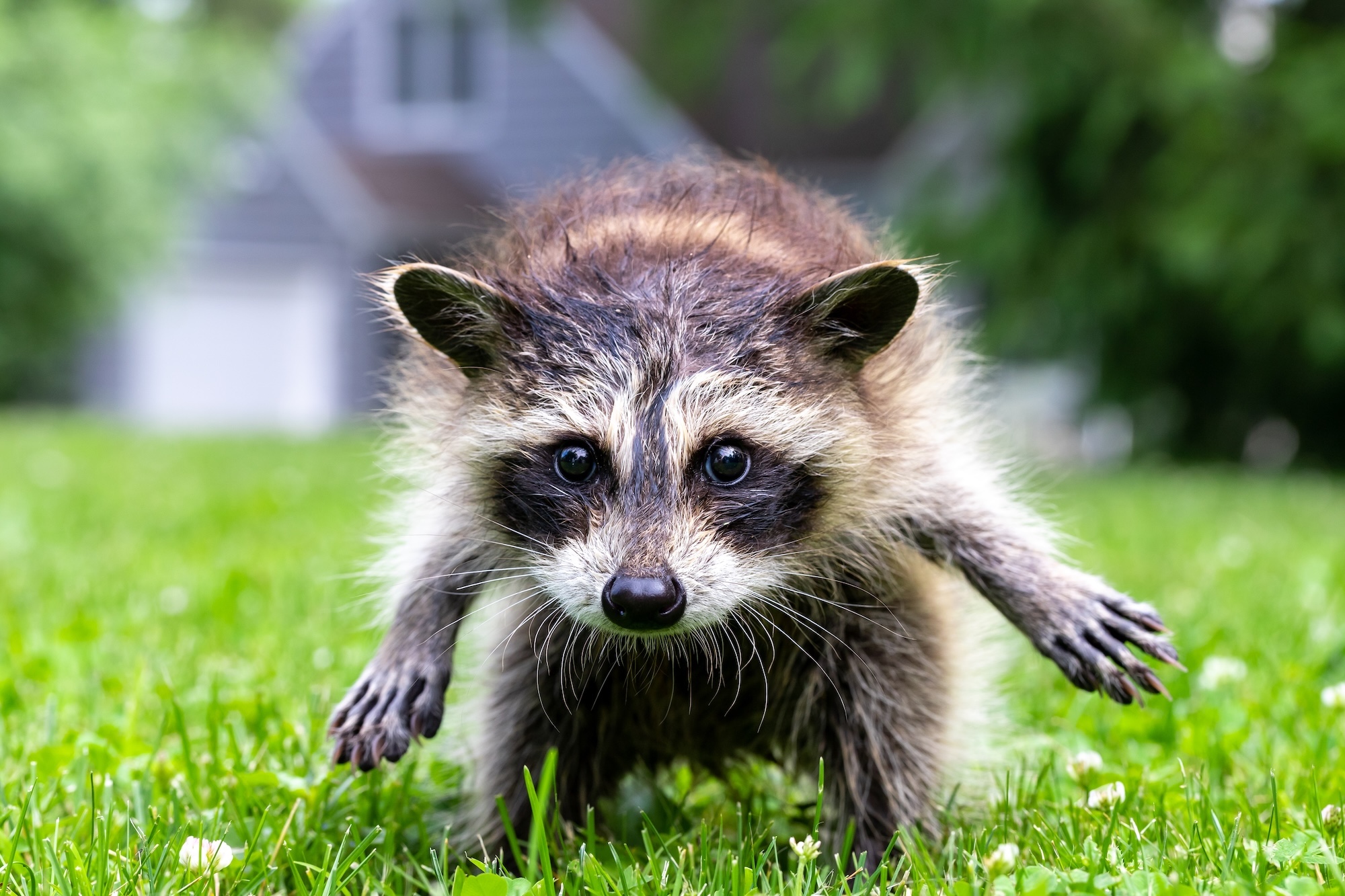
You’d have to be living under a dumpster not to have heard of Jimothy, Seattle’s favorite raccoon and the internet’s newest folk hero. He’s inspired nicknames like ‘King Jimothy,’ as well as fan art, tattoos, and even his own meme, ‘Hot Jimothy Summer,‘ after racking up millions of views this month. Beyond the basic masked bandit cuteness of his species, Jimothy has become a sensation largely thanks to his compact, adorably round shape, the apparent result of a rare condition called short spine syndrome.
Jimothy first turned up near a Goodwill store in Ballard, Washington.
“I initially thought I saw a cat under a car and wanted to have a closer look,” Kiana Hall, the Seattle resident whose video introduced Jimothy to the world, tells Popular Science, “then realized it wasn’t the shape of a cat at all.” It wasn’t until Jimothy turned around that Hall noticed his telltale markings and realized he was a raccoon. As for the origin of his unusual name?
“He just looked like a Jimothy to me,” says Hall.
Online, commenters have since compared Jimothy’s unusual appearance to a cryptid, evoking everything from Bigfoot to the chupacabra.
It’s Jimothy’s world, and we’re all living in it, but his fame raises some real questions about what causes short spine syndrome, why it’s so rarely documented in wild animals, and what it might mean for Jimothy’s future.
So what exactly is short spine syndrome, and how did it leave Jimothy with that unmistakable, highly lovable, no-neck silhouette?
What’s wrong with Jimothy? Why does he look like that?
Short spine syndrome is a rare genetic condition, says Julian D. Avery, an ecologist at Penn State University. A faulty recessive gene causes the condition, meaning an animal needs two copies, one from each parent, for the syndrome to actually appear.
“The odds of putting two individuals together that have it are generally pretty rare,” Avery says, “and probably rare in part because the animals with this condition will have significantly more challenges than a normally formed animal would have in any kind of context.”
Short spine syndrome is a condition that affects the formation of a developing spine, leaving an animal with a shortened, compressed, or fused set of vertebrae. Avery likens the process to rolling out a long tube of Pillsbury dough, then pressing down at regular intervals to pinch off individual segments, roughly how a developing spine differentiates into distinct vertebrae. “That does not unfold properly in animals that have these faulty genes,” he says.
The added challenges for animals with short spine syndrome likely explain why cases like Jimothy’s are so rarely seen at all. Jimothy, though, seems to be one of the lucky ones.
“He seems to have made it through this developmental process in a way that allows him to be pretty successful,” Avery says. “He or she. I don’t think anyone knows whether it’s male or female.”
Related 'Ask Us Anything' Stories
Will Jimothy the raccoon be okay?
Despite his unusual shape and the difficulties it might pose, Avery says animals with short spine syndrome generally have normal brain function and internal organs.
“There’s no reason to think the lungs are compromised or the brain is compromised,” he says. “I would expect that Jimothy would have a normal life.”
Given how Jimothy appears in his viral videos, actively foraging, climbing, and moving with apparent ease, there’s real reason for optimism. Raccoons as a species tend to come equipped with this kind of adaptability, Avery says.
“Raccoons are crazy resourceful,” he says. “They’re one of those species that is generalized enough that they can make a go in many kinds of situations and be successful.”
The bigger risk to Jimothy isn’t his condition, Avery points out. It’s how people react to him.
“When people start feeding wild animals, then they start hanging around in unsafe ways,” he says. Habituated animals become more likely to be hit by cars, or removed by wildlife officials once they are viewed as too tame.
“They’re not wary enough of those threats coming at them, and then they suffer,” Avery says.
How we can help Jimothy
When it comes to intervening in situations like Jimothy’s, Avery recommends a strict hands-off approach. “I’m always on the side of letting wild animals run their course,” he says. “You want natural variation in a population.”
That doesn’t mean you should stop admiring Jimothy’s adorably circular physique from a distance, though—quite the opposite.
“If more people are going to see Jimothy and doing so at a respectful distance, that’s awesome,” Avery says. “That’s more people that have seen a raccoon and are then going to get hooked on wanting to see a porcupine or robins nesting in their shrubs. Those sorts of things really get people invested and caring about what’s going wrong in the world around us.”
Washington’s own wildlife agency echoes Avery’s hands-off philosophy for Jimothy-watchers. In a written statement to CBC News, a spokesperson for the Washington Department of Fish and Wildlife said, “We do encourage folks to leave the animal alone as it does appear to be getting around fine, unassisted, with the apparent congenital defect.”
That said, his fandom shows no signs of slowing down. On July 26, Seattle City Councilmember Alexis Mercedes Rinck plans to present an official proclamation in Jimothy’s honor, commemorating what she’s calling ‘Jimothy Summer,’ complete with a community art competition.
Amid all the fanfare, Hall says her hope is simple: That Jimothy keeps bringing people joy, and that people, in turn, look out for him.
“It has been so fun watching Jimothy bring some joy and silliness to the world,” she says, “and I hope this encourages people to go out for walks in their neighborhood and observe the wildlife around them.”
In Ask Us Anything, Popular Science answers your most outlandish, mind-burning questions, from the everyday things you’ve always wondered to the bizarre things you never thought to ask. Have something you’ve always wanted to know? Ask us.