Back to our story:
February 12, 1898: TMTR: “The Grunewald Harp-Guitar”
What’s going on? Not a month later, the trade journal again highlights the new instrument, with the same woodcut and 2 columns of hype, claiming that it is “attracting considerable attention in trade and musical circles.” In fact, “all who have examined it are unanimous in proclaiming it to be a radical and practical improvement upon the time-honored guitar.” True? There doesn’t seem to be reason to totally discount the report, yet where are all the surviving instruments? Perhaps all south of the border, as the company’s activity there is again specifically mentioned?
This time, in the tone department, they’re having their cake and eating it too, describing the “quality of tone (that) resembles that of the mandolin and guitar, or more particularly that of the harp…” Personally, I consider a mandolin and harp very different (!) - the mandolin being steel strung, high and bright with short sustain, while available harps were all gut strung and meant to ring. Note that the “autoharp or mandolin” clues have informed us from the beginning that Brown’s original instrument and the two manufacturer’s were almost certainly all strung in steel (or silk & steel), which at the time was intended for amateurs and not “serious” guitar players.
This piece ends with another reminder that the “ordinary guitar…is an instrument upon which…comparatively few can play.” It sounds like the Grunewald harp-guitar may indeed soon supersede it!
April 16, 1898: TMTR: A short blurb tells of a Grunewald agent’s success in Mexico and soon South America with the harp-guitar.
September 10, 1898: TMTR: “Rene Grunewald Forging Ahead”
Now things are getting serious. First, they’re already talking about the “now famous harp-guitar.” We then learn that Grunewald is planning to aggressively market the instrument (along with his mandolins) throughout the United States, but also in Cuba and Puerto Rico (America’s “new possessions”). Further acclaim of the still-10-string instrument and much name-dropping regarding Grunewald mandolin testimonials follows.
October 15, 1898: TMTR: “The Harp-Guitar”
A month later and TMTR is really taking this seriously, insisting that “The new American harp-guitar…is considered by experts, soloists and amateurs as the acme of perfection.” For the first time, we are told exactly how the melody will be played in first position via the paired octave strings: “The air will sound in a clear treble, bass, or plainly in octaves, with great volume, by simply engaging the treble of the parallel strings with the thumb and its larger companion with the first finger.” Man, can you imagine a beginner doing that with a few days practice? They’re telling me I can pluck just the skinny string of the pair and get a melody with “great volume”? How many modern 12-string players can do that?!
December 3, 1898: The Houston Daily Post: Display Ad
A separate C. Grunewald store in Houston, Texas at 310 Main St. lists “Harp-Guitars” among its inventory. "C" must be Clifford, brother of Rene.
April 8, 1899: TMTR: “The Harp-o-chord the Latest”
This tells of Carl Brown’s second invention, the “Harp-o-chord.” Clearly, the TMTR editor is a Brown fan!
September 10, 1899: The Sacramento Record-Union: News Announcement
A short entry announces Brown’s new Harp-o-chord invention, and includes “who made such a success of a ten-stringed harp guitar, which he brought out some two years ago…”
December 23, 1899: TMTR: “A New Guitar”
An interesting little press release (with a typo of “1889” in the heading, so don’t get confused) from Brown’s firm in Columbus, Ohio, that mentions the “new 10-string guitar recently invented…manufactured by the “New Orleans branch of the Columbus Harpochord Co.”
Curiously, the address given (West Bond St.) is different than the Grunewald’s factory (Conti St.), so the question is: Is this a new facility unrelated to Grunewald, or simply a department of, or new location of, Grunewald’s original factory? It’s curious that Grunewald – surely the bigger “name” – isn’t mentioned, nor have we heard anything of him in TMTR for over a year.
If Grunewald was indeed still the manufacturer, this would indicate that at the very end of 1899, Grunewald still had not come up with the 12-string version. However, if Grunewald was out of the picture, could he have been now creating his 12-string? And if he broke off from Brown, could he still call his 12-string version “the Harp-Guitar”? What’s missing is a 12-string specimen showing the label, which would presumably be under the original Brown patent. Or would it? None of the next Grunewald ads mention a patent. December, 2015: A surviving 12-string finally appeared, but it only has the Grunewald stamps, no label.
Irrespective of this puzzle, note the key sentence
of this notice: the claim that “The New Orleans house is sending them out by
the hundreds, and the sales are enormous.”
Again, if true, where are the surviving instruments?!
August 19, 1900: The Houston Daily Post: Display Ad
The Houston C. Grunewald store announces “Have just received new lot Harp Guitars of…$10.50.” There is no way to know whether these were 10-strings or 12-strings.
1901-1902: Here is where our trail grows cold, as nothing further on the 10- or 12-string Brown or Grunewald (to say nothing of Gordon) harp-guitar appears in The Music Trade Review (that I have found through searching. Someone next needs to carefully read all pages of all weekly issues).
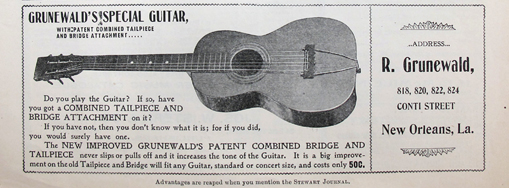
 There is
an ad in the S. S. Stewart Journal issues of April and May, 1901 for Grunewald’s new “Special Guitar," but this is only a 6-string guitar with
their "new improved patent combined bridge and tailpiece" (the patent
does not appear to have granted). There is
no mention of their 10- or 12-strings.
There is
an ad in the S. S. Stewart Journal issues of April and May, 1901 for Grunewald’s new “Special Guitar," but this is only a 6-string guitar with
their "new improved patent combined bridge and tailpiece" (the patent
does not appear to have granted). There is
no mention of their 10- or 12-strings.
The Cadenza
After the end of the Music Trade Review 10-string write-ups above and the 1901-1902 “lost years,” Grunewald came back blazing with full page ads in The Cadenza for a couple years running. These were seen by most every “serious” guitar player in America, and various levels of amateurs. While TMTR catered to the trade, The Cadenza catered to the customers – the players.