- For much of their history submarines have spent most of their time on the surface, only submerging to make attacks.
- But the arrival of nuclear power allowed a submarine to stay underwater indefinitely.
- Operation Sandblast demonstrated to the world that submarines could now spend an entire patrol underwater.
In 1960, the U.S. Navy conducted a landmark exercise in the history of submarine warfare. The nuclear powered submarine USS Triton circumnavigated the globe completely underwater, proving that submarines—which until then had spent much of their time on the surface—could now operate completely submerged.
It was all thanks to nuclear energy, which provided unlimited power to submarines.

Older submarines, such as the World War II veteran USS Gato, were designed to operate on the surface. Nuclear power changed that.
One surprising fact about submarines is that for decades they spent more time on the surface of the ocean than underneath. From the earliest subs to those built in the immediate postwar years, submarines were powered by air-breathing diesel engines. Submarines would cruise on the surface, searching for targets, and then submerge and operate off lead acid batteries to make their torpedo attacks. Submarines were built to be faster on the surface of the water than under the surface, typically making 20 knots surfaced and only about 10 knots submerged.
Nuclear power changed everything. Nuclear power didn’t need air to help power the submarine, meaning that a nuclear submarine could operate submerged indefinitely. As a result, the shape of submarines went from the chunky u-boat types subs to smooth, tuna-like hulls that greatly increased hydrodynamic efficiency. The combination of a more efficient hull and nuclear power made for quieter, faster subs capable of traveling three times faster underwater than their predecessors.
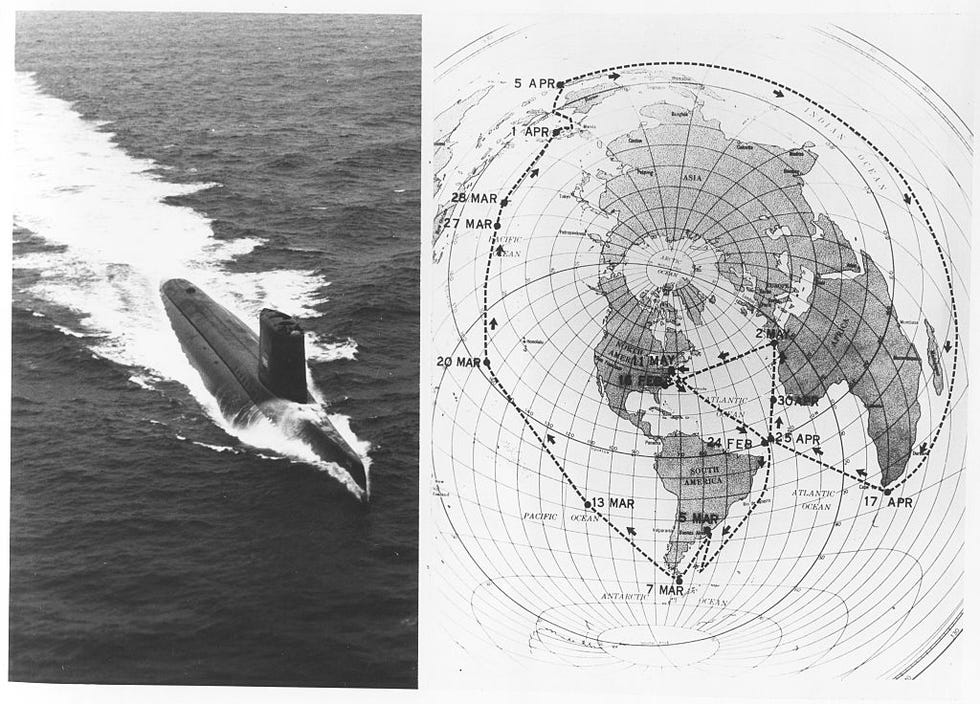
USS Triton and her route circumnavigating the globe, 1960.
Operation Sandblast was the U.S. Navy’s demonstration of the superiority of nuclear power. USS Triton (SSRN 586), a nuclear-powered radar picket submarine, was at 447 feet long the largest submarine ever built at the time. Designed to sail to remote locations near the Soviet Union and use its radar to search for signs of nuclear attack, Triton was also the fastest submarine ever built.
Triton left her home port in New London, Connecticut, on February 16, 1960 and proceeded on a path largely inspired by Portuguese explorer Ferdinand Magellan. Triton crossed the globe in 60 days, returning to New London on April 25. The submarine’s circumnavigation route was a total of 26,723 nautical miles, though the sub actually sailed a total of 36,000 nautical miles over 85 days overall.

Captain Edward L. Beach, Commanding Officer of the nuclear submarine USS Triton, during submerged cruise around the world.
In addition to the circumnavigation mission Triton released hydrographic bottles to study the world’s ocean currents and mapped the ocean floor with its fathometer and sonar. Triton surfaced only once during the voyage in order to evacuate a sick crewman.
USS Triton had a brief career, serving with the U.S. Navy for only 11 years. The radar picket submarine concept was a short-lived one, and the sub was decommissioned in 1968. The sail of the sub was preserved and today is on display in Benton, Washington.

Kyle Mizokami is a writer on defense and security issues and has been at Popular Mechanics since 2015. If it involves explosions or projectiles, he's generally in favor of it. Kyle’s articles have appeared at The Daily Beast, U.S. Naval Institute News, The Diplomat, Foreign Policy, Combat Aircraft Monthly, VICE News, and others. He lives in San Francisco.