Advanced economies did not simply abandon capital controls after the 1944 Bretton Woods Agreement. Martino Comelli and Pedro Perfeito Da Silva show that welfare states quietly took over their job. Countries that protect workers can afford open financial borders. Countries that spend mainly on pensioners still police the movement of money
What Keynes called heresy
In 1944, defending the Bretton Woods plans in the House of Lords, John Maynard Keynes celebrated a conversion: 'the plan accords to every member Government the explicit right to control all capital movements. What used to be a heresy is now endorsed as orthodox'. Capital controls are rules that limit how money moves across borders, from taxes on foreign inflows to restrictions on taking money out of the country. The postwar financial order stayed on a national leash, and governments used this policy space to pursue full employment and build welfare states.
Development of the welfare state in Europe happened in a regime of tight capital controls. Welfare and capital controls grew together because they had similar goals. Every capitalist state must keep accumulation going while keeping society governable. Capital controls handled the external side, blocking the sudden flight of money that punishes governments and disciplines workers. Welfare handled the internal side, absorbing the people and risks the market discarded.
Most economies, decades into liberalisation, still restrict cross-border finance somehow
The 1970s broke the Bretton Woods system, closing the parenthesis of the Keynesian heresy, back to market orthodoxy. Washington ended dollar convertibility in 1971, finance went global, and the threat of exit became a permanent presence at every bargaining table, as capital chased lower wages and higher financial profits.
Yet capital controls never disappeared completely: IMF data compiled by Andres Fernández and colleagues show that most economies, decades into liberalisation, still restrict cross-border finance somehow. The interesting question is why some countries keep the drawbridge up while others let it down.
Not how much, but on whom
The standard answer, going back to Dani Rodrik, holds that open economies compensate their citizens. More exposure to world markets, more social spending.
Social assistance spending as a percentage of GDP
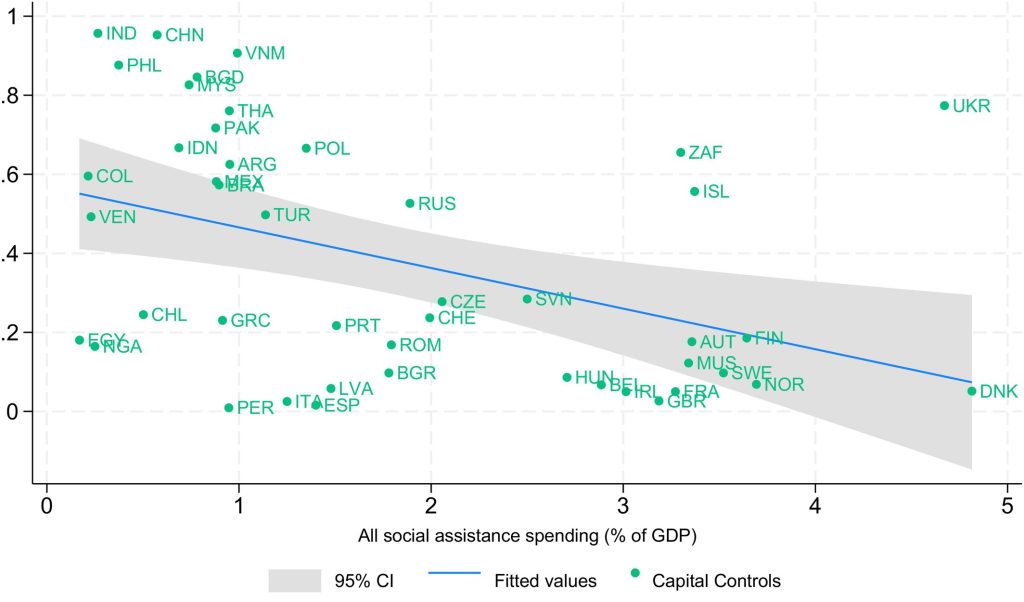
Our new study in Social Policy & Administration finds that this compensation thesis misses the composition of that spending. We split the welfare budget into three. Passive spending covers pensions. Protective spending covers health, family and unemployment support for the working-age population. Productive spending covers training and education.
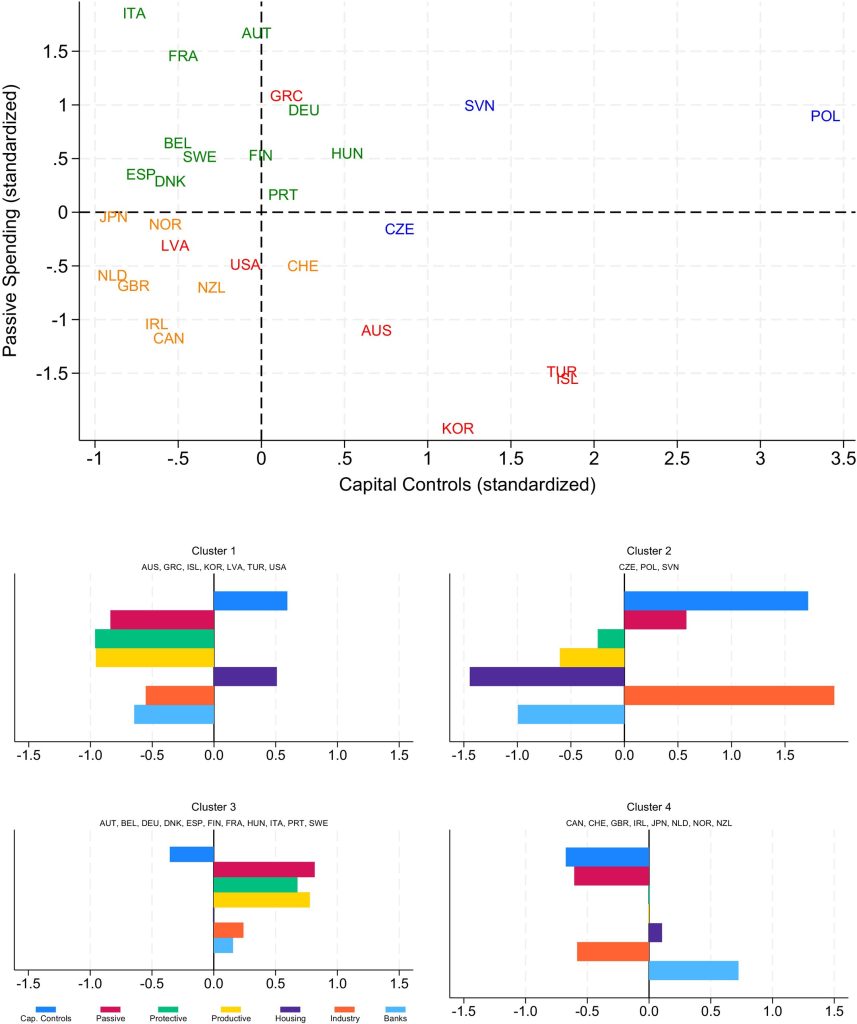
Across OECD countries from 1995 to 2019, the welfare mix correlates with the cross-border financial regime. Countries that tilt their budgets towards pensions maintain tighter capital controls. Countries that protect and train their workforce keep their financial borders open. Housing wealth pushes in the same direction, because households sitting on appreciating assets acquire a direct stake in open finance.
Open economies compensate their citizens: more exposure to world markets, more social spending. But how that money is spent is just as important
The mechanism behind the scenes is what Walter Korpi called the 'democratic class struggle' then crystallised in welfare arrangements. Protective spending gives workers back part of the bargaining power that mobile capital takes from them. Productive spending moves economies away from price competition, so governments no longer need to defend the exchange rate. Pensions, on the other hand, do neither: they secure people who have already left the labour market.
Four welfare-capital configurations
A cluster analysis sorts the OECD into recognisable families. Comprehensive welfare states, Nordic and Continental alike, pair broad social investment with the most open capital accounts. Post-communist industrial economies pair pension-heavy welfare with the tightest restrictions. Liberal economies stay open through large banking sectors and housing wealth rather than public protection. And countries with thin welfare across the board also keep controls, because nothing else cushions the blows.
Coverage beats generosity
We then widened the lens beyond the OECD with the Global Welfare Dataset, covering 35 countries including large emerging economies. There, the share of the population that social assistance can reach matters more than the money spent. Broad coverage travels with open capital accounts. Narrow coverage travels with controls, whatever the budget.
The cases behave as the numbers suggest. Poland directs roughly two thirds of its social spending to people outside the labour market and runs the tightest capital flow management in the Visegrád group. Uruguay built one of Latin America’s broadest welfare systems and has kept its capital account open since the 1990s. Chile, whose dictatorship privatised and segmented social protection, has repeatedly reached for capital controls to steady an exposed society.
Austerity breeds financial protectionism
The pattern invites us to read welfare as macroprudential policy, part of the toolkit that keeps financial openness politically survivable. Where redistribution runs vertically and broadly, the welfare state itself absorbs the shocks of global finance. Where it runs horizontally, protecting established insiders while the rest carry the risk, governments buy stability at the financial border instead. Capital controls work as a cheap, imperfect substitute for redistribution. They calm an exposed society without asking anyone at the top to pay.
Where redistribution runs vertically and broadly, the welfare state absorbs global finance shocks. Where it runs horizontally, governments buy stability at the financial border
Gut broad social protection, and you don't get a free market, you get working people and exposed businesses demanding that borders close. Keynes watched a heresy become orthodoxy because the old order had made itself unbearable after the crisis of 1929 and the fall of gold-standard liberalism. Analogously, regimes that dismantled the welfare that made openness bearable should not be surprised when the drawbridge starts rising again, as in Trump’s America and elsewhere, becoming a policy tool of the right.
The paper on which this blog piece is based won the ECPR Standing Group on Political Economy and Welfare State Politics Best Paper prize 2025