
Canada is exporting its highest earners to the United States. This finding, highlighted in a recent Hub analysis on Canada’s GDP per capita crisis, including its causes and manifestations, generated substantial discussion and debate over the past week.
That discussion, coupled with a new article from The Economist entitled “Westerners are fleeing their countries in record numbers,” prompted a revisit of Canada’s brain drain.
The numbers
The Economist’s analysis highlights record emigration from Western countries. Roughly 4 million people left 31 Western nations in 2024, up 20 percent from pre-pandemic levels. Canada’s departures in the third quarter of 2025 were 34 percent higher than six years earlier.
Canadian net emigration—a series Statistics Canada maintains for long-term consistency due to methodological changes to the gross numbers—reached 65,372 in 2024-25, the highest level in the 50-year data series. Whether this represents catch-up from pandemic travel restrictions or a genuine new trend remains unclear.
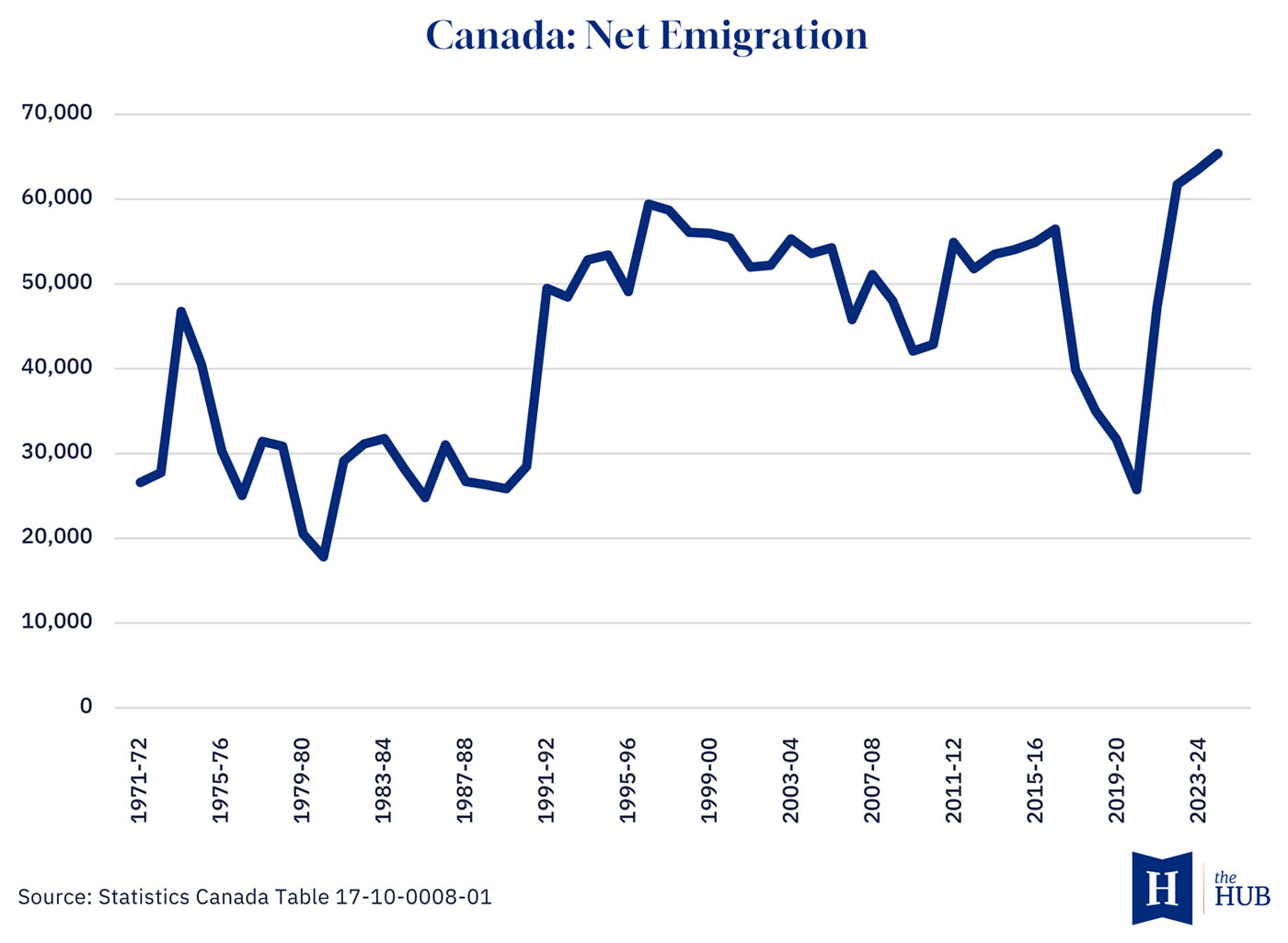
Graphic Credit: Janice Nelson.
Statistics Canada relies on tax filing patterns and surveys, not comprehensive exit tracking, and the distinction between temporary and permanent departures is opaque. These uncertainties matter for policy. If emigration is primarily driven by temporary opportunities and most people return with enhanced skills and networks, the long-term impact differs substantially from permanent brain drain. But the trend and its implications for Canada’s economy are significant enough that policymakers ought to take note.
Who’s leaving Canada?
A recent “portrait of emigration” reveals that close to 70 percent of Canadian emigrants had at least a university degree, substantially higher than the working age population (roughly 33 percent). Canada’s educational skew is consistent with international patterns, as noted by The Economist. Data from New Zealand, for instance, suggest people with undergraduate degrees are at least twice as likely to emigrate in their 20s.
Canadian emigrants are predominantly young professionals—67 percent are ages 20 to 44. They’re also more likely to work in natural/applied sciences or finance. A 2024 survey by the Ottawa Science Policy Network found that nearly two in three current graduate students (64 percent) report being likely to move abroad upon completing their degree, with finances and job opportunities cited as the primary drivers.
View reader comments (19)
According to Bank of Canada research, the study that generated the much-discussed finding, roughly 40 percent of Canadians who would rank in the top 1 percent of earners have emigrated south, along with 30-50 percent of the next nine percentiles. Canadian-born individuals in the U.S. are more educated than native-born Americans, earn substantially more, and cluster in top income brackets. The study finds these top earners account for three-quarters of the Canada-U.S. GDP per adult gap and up to two-thirds of the labour productivity gap.
Taken together, these patterns suggest Canada is losing precisely the human capital needed to reverse its productivity decline.
Where do they go?
Among the 1.3 million Canadians by birth living abroad, the United States dominates as the destination of choice. In 2020, 793,897 or 61.4 percent of them resided in the United States. The next largest destinations were the United Kingdom (7.8 percent), Australia (4.6 percent), France (2.3 percent), and Italy (2.0 percent).
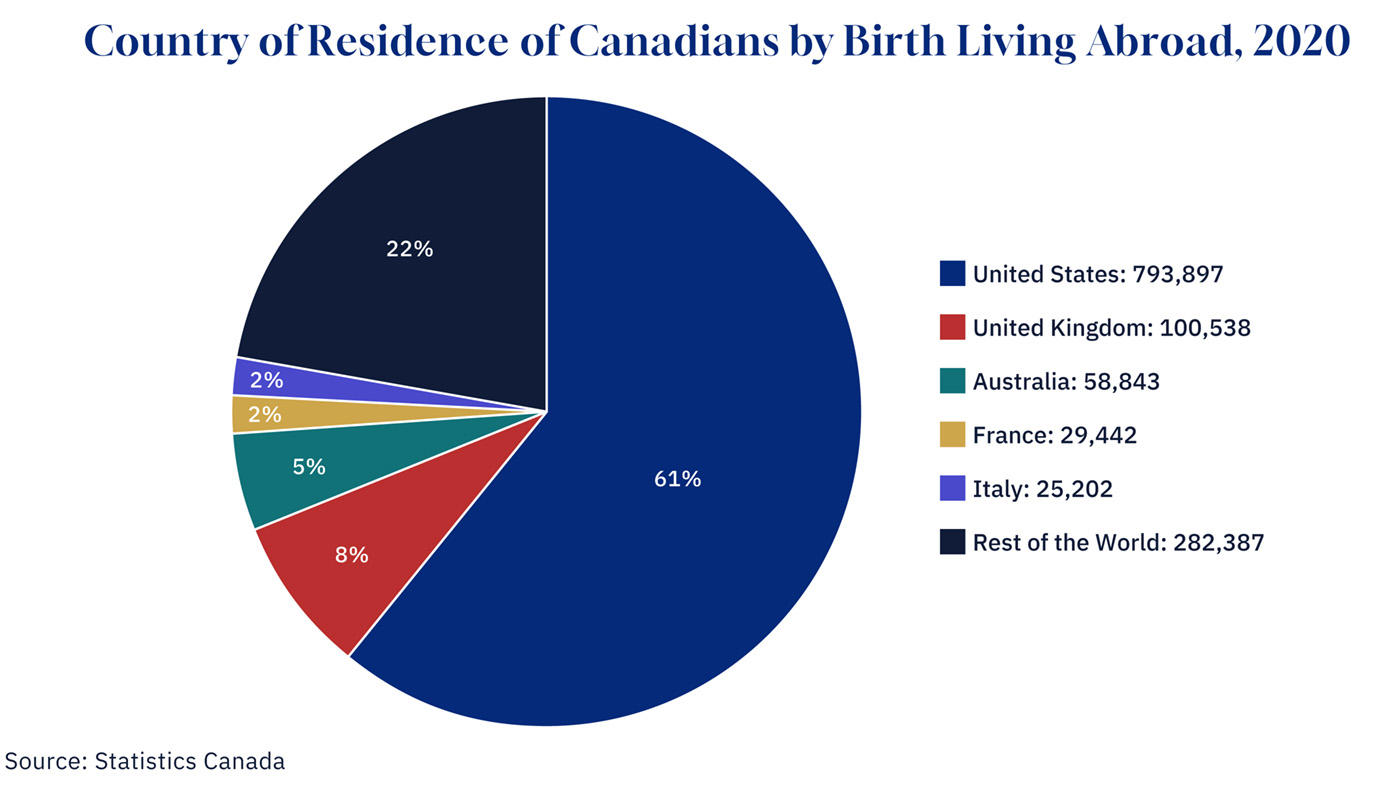
Graphic Credit: Janice Nelson.
This concentration reflects geography, language, and labour market integration. The U.S. offers immediate access to larger markets, deeper capital pools, and higher wages without the cultural and linguistic barriers that complicate moves to other high-income countries. For Canadian professionals and entrepreneurs, the U.S. is both the path of least resistance and a source of income and wealth opportunities.
Consider an example of the U.S. offering substantially higher compensation for high-skilled workers. A new NBER working paper finds American physicians earn roughly two to four times their Canadian counterparts. What’s interesting, though, is that U.S. doctors don’t earn unusually high incomes relative to other high-skill American workers—their income ranking within the U.S. is similar to how Canadian doctors rank within Canada. The study’s key finding is that high-skill workers generally make more in the U.S. because its economy is uniquely productive, which in turn creates strong outside options that bid up wages. As economist Alex Tabarrok notes, the U.S. faces an extreme shortage of high-IQ workers. Demand is strong on both sides.
The startup exodus
The pattern extends to entrepreneurship. Leaders Fund research analyzing nearly 3,000 venture-backed startups founded by Canadians between 2015 and 2024 found the U.S. went from producing 11 times more high-potential startups than Canada in 2015 to 45 times more in 2024. Nearly half of Canadian founders who raised over $1 million in 2024 were based in the U.S., versus one-third based in Canada, and the U.S. share has steadily grown since 2018. Canadian founders operating south of the border raise nearly twice as much capital as those who stay.
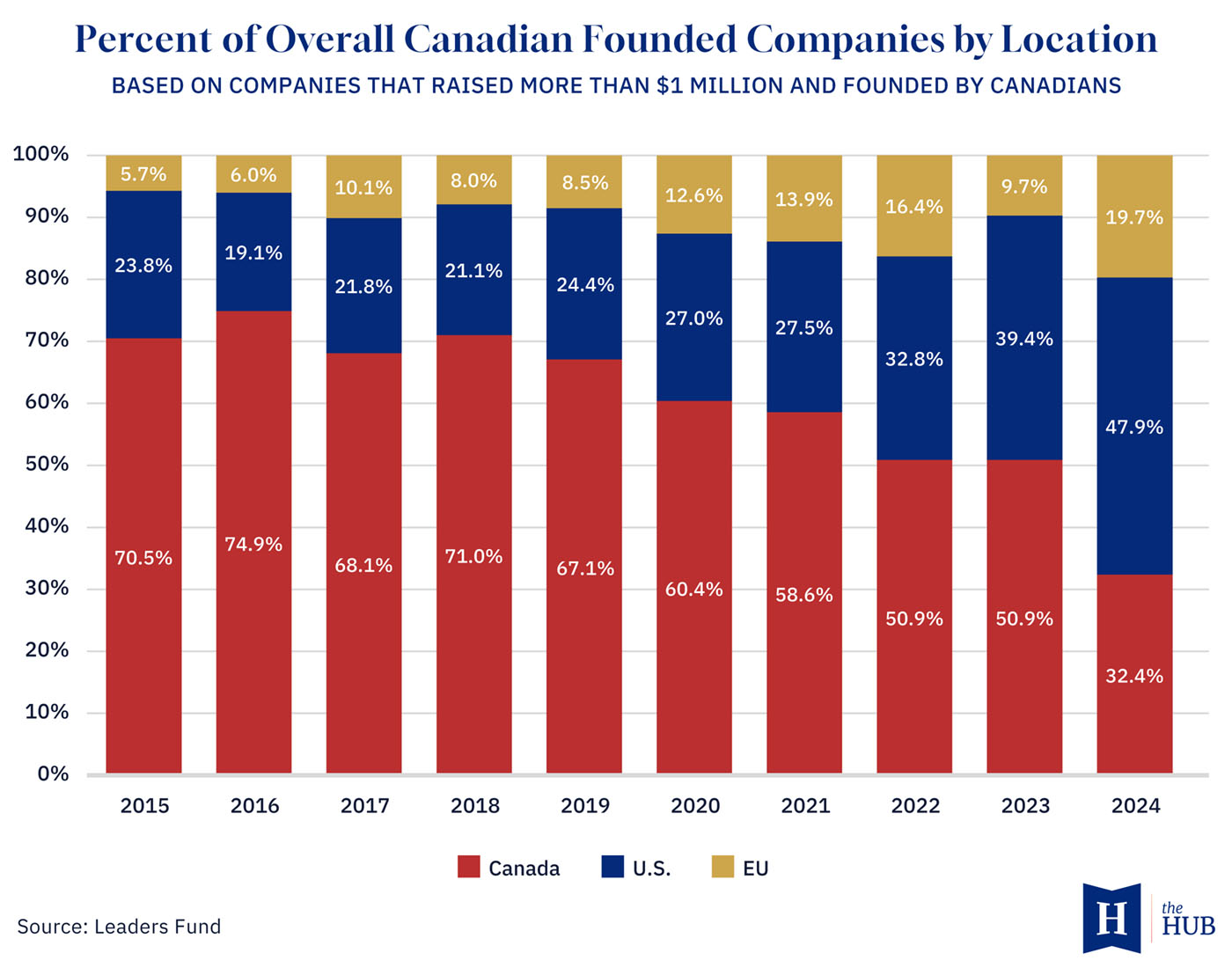
Graphic Credit: Janice Nelson.
While access to deeper capital pools and networks is a draw to the U.S., when entrepreneurs increasingly choose to locate their companies abroad, the compounding effect on Canada’s innovation capacity is severe.
Understanding drivers
The evidence is clear on several points. High-skilled workers face strong economic incentives to relocate to the U.S.
The Economist article identifies three broader factors driving Western emigration: remote work normalization (enabling geographic arbitrage), tax policy (high marginal rates on top earners), and institutional performance (declining faith in government effectiveness). Canada faces all three pressures simultaneously.
The pandemic normalized remote work, opening geographic options for knowledge workers. High marginal tax rates on professionals and entrepreneurs create financial incentives to relocate. And broader economic underperformance—stagnant GDP per capita, declining productivity, weak business investment—signals persistent institutional failures. The ability to earn higher incomes elsewhere is a powerful draw.
The fiscal squeeze
When a country invests in education only to lose those it educates at their peak earning years, it forfeits future tax revenues. For countries with aging populations and expanding public sectors, this creates a fiscal squeeze. The irony is striking: the very policies meant to fund expanded public services may be chasing away the tax base those services depend on.
As The Economist notes, the rise of the “expat economy” is making the West more interconnected than ever. For receiving countries, that’s an opportunity. For sending countries, it’s a warning.

Charles Lammam is an economic and policy professional with over two decades of combined experience as a think-tank scholar and thought leader,…
Canada is experiencing a significant brain drain, exporting its high-earning and highly educated professionals, particularly to the United States. This trend is exacerbated by factors such as remote work normalization, high marginal tax rates, and declining faith in government effectiveness. Data shows a substantial increase in emigration, especially among young professionals in natural sciences, finance, and graduate students. The U.S. attracts Canadian talent with larger markets, deeper capital pools, and higher wages. This exodus of skilled workers and entrepreneurs poses a threat to Canada’s productivity, innovation capacity, and future tax revenues, creating a fiscal squeeze and highlighting the need for policy adjustments.