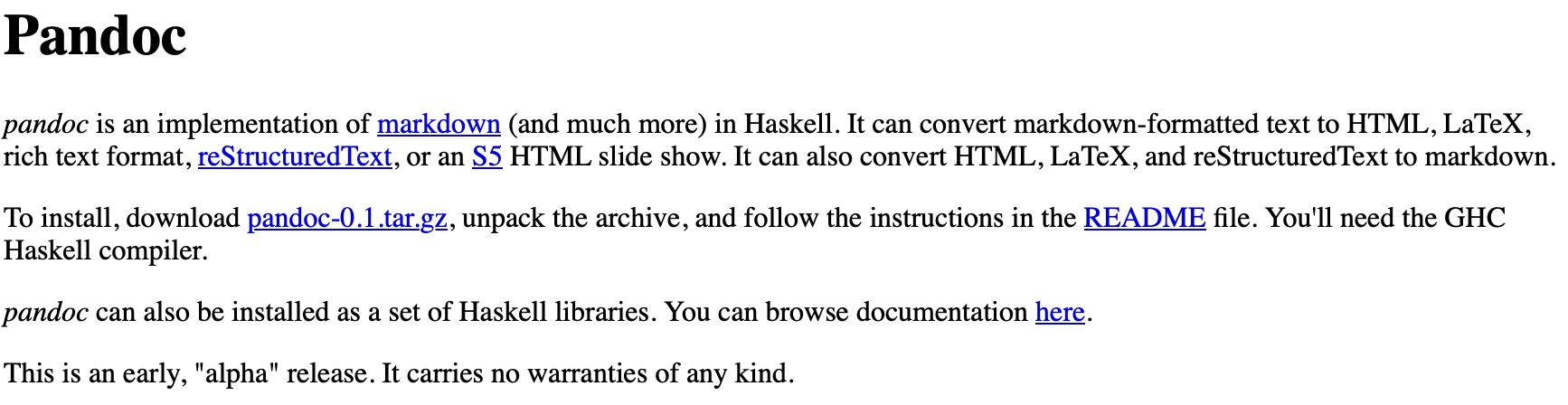
On August 3, 2006, I uploaded the first version of pandoc to my website, releasing it under the free GPL license. Pandoc 0.1 consisted of about 3000 lines of Haskell code, with no dependencies aside from GHC’s standard library. It could convert Markdown, reStructuredText, HTML, and LaTeX documents into any of these formats, plus RTF or S5. I had no idea at the time that this would just be the first of over two hundred releases over the next twenty years; that the project would become the most popular program written in Haskell; that I would spend countless hours on bug-fixes, improvement, and project management; that I would collaborate with programmers in many other countries; that pandoc would come to support over fifty document formats; that it would allow automatic generation of citations and bibliographies; that it would become integrated into academic writing tools like Quarto and Jupyter Notebook; that it would be installed on millions of computers around the world.
How did this happen? I want to take advantage of pandoc’s birthday to tell the story of the project, as best I can remember it.
John MacFarlane
August 2, 2026
Prehistory
People often ask: Why is pandoc written in Haskell? There could have been good answers to this question: Haskell is a very good language for writing this kind of application. But in fact, I didn’t decide to write a document converter, then decide to use Haskell for it. I decided to use Haskell, and then decided to write a document converter in it.
I had heard about Haskell from the blog of a philosophical logician friend, Greg Restall. Of an introductory book on Haskell, he said: “I’m glad that this wasn’t the textbook in my introductory computer science course, long ago in 1986. If it were, I may have fallen in love with computing and never become a philosopher” (consequently.org).
Intrigued by this (and not heeding Restall’s warning about the potential effects on my future philosophical productivity), I read A Gentle Introduction to Haskell to get a basic understanding of the language. But the only way to really learn a programming language is to write something in it. I saw that Haskell was good for writing parsers and compilers, and it came with a really nice parser combinator library (parsec), so I decided to write a Markdown parser.
At that time, there were implementations of Markdown in Perl, Python, Ruby, and PHP; they all transformed Markdown directly to HTML through a sequence of regex transformations. Pandoc took a different approach. It parsed the Markdown using parser combinators and produced a real abstract syntax tree (AST), which it could then render to HTML or another format. This was a more reliable architecture (avoiding many quirks of the regex versions). It was also a more extensible one: by writing N parsers (“readers”) and M renderers (“writers”), one could support N × M conversions. Soon I added a reader for reStructuredText, because I kept a lot of my lecture notes and handouts in that format. And I added a writer for LaTeX, because I wanted to be able to produce PDFs. Then I added a writer for Markdown, so I could start to convert my reStructuredText notes to Markdown. And from there the project just snowballed.
Thus, a project that started out as nothing more than the product of procrastination was nurtured by the joy of writing in Haskell and by its increasing usefulness for my own academic work.
First releases (2006–8)
In August 3, 2006, I decided to make the source code available on my website. By now pandoc supported HTML, LaTeX, RST, and Markdown as input and output formats, and RTF as an output format; also PDF via LaTeX.

I made no attempts to advertise the project, other than emailing two friends. This was before social media (which I’ve never used anyway), before GitHub, and before Hackage, the Haskell package repository. But apparently some people stumbled across it on my website and started using it. In October I was contacted by a Turkish developer, Recai Oktaş, who was trying to get certified as a Debian developer and wanted to package pandoc for Debian linux. So I worked with him to do that. This was a great learning experience for me and it greatly increased the visibility of the project.
During 2007, I continued to improve pandoc, largely guided by
my own needs. Version 0.3 added the DocBook writer and the
now-standard syntax for footnotes in Markdown. Version 0.4 added
support for Markdown tables, definition lists, super/subscript,
strikeout, and enhanced ordered lists, as well as writers for
groff man pages and ConTeXt. This was the first release to go on
the Hackage Haskell
package repository, which was started in 2007. The Hackage archive
and the new cabal-install tool, which automatically
resolved and fetched dependencies, opened up the possibility of
depending on external packages.
Pandoc 1 (2008–17)
Pandoc 1.0 was released in September 2008, with new writers for
MediaWiki, GNU Texinfo (contributed by Peter Wang), OpenDocument
(contributed by Andrea Rossato), ODT, and delimited code blocks
(now called “fenced”) with automatic syntax highlighting. Support
for ODT requires the ability to create a zip archive, and at the
time there was no Haskell package for this, so I created one (zip-archive),
using the excellent binary package for binary parsing
and serialization. Support for syntax highlighting required a
syntax highlighting library, which also did not exist in Haskell.
For this, I wrote highlighting-kate,
which parsed the XML syntax definitions used by the Kate text
editor and turned them into Haskell code highlighters. This
allowed pandoc to support a large number of syntaxes right off the
bat. This version also contained support for automatic generation
of citations and a bibliography using CSL style, using Andrea
Rossato’s citeproc-hs
library.
Throughout this period, I was involved in discussions with
other Markdown implementers on the (now defunct) markdown-discuss
mailing list. The syntax for delimited code blocks, which
pandoc supported long before GitHub popularized fenced code
blocks, was worked out in collaboration with Michel Fortin, the
maintainer of PHP Markdown Extra. I took care when adding
extensions to pandoc’s Markdown to pay attention to prior art, for
example copying PHP Markdown Extra’s definition list syntax.
During this period, I also became aware of many ambiguities in
Markdown’s syntax—a situation I would later try to improve in the
commonmark project.
The next big change to pandoc came in version 1.4 (released in January 2010), which introduced a flexible template system, replacing hard-coded headers and making pandoc’s output much more customizable.
In 2010, we moved from Google Code
to GitHub, which would
do even more to increase the visibility of the project. Further
releases in 2010 and 2011 added support for EPUB output, Org-mode
output (due to Puneeth Chaganti), and Textile input (due to Paul
Rivier). Pandoc also gained support for converting TeX math to
MathML (for DocBook or HTML), via my texmath
library.
Pandoc 1.9, published in 2012, finally made it possible to
produce Word docx output. To handle the equations properly, I
added support for Word’s OMML format to texmath. This
release also added an AsciiDoc writer and support for Beamer and
DZSlides, and in 1.9.3 we gained a DocBook reader (with
contributions from Mauro Bieg, who became a long-time
contributor).
In 2013, we focused on several features that made pandoc much
more flexible and customizable. The first was a fine-grained
system of Markdown
“extensions,” allowing support for the many variants of
Markdown that were then proliferating. The second was the ability
to include YAML
metadata blocks in Markdown, with arbitrary structured fields
that populate template variables. The third was the ability to
create custom
writers in Lua, allowing ad hoc output formats to be supported
by users. The fourth was the introduction of JSON
filters—user-created programs that transform a JSON
serialization of the pandoc AST, allowing the document to be
customized between the parsing phase and the rendering phase.
Citation processing was moved from the core of pandoc into an
external filter, pandoc-citeproc.
This era saw the addition of reveal.js, EPUB v3, DokuWiki, and FictionBook2 output; OPML input and output; and Haddock and MediaWiki input. Notable contributors include David Lazar (Haddock) and Sergey Astanin (FictionBook2).
The year 2014 saw the arrival of three new contributors who
would go on to make many contributions to the project. Albert
Krewinkel added support for Org-mode input; Jesse Rosenthal added
a Word docx reader (complete with track-changes awareness); and
Matthew Pickering (at the time a student at Oxford whom I
“advised” as a Google Summer of Code Student) added support for
EPUB and Txt2Tags as input formats. Supporting EPUB input required
being able to convert MathML equations, so Pickering also worked
on texmath. We were in very different time zones, and
I remember waking up every morning to find all the work Pickering
had done during the night. (Pickering has gone on to become one of
the core maintainers of the ghc compiler.) All of
these contributions were released in pandoc 1.13, together with
Clare Macrae’s DokuWiki writer.
Since 2012, I had been involved in a working group that aimed to produce an unambiguous specification of Markdown’s syntax, initiated by Jeff Atwood and including representatives from GitHub, Reddit, and Stack Overflow. The group held intensive discussions in 2012, which petered out in 2013. I still believed in the project and didn’t want to let the work we’d done go to waste, so I sat down in August 2014, before the academic year began, and wrote up a spec for Markdown, as well as parsers in JavaScript and C. I sent the draft spec to John Gruber for comment and did not get a response, so a few weeks later we posted the spec. At this point, Gruber strongly objected and demanded that we not call the project “Standard Markdown,” so we changed the name to “commonmark.” The project has been a success, in that with a few exceptions, most Markdown processors implement the commonmark spec for their core rules. (Commonmark does not concern itself with extensions.)
Pandoc 1.14 (2015) added support for commonmark and a number of
extensions (at first via bindings to the C library libcmark,
but later, in 2020, via my Haskell packages commonmark,
commonmark-extensions, and
commonmark-pandoc). I intend eventually to
replace pandoc’s legacy Markdown parser with a commonmark core,
but there are still a few key extensions that have not been
implemented, so pandoc users must still choose between parsing
their documents as markdown (Markdown with pandoc’s
extensions) or as gfm or commonmark or
commonmark_x (commonmark with a number of
extensions). Ironically, although I was the author of the
commonmark spec, pandoc still uses a pre-commonmark Markdown
parser!
The next year brought some important changes in the pandoc AST, with the addition of image and link attributes, a SoftBreak element (enabling pandoc to preserve line breaks from the original source, or wrap, depending on a command line setting), and a LineBlock element. MarLinn added an ODT reader, Chris Forster added a TEI writer, and Ivo Clarysse added support for DocBook 5.
Pandoc 2 (2017–23)
Pandoc 2.0 (released in 2017) brought some big architectural changes, worked out in collaboration with Jesse Rosenthal. In the past, most of pandoc’s readers (parsers) and writers (renderers) had been “pure” (that is, they had Haskell types that prevented them from having any side effects, including I/O operations). But some formats needed to be able to do I/O for a fully faithful conversion. (For example, reStructuredText has a syntax for including files, so the parser needs to be able to read files; in some other formats, images require explicit sizes, so a renderer has to be able to read image files, perhaps fetching them using HTTP, and determine their sizes.) We designed a system that allowed pandoc readers and writers to run in any instance of the PandocMonad typeclass, and we provided both a pure instance (which could be used for controlled testing, and in situations where we wanted to forbid I/O) and an instance that allowed I/O operations. The system also provided a way to handle images included as resources in formats like docx or EPUB.
The other big change was the introduction of Lua filters:
filters running in an embedded Lua interpreter and operating
directly on the pandoc AST, requiring no software other than
pandoc itself and offering far better performance than JSON
filters. This was made possible by the massive efforts of Albert
Krewinkel, building on the hslua,
a Haskell-Lua bridge library.
In addition, pandoc 2.0 introduced the raw attribute syntax in
pandoc’s Markdown, and support for GitHub-flavored
Markdown, Emacs Muse (Alexander Krotov), TikiWiki, Vimwiki
(Yuchen Pei), Creole (Sascha Wilde), groff ms, and JATS. The old
highlighting-kate was replaced by the new skylighting,
which offered better performance and more accurate interpretation
of KDE syntax definitions. A PowerPoint writer (due to Jesse
Rosenthal) soon followed, as well as support for FictionBook2
(Krotov) and man (Yan Pashkovsky and me) as input formats.
In 2018, the project received a generous $100,000 donation from Handshake, which we used over the next five years to give small stipends to the most active maintainers.
In 2019, support for ipynb (Jupyter notebooks) was
added, allowing pandoc to be used in data science workflows, and
Jira wiki markup was supported as an output format. With pandoc
2.8, it became possible to specify collections of default options
using defaults
files.
Users had long complained that pandoc’s model of a table was too restrictive, not even supporting row and colspans. After extensive discussion of what was needed in a table format, Christian Despres designed the new types for tables and modified all of the readers and writers to use it (a big job).
At this point pandoc had supported citation resolution for many
years, by means of the pandoc-citeproc filter that
used Andrea Rossato’s citeproc-hs. This was slow and
somewhat buggy, and Rossato had long since disappeared from the
scene, so I wrote a Haskell
citeproc library from scratch, using just the CSL spec and
test cases. Pandoc 2.11 depended on this library and offered far
better citation support: faster, more faithful to CSL, and with no
need for an external filter. In order to get citations to sort
properly, I had to write a another library (unicode-collation)
implementing the Unicode Collation algorithm in pure Haskell.
During this era Pandoc came to support conversions between
bibliography database formats: BibTeX, BibLaTeX, and CSL JSON,
EndNote XML and RIS; conversion from CSV and TSV to pandoc table
formats; conversion to Markua; and conversion from RTF. With
pandoc 2.15 a --sandbox
option was added, which guarantees that pandoc’s parsers and
renderers have no I/O side effects. (This was possible because of
the PandocMonad abstraction we added back in pandoc 2.0.) With
pandoc 2.16.2 it became possible to write custom readers in Lua to
complement the custom Lua writers that had been added in 2013. And
with pandoc 2.19.1 it became possible to run pandoc as a web
server exporting an API.
Pandoc 3 (2023–present)
By 2023, pandoc had become a very big, monolithic project. Some
users wanted a leaner program, one that didn’t include a full web
server and Lua interpreter. So with the pandoc 3.0 release, we
split pandoc into four parts: pandoc remained the
Haskell library, pandoc-lua-engine brought the Lua
integration, and pandoc-server exposed the library
over HTTP as an API. The command-line program, now in the
pandoc-cli package, could optionally be compiled
without server or Lua support. We also introduced a native Figure
element in the AST and a “chunked HTML” writer for multi-chapter
HTML books and documentation.
The first versions of Typst, a
modern LaTeX competitor with incremental compilation, were
released in 2023. I wanted to help the project by providing an
easy on- and off-ramp, making it easy for others to try Typst. It
turned out that creating a Typst reader for pandoc required
implementing an interpreter for a fairly full-featured programming
language. The result was the typst
package on Hackage. Typst support was added in pandoc 3.1.3.
In 2018 I had published an essay “Beyond
Markdown” in which I described the six features of Markdown
that I thought had created the most difficulties, both for writing
a spec and for implementations, and I explained how I thought
these flaws could be fixed in a future Markdown-like light markup
syntax. In 2022, I published a syntax description for such a
syntax, djot, together with code in
Lua, JavaScript and (later) Haskell. Pandoc 3.1.12,
published in 2024, added djot as both an input and
output format.
Subsequent releases in 2024 and 2025 saw the addition of an
ANSI writer for formatted terminal output and a reader for the
mdoc and POD formats (all due to Evan Silberman), a reader and
writer for an XML representation of the pandoc AST (massifrg), a
vimdoc writer (reptee), a PowerPoint reader (Anton Antich), an
Excel spreadsheet reader (Anton Antich), and a BBCode writer
(reptee), and an AsciiDoc reader (supported by my asciidoc
package).
Pandoc 3.9, released in February 2026, included support for compiling pandoc to WASM, which allowed a full-featured version of pandoc to run in the browser. Most of the key work was done by TerrorJack. The GUI interface “pandoc for the people” was designed with the help of Claude Opus.
I still work on pandoc almost every day. Most of this work doesn’t involve the kind of new features or architectural changes I have focused on in this narrative. Mostly it consists in fixing small bugs, making tiny improvements, reviewing issues and pull requests, repairing infrastructure (continuous integration, building releases, code signing, website), improving documentation, and engaging in discussions with maintainers and users.
Statistics
Pandoc currently supports 51 input formats and 76 output formats, thus 3876 distinct conversions (not counting the variants that are possible by adjusting extensions).
The four core packages (pandoc,
pandoc-lua-engine, pandoc-server,
pandoc-cli) consist of 85,684 lines of Haskell code,
not including tests. If one includes dependencies that exist
mainly for the sake of pandoc (texmath,
typst, djot, commonmark,
asciidoc, citeproc, and the pandoc/Lua
interface packages), this number approximately doubles.
On GitHub, 7346 issues have been resolved.
Over 600 people have contributed to pandoc over the years. The top twenty contributors (measured by numbers of source lines changed) are:
| Contributor | Lines changed | Years active |
|---|---|---|
| John MacFarlane | 372,317 | 2006– |
| Albert Krewinkel | 77,136 | 2014– |
| Jesse Rosenthal | 39,664 | 2014– |
| Christian Despres | 15,314 | 2019–2021 |
| Alexander Krotov | 8,657 | 2017–2019 |
| Matthew Pickering | 6,919 | 2014–2015 |
| MarLinn | 4,142 | 2015 |
| Evan Silberman | 3,478 | 2024– |
| Nikolay Yakimov | 3,362 | 2014–2020 |
| Mauro Bieg | 3,044 | 2012–2020 |
| Emily Bourke | 2,196 | 2021 |
| Yan Pas | 2,035 | 2018 |
| reptee | 1,732 | 2025 |
| Anton Antich | 1,552 | 2025 |
| massifrg | 1,171 | 2025– |
| Nathan Gass | 1,011 | 2010–2011 |
| Tuong Nguyen Manh | 801 | 2022– |
| Joseph C. Sible | 767 | 2020–2024 |
| Clare Macrae | 759 | 2013–2015 |
| Sergey Astanin | 718 | 2011–2012 |
Here are the twenty contributors who have contributed over the longest spans of time:
| Contributor | Years active | |
|---|---|---|
| John MacFarlane | 2006–2026 | |
| Albert Krewinkel | 2014–2026 | |
| Andrew Dunning | 2015–2026 | |
| Nikolay Yakimov | 2014–2025 | |
| Thomas Hodgson | 2015–2026 | |
| Mauro Bieg | 2012–2022 | |
| Kolen Cheung | 2016–2025 | |
| Pablo Rodríguez | 2014–2023 | |
| Pascal Wagler | 2019–2026 | |
| Felix Yan | 2016–2023 | |
| Sergei Trofimovich | 2011–2018 | |
| Tristano Ajmone | 2017–2024 | |
| Frerich Raabe | 2015–2022 | |
| Salim B | 2017–2024 | |
| Yihui Xie | 2014–2020 | |
| Sascha Wilde | 2017–2023 | |
| Jose Luis Duran | 2013–2019 | |
| Jesse Rosenthal | 2014–2020 | |
| John Muccigrosso | 2016–2022 | |
| Jan Tojnar | 2020–2026 | |
| Brian Leung | 2018–2023 |
Retrospective: the choice of Haskell
As I noted at the beginning, I didn’t choose Haskell because I judged it to be the best language to use for a project like pandoc. But was it?
It’s hard to answer this confidently, because I’m not very familiar with what would now be the most obvious alternative: Rust. But I have created and maintained significant projects in a number of languages, including Pascal, C, Ruby, and JavaScript/TypeScript. I don’t think I would have been able to manage a project like this in my spare time if it had been written in one of these languages.
Haskell has a number of features that have been very helpful in developing pandoc:
Its algebraic data types give us a very clean, ergonomic representation of a structured document
Its strong type system, which gives you a compiler error if you don’t combine the types of things in the right way, allows one to make big changes to the program with confidence that you’re not breaking anything; the compiler will show you everything that needs to be changed, and when the code compiles, you are very often done. When working with languages without a strong type system, e.g. Python and JavaScript, the lack of these safeguards always make me afraid to make big changes, especially when I am maintaining code long after I’ve written it.
Haskell is a pure language; nothing can have side effects that aren’t explicitly allowed for in the types. If you have a pure function, you know it won’t create a file or delete one or make a web request or launch missiles or change a global variable. This is extremely useful for preventing bugs. In pandoc we also use it to give us a really strong guarantee that, when run in sandbox mode, the readers and writers won’t touch the file system.
The choice of Haskell has also led to a high quality and low volume of contributors (a combination that is good for a project without a lot of resources).
From what I have seen, Rust appears to have many of the good features of Haskell, while producing faster, more memory-efficient, and more compact code. But Haskell still strikes me as more “ergonomic,” better suited to express abstractions, and just closer to the ideal of a language that helps the developer think.
Whither Pandoc
I plan to continue improving pandoc. There are many ways in which it can be improved. But sometimes I wonder how long such a tool will continue to be necessary.
Just as current LLMs can do a very good job translating from one human language to another, they can do a decent job translating from one document format to another. In my small tests, ChatGPT did a good job translating from Markdown to HTML, and a decent (but notably worse) job converting to reStructuredText. My guess is that you could write a document in a light markup language you just had invented, and an LLM could do a decent job guessing your intent and translating it to HTML or another format.
Perhaps, then, in the future, people will no longer have a need for tools like pandoc. As things stand now, though, I think that using pandoc to convert texts has several large advantages over relying on an LLM. The first is ecological; it simply requires far less energy for the same conversion. The second is that pandoc’s output is deterministic; if you convert your text with pandoc, you’ll always get the same result, and you’ll be able to predict what that result is. The third is that, for the moment at least, pandoc’s conversions are going to be more reliable. But that could change in the coming years. Indeed, a time may come when LLMs can produce more reliable conversions than pandoc or anything that works like it.
In designing the commonmark spec, we had the goal of interpreting complex strings in the way that a human would naturally interpret them. This turns out to be quite difficult to achieve: witness the complex rules for emphasis. What we found is that, no matter how complex we made the rules for nested emphasis, it was always possible to come up with cases where the algorithm diverges from the meaning a human would naturally find in the string. In such cases, I would often remark, “until our programs have AI, we are going to have edge cases like this; at some point we have to accept that and stop trying to develop more complex rules.” Interestingly, now we do have tools that can understand (or at least simulate understanding) of the meaning and intent of the text, and can potentially do better at recognizing the formatting intended by the author than any light markup syntax that could be designed.
Whatever the future may bring, I am proud of the 20-year history of this project, which has saved people all over the world countless hours of drudgery. Happy 20th birthday, pandoc!
In honor of this occasion, I have produced some pandoc mugs and stickers: