Police in Wisconsin used Flock to determine that a man “travels to Michigan frequently,” where marijuana is legal, then back to Wisconsin, where it is illegal. They then used his travel across state lines as tracked by Flock as part of the probable cause justification to search his car for weed; he was eventually arrested on marijuana possession charges, according to court records reviewed by 404 Media.
The searches came to light in a Wisconsin criminal complaint against Edward Abrams-Phillips, who was wanted for bail jumping on domestic violence charges. But the criminal complaint makes clear that beyond the bail jumping and domestic violence charges, police specifically studied Abrams-Phillips’ interstate travel to create the pretext for searching his car for marijuana. The bail jumping charge was dismissed; Abrams-Phillips was found guilty only of weed possession in the case, according to the court records.
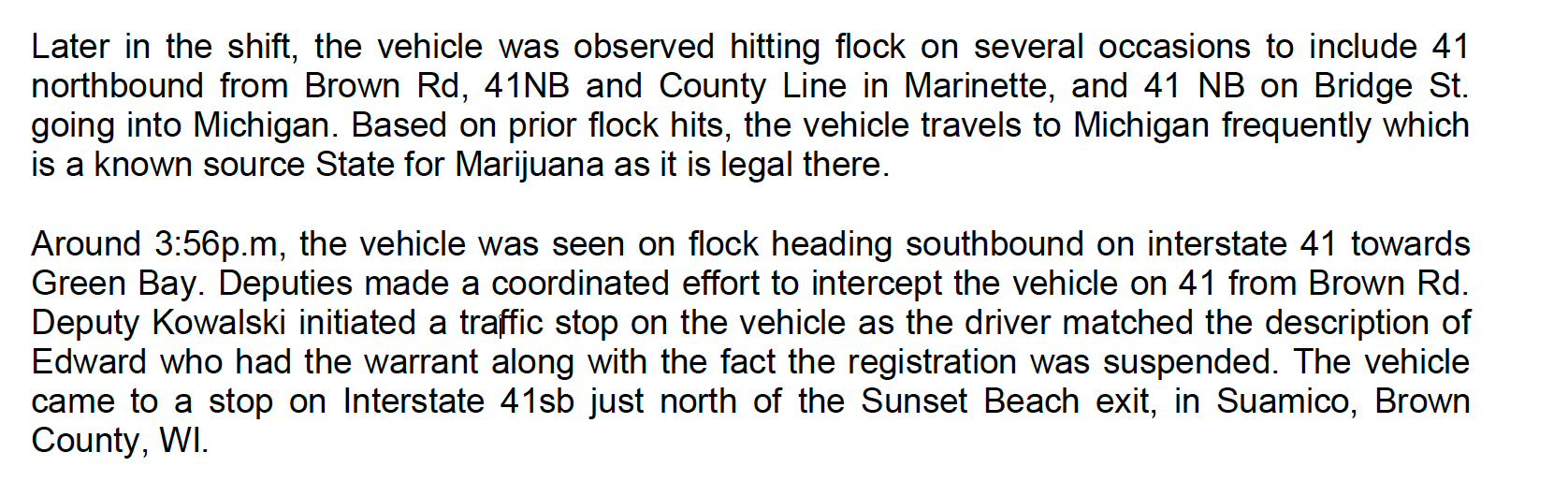
The complaint explains that Abrams-Phillips was tracked via Flock’s network over the course of the day to determine that he drove from Wisconsin to Michigan, a “known source state for marijuana as it is legal there,” the complaint states, adding that previous Flock hits indicated that he “travels to Michigan frequently.” Police note that, using Flock, they were able to track Abrams-Phillips driving from Wisconsin to Michigan, then back to Wisconsin over the course of several hours, where he was pulled over and arrested. The Flock searches and arrests happened in April 2025.
“The vehicle was observed hitting flock on several occasions to include 41 northbound from Brown Rd, 41NB and County Line in Marinette [Wisconsin], and 41 NB on Bridge St. going into Michigan. Based on prior flock hits, the vehicle travels to Michigan frequently which is a known source State for Marijuana as it is legal there,” the charging document notes. “Around 3:56 p.m., the vehicle was seen on Flock heading southbound on interstate 41 towards Green Bay [Wisconsin]. Deputies made a coordinated effort to intercept the vehicle on 41 from Brown Rd. Deputy Kowalski initiated a traffic stop on the vehicle as the driver matched the description of Edward.”
After pulling him over, the complaint states that police “detected the odor of what he knew to be raw marijuana coming from inside the vehicle.”
The case is an example of Flock cameras being used to arrest a wanted alleged criminal suspected of committing a violent crime. But it is also an example of police surveillance overreach in that the cameras were specifically used to create a pretext to tack on additional petty crimes based primarily on where a person’s vehicle had traveled. There is a long history of surveillance technology being used in problematic ways in seemingly unsympathetic cases, which eventually creates a slippery slope where the technology can be used against the masses or to enforce against very minor crimes.
It is not difficult to imagine police in one state using Flock to track a resident of their state cross state lines to, for example, obtain an abortion that is legal in one state but not in another. Last year, 404 Media reported on police in Texas who searched more than 80,000 cameras across Flock’s nationwide network for a woman who had a self-administered abortion.
The case is also particularly concerning considering that Flock cameras have popped up outside of weed dispensaries in Michigan. The JARS Cannabis dispensary in Madison Heights, Michigan, went viral this week for putting a “No Flock Zone” sign in front of a Flock camera in the dispensary’s parking lot. “We share our community’s concerns about increased surveillance, which is why we placed the No Flock Zone sign in front of the camera to block its ability to record,” the dispensary said in a public statement. “JARS does not control the camera or have access to any of the data it collects … after we installed our No Flock Zone sign, the city issued a demand letter warning of sanctions if we did not remove it within 48 hours.” But that Flock camera exists specifically to monitor the license plates of people who come and go to the dispensary. It was required by Madison Heights as one of the conditions for giving a dispensary license to JARS: “[The dispensary] must place a FLOCK license plate scanning camera system at the entrance of the customer parking lot prior to commencement of retail sales, and it will give the Madison Heights Police Department unhindered live access to the FLOCK camera, camera footage, and any and all data, which must remain operational at all times.”
Jars cannabis dispensary responded to the Flock camera put up in their parking lot in Michigan 💪 pic.twitter.com/77l1yqA6kA
— Orwell Day (@OrwellDay) July 31, 2026
Flock Audit Reports covering searches done by the Brown County, Wisconsin Sheriff’s Department from April 26, 2025 show that the department used Flock dozens of times that day, often searching thousands of Flock cameras at a time (it is not clear which specific searches were done for Abrams-Phillips’ car, because many of the searches simply list “warrant” or “traffic inv” as the reason).
Tuesday, Flock executives tweeted video examples of their cameras being used to rescue abducted children, in what appears to be a new marketing strategy for the company. “Every child in this video is home tonight because Flock gave officers the right information at the right second,” Flock’s Chief Strategy Officer Rahul Sidhu tweeted. “That’s the mission. That’s the whole company. I wouldn't trade that for anything.”