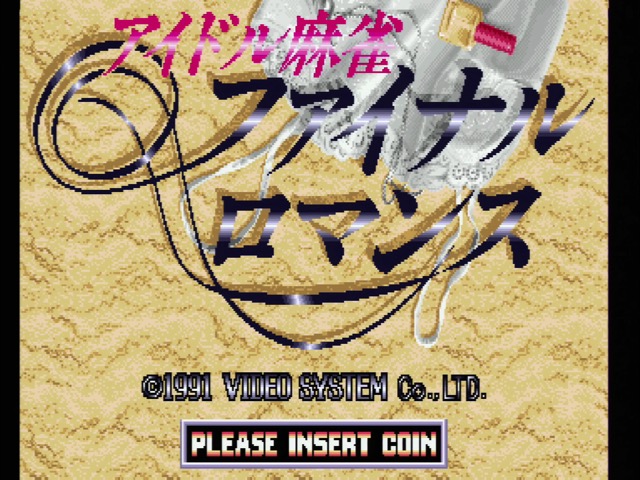
We’re back into the strip mahjong games today, here going back to 1991. Video System is a company that’s probably best known in retro-gaming circles for Aero Fighters/Sonic Wings, but mahjong games (usually branded Idol Mahjong) were one of their bigger moneymakers. And there’s something interesting going on here– Idol Mahjong Final Romance 2-R-4 Special re-releases the final three games in the series, which all also got contemporary console releases, but the first game in the series has never been seen outside of its original arcade launch. Why?
The last romance
The first game in the Idol Mahjong series was actually 1988’s Idol Mahjong Housoukyoku, but all the rest of the games in the series followed the lead of this 1991 title: Idol Mahjong Final Romance.

The goal of this game is simple; you have dates with eight different women. And you’re going to play strip mahjong with all of them, as you do. No elaborate Nichibutsu-style plotline here, though it’s also worth noting that unlike Jaleco’s Mahjong Daireikai, you also don’t get a choice of which girl to play against, you always go through them in the same order.

Idol Mahjong Final Romance has a lot of aesthetic, and a lot of it disappears in later games in the series. This guy who runs the item shop that appears between stages, for example, is replaced with a maid– in fact, I’m not sure you ever see a man in the Final Romance series again. (Is that what makes it final?) The way the item shops work, though, is about the same.

When you’re presented with a girl, you get various graphics to set the scene, along with sampled voice at a very low bitrate.
And then, of course, what you do is play the riichi variant of mahjong, with far fewer points than you should have, with the goal of winning three rounds with a girl so she will become sufficiently unclothed. I went over the basics in my first strip mahjong post earlier this year.

A nice thing about this game is that every coin, even the first one, will start you with enough money to buy the item that lets you do a redraw on your initial hand, and even better, you can choose whether to use it or not after seeing the initial draw. This can be pretty useful if you get an awful hand to start with.

This game is definitely more mahjong-centric than Nichibutsu’s; notice the girl doesn’t even show up during the matches, whereas in Mahjong Koi no Magic Potion the picture of the girl dominated the screen, to the point of hiding the opponents tiles. Keep your eyes on the game! And the AI player can do calls like chii and pon, so look out.

I have to say, I really like the rotoscoped actual pictures approach to these games. Let’s put a pin in that, and instead just note how the animations are also very low frame rate. Every once in a while, you might be able to get a strange state for a single frame.

Hardware

The Idol Mahjong Final Romance PCB is exactly standard for contemporary Video System mahjong games of the late 1980’s and early 1990’s. How much so? Here’s my Final Romance, PCB code VS-Z80-7, next to my copy of Mahjong Daiyogen, PCB code VS-Z80-6. Pretty much the only real difference I see is that less of the board is populated.

So, what does this PCB get you? Well, it gets you an audio circuit with a YM2413 (the same syntehsizer used on the Master System FM add-on) and a OKI MSM5205 ADPCM chip for sample playback. It gets you two 6MHz Z80 CPUs. This is all pretty typical so far. (Someone broke off the corner of this PCB, I see)

The audio circuit is somewhat questionable. This is the sort of thing you’d never bother emulating, but there’s a constant buzz. In this clip from the attract mode with attract mode audio disabled, you can really hear how it interacts with sound effects, which is kind of interesting.
Interestingly, the master CPU has no direct access to the audio circuit or the video circuit. Instead, only the sub CPU has access to that. The master CPU, however, gets the VBlank interrupt and reads the controllers. It’s an interesting division of work, and makes me wonder if the master CPU spends most of its time running the mahjong engine. Note that the other mahjong titles I’ve looked at either used a more powerful 68000 CPU, or in Nichibutsu’s case, scaled back the mahjong engine, removing features like the opponent calling.
The video circuit is almost entirely made up of discrete logic, with the exception of one component, the V-System GGA (Graphics Gate Array?). This chip is seen not only in other mahjong boards, but a whole host of non-mahjong games like Pipe Dream and Welltris. My understanding is it primarily provides some timing assistance in a similar way to the Motorola 6845, but don’t quote me on that one.

Interestingly, the GGA on Final Romance is marked 06.5 while the one on Daiyogen is marked 9N.4. I did not bother to try swapping them, because they’re soldered in and have a high pin density.
Tilemaps
The V-System hardware used in this game features two tilemaps, with scrolling capabilities and colors in 5-bit RGB palettes, 16 colors per tile. That’s perfectly fine for the era, though an interesting quirk is that the tiles are 8x4, unlike the almost universal 8x8. I’m not aware of anyone other than V-System using 8x4 tiles, though Commodore 64 multicolor characters are 4x8.
The interesting thing here is that this is all the hardware has. Now, that’s not unheard of in mahjong– Mahjong Dairekai only had tilemaps. But it had four of them. Why does that matter? Think of it this way: the only way for things to move on screen in increments of less than a tile is to put them on their own scrolling layer, or waste a bunch of tile ROM.
In practice, not very much moves in Idol Mahjong Final Romance. No hands over the tiles, tiles just jump into place, and the main way you see anything move is a full-screen call that puts the text over the screen. And that’s where I say this feels a bit like a slideshow.

This is especially true when paired with another choice made. When tilemaps are loaded in, the palette is blacked out, and then the palette is only loaded in afterwards. This is presumably to prevent you from seeing some kind of partial abomination. What’s interesting is that this is done in phases and blocks; so, for example, when a girl loads in, she fades in in separate parts, the body palette and the face palette take turns on each cycle. It’s subtle, but creates an effect.

Overall, in this case the hardware just gives the game kind of a unique “after-dark” feel. Console ports of strip mahjong games were extremely rare (though not non-existent) at the time, but without the slideshow feel and the audio buzz I think it’d actually lose something.
Pictures

So I wanted to end this by saying a bit about the direction the Idol Mahjong Final Romance series went. The sequel, Taisen Idol Mahjong Final Romance 2, came out in 1995. The “Taisen” refers to the fact that the arcade release allowed two cabinets to be connected, allowing actual two-player mahjong (since, of course, you have to stop your opponent from seeing your screen). We’ll ignore that because I don’t have any friends, or two arcade cabinets. In fact, I’ll be playing the Neo Geo CD port, over composite video because I don’t feel like pulling the SCART cable out of its setup. It is making me wonder if the old CDZ needs some recapping, though.

The gameplay in the single-player mode is pretty much the same as ever. You don’t get to choose your girl, but go through a set order. The item shop works the same way, as does the actual mahjong. You’ll see some pointers here rather than letters, but that’s just because this is a home version running with a controller– I do not have a Neo Geo Mahjong controller, and I doubt that’ll change.

The big difference, though, is that all the artwork of the girls is no longer the rotoscoped photograph look, but instead are anime-style.

This is a general shift that happened in this period, and I’m not exactly sure why. It might just be because of the increased popularity of anime, and in particular, hentai pornographic art. Children who had grown up watching anime were now older teenagers and young adults, and were a larger audience than the old mahjong base.
However, Atwiki claims that it was a rights issue, that using actual models became increasingly complicated as they gained additional rights to their portraits. And, as I noted in the intro, Idol Mahjong Final Romance 2-R-4 Special, the modern re-release, didn’t bother throwing in the original. I mean, otherwise how hard could it be to include? But these are all theories; unless we get an interview with someone from Video System at the time, I doubt we’ll ever know.