Demands from mobile users continue to grow. They want richer visuals, smoother frame rates, and increasingly immersive experiences. For developers the challenge is complex, as they aim to meet these expectations while staying within the strict power, thermal, and bandwidth limits of mobile devices.
Traditional rendering can deliver high image quality, but reaching desktop-class visual fidelity within mobile constraints demands greater efficiency. Neural graphics offers another path, using AI to reconstruct detail, generate intermediate frames, and refine images while reducing GPU demands and overall system workload.
However, bringing neural graphics into mainstream mobile experiences requires deep integration across the GPU architecture and developer ecosystem. With more than 14 billion Mali GPUs shipped to date, Arm has the scale and experience to make these capabilities accessible across the next generation of mobile devices.
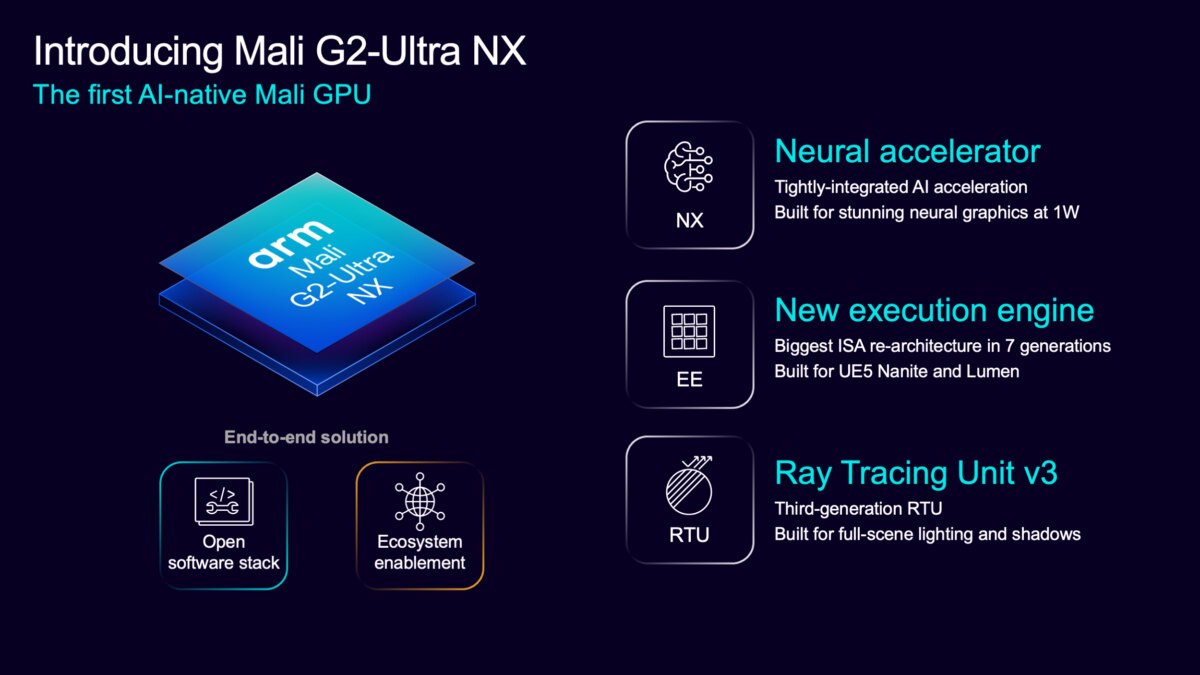
That shift is at the heart of the Arm Mali G2-Ultra NX GPU. As the first AI-native Mali GPU, it integrates neural acceleration directly into the graphics pipeline, helping developers deliver richer, more responsive visual experiences within the mobile power envelope and bring neural graphics into production faster.
An AI-native GPU for neural graphics
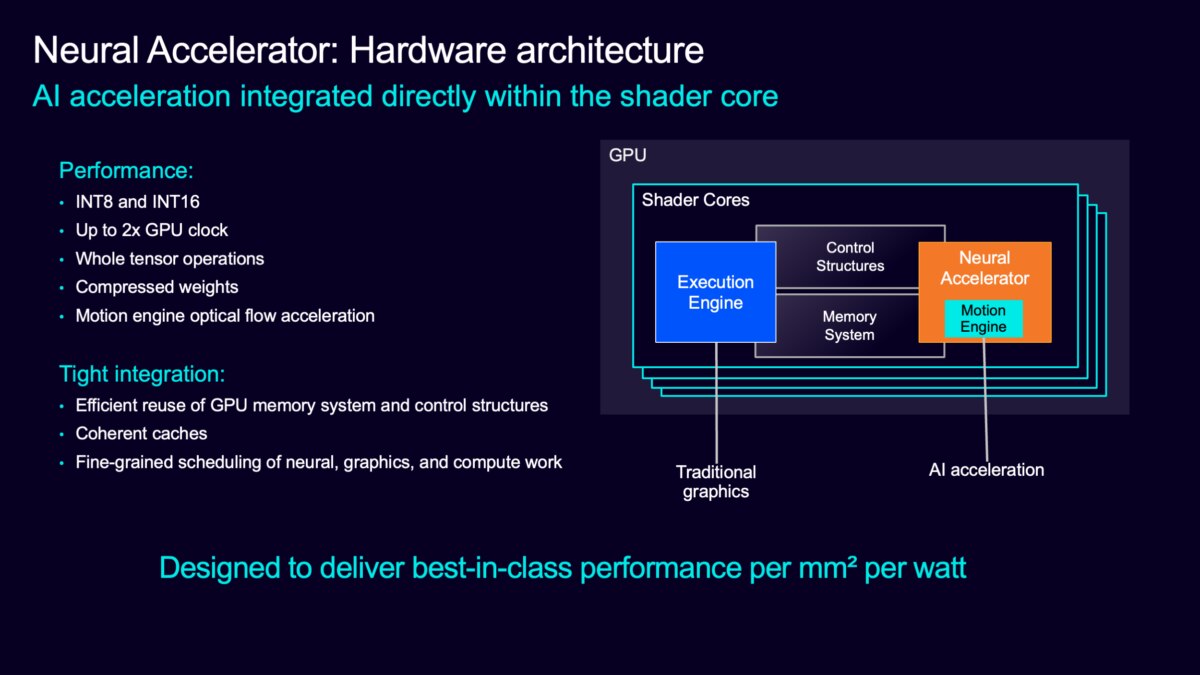
Mali G2-Ultra NX is built for neural graphics from the ground up, with neural accelerators tightly integrated into the shader cores, allowing neural graphics workloads to run alongside graphics and compute workloads. The tight integration reuses the GPU memory system, coherent caches, and control structures, helping reduce data movement and improve efficiency across the pipeline.
Three neural technologies that are part of Mali G2-Ultra NX demonstrate what this enables:
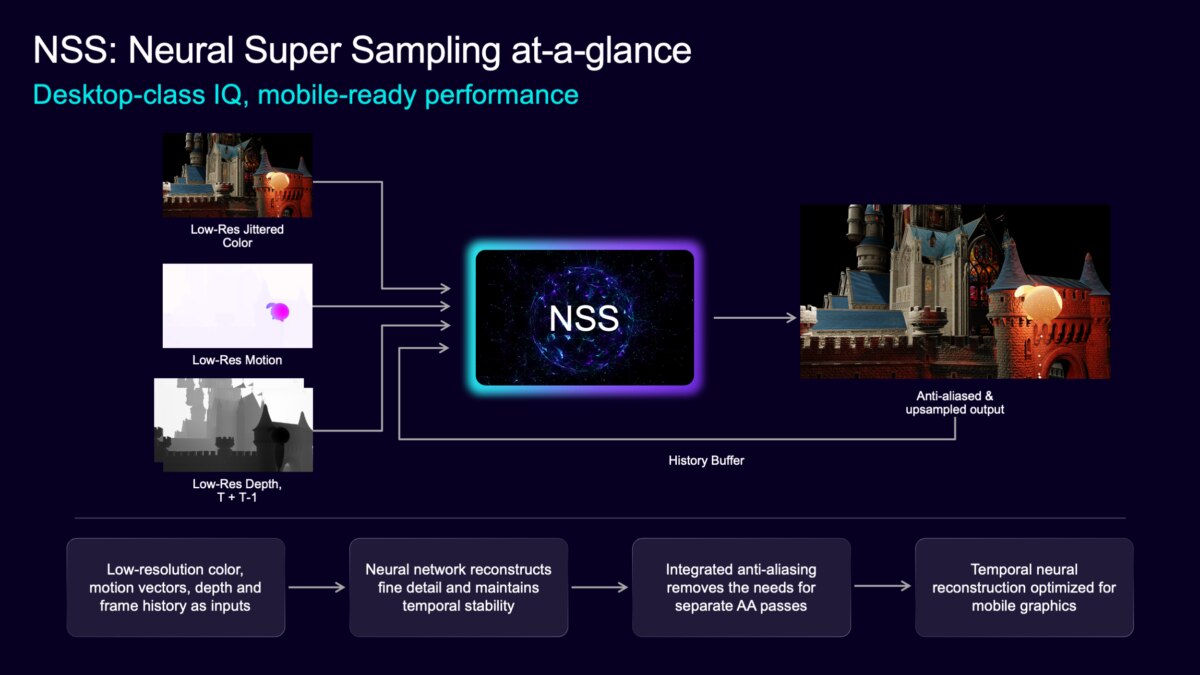
- Neural Super Sampling (NSS) reconstructs higher-resolution images from lower-resolution renders, reducing the amount of conventional rendering work needed to produce a high-quality final image.
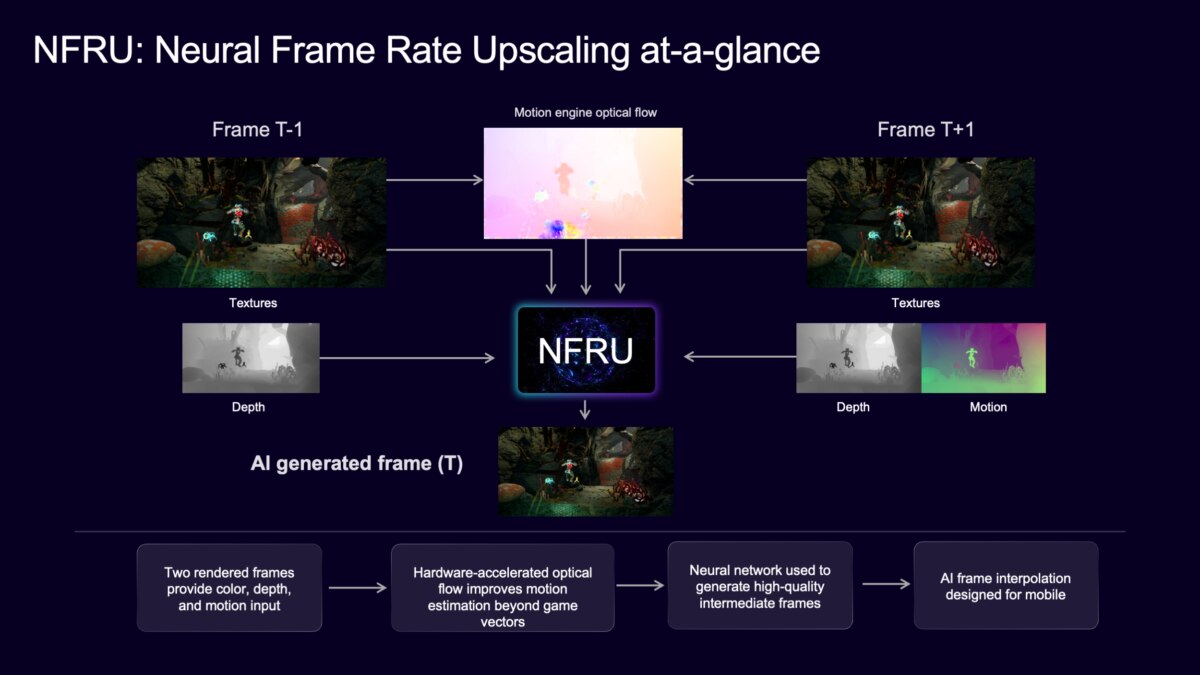
- Neural Frame Rate Upscaling (NFRU) generates intermediate frames to increase frame rates and deliver smoother gameplay.
- Neural Super Sampling and Denoising (NSSD) combines neural upscaling with denoising to improve image quality in demanding ray-traced scenes with complex lighting and shadows.
Neural Dawn, developed by Arm and Sumo Digital, showcases how developers can integrate NFRU and NSSD into a production game pipeline, delivering up to 4x higher performance efficiency and up to 70 percent lower external memory traffic compared with native rendering. These gains can make advanced techniques such as Unreal Engine MegaLights practical on mobile devices.
By combining traditional rendering and neural graphics, developers can preserve image quality while reducing GPU and system-level workloads. For players, that means sharper images, smoother frame rates, richer scenes, and more responsive gameplay within the constraints of a mobile device.
A new execution engine increases the graphics budget
Alongside neural acceleration, Mali G2-Ultra NX introduces a new execution engine – the biggest Mali GPU instruction set architecture upgrade in seven generations – which is designed to handle increasingly complex graphics workloads while improving performance. It provides up to 2x more registers per wrap, helping the GPU handle increasingly demanding scenes more efficiently. This gives developers greater headroom for richer visuals and more complex effects, while maintaining consistent frame rates.
The architectural improvements translate into up to 24 percent higher benchmark performance and 14 percent higher non-AI gaming performance compared with the previous generation. Combining the architectural improvements with neural acceleration through NFRU supports longer mobile gaming sessions at up to 120 FPS for smoother, more responsive gameplay.
Third-generation ray tracing unit delivers richer lighting and shadows more efficiently
Mali G2-Ultra NX introduces Arm’s third generation of hardware ray tracing, supporting more complex lighting, shadows, reflections and geometry on mobile devices. The new GPU architecture delivers up to 13 percent lower DRAM traffic on leading ray tracing benchmarks, reducing memory pressure as scene complexity increases.
Meanwhile, hardware support for Opacity Micromaps helps handle intricate transparent geometry more efficiently, enabling richer foliage, more detailed fabrics, layered surfaces, and other complex scene elements on mobile devices. In one Arm demo, using Opacity Micromaps increased frame rates by 30 percent and reduced the ray tracing workload by up to 70 percent, demonstrating how the technology can make complex geometry more practical on mobile.
Neural graphics complement these advances in ray tracing. Combining new ray tracing hardware with neural technologies, such as NFRU, helps deliver richer visual detail more efficiently within mobile rendering constraints.
Giving developers a practical path to bring neural graphics to production faster
However, new graphics hardware only delivers value when developers can access it through familiar tools and workflows. Arm started preparing the software ecosystem two years before Mali G2-Ultra NX with Arm Neural Technology and an open development kit for neural graphics. These gave content developers, tools developers, and game engine providers early access to neural techniques, so they could begin integrating them into existing workflows before the hardware arrived.
Today, the Arm Neural Graphics Development Kit provides the software and tools needed to move that work toward production across established graphics APIs, game engines, and custom workflows. The developer stack includes NSS and NFRU, along with machine learning extensions for Vulkan and plug-ins for leading game engines, including Unreal Engine. An SDK supports custom-engine integration, while profiling, graphics optimization, training, and model-optimization tools help developers evaluate and fine-tune neural graphics workloads.
All these resources provide a path from experimentation to production without requiring studios to build bespoke research infrastructure or change the development workflows they already use.
As Keli Zhou, Engine Lead for Where Winds Meet, says, “Through our collaboration with Arm, we are integrating Arm Neural Technology into the Messiah Engine and bringing it into real-world game development. Where Winds Meet will be among the first games to bring Arm Neural Technology to players, marking an important step from engine-level integration to real-world deployment. Together, we are paving the way for broader developer adoption of neural graphics across the gaming ecosystem.”
The AI-native graphics foundation for Arm CSS for Mobile 2
Advanced mobile graphics require optimization across the entire system, not just the GPU. Within Arm CSS for Mobile 2, Mali G2-Ultra NX brings AI-native graphics together with compute, memory, software and implementation optimizations to help silicon partners manage increasingly demanding workloads within mobile power and thermal constraints.
Combined with an ecosystem ready to put these capabilities into production, this raises the ceiling for mobile graphics, enabling richer visuals, and smoother experiences delivered to billions of mobile devices.
Arm Mali G2-Ultra NX
Advancing mobile graphics by integrating neural accelerators directly into the graphics pipeline.