Border Patrol is running secretive predictive policing units that analyze Americans’ financial activity and other data, then feed that intelligence to local police who pull people over who are not suspected of any specific crime, but which the government thinks may be worth searching, 404 Media has found.
The units, the name of which 404 Media is revealing here for the first time, are called Predictive Intelligence Targeting Teams (PITT). In one case, a PITT analyzed the financial activity of a man who was driving across Montana, and local authorities stopped him under the pretense of an obstructed license plate and charged him with a DUI.
404 Media identified one PITT in the Spokane Sector, Washington, which polices the U.S. border with Canada, and another in the Laredo Sector, Texas, which polices the border with Mexico. The findings add to an Associated Press investigation from last year which found Border Patrol was using automatic license plate readers (ALPRs) as part of the same wide-spanning predictive policing program.
“The bottom line is genuine probable cause cannot be synthetically generated,” Jake Laperruque, deputy director of the Security and Surveillance Project at the Center For Democracy & Technology, told 404 Media in an email. Here Border Patrol seems to be “using parallel construction to cloak the reason behind its car stops in secrecy. If we can't meaningfully review and evaluate these systems, we can't trust them,” he added.
💡
Do you work at DHS? Do you know anything else about these predictive policing teams? I would love to hear from you. Using a non-work device, you can message me securely on Signal at joseph.404 or send me an email at [email protected].
Predictive policing is a highly controversial practice that police departments and federal agencies are increasingly turning to. The practice is designed to find people who may have committed crimes, but at the moment, no evidence of them doing so exists. Broadly, law enforcement may analyze data — such as a person's movements, where they are at a certain time, or the roads they drive — then create or find another pretense to pull them over.
At around 9:30pm one night in May, Kyle William Olson was driving his black Chevy SUV on Interstate 90, with his dog Ducky in the backseat, according to police reports and an interview Olson gave to 404 Media. In Olson’s vehicle were marijuana edibles, marijuana cuttings, and butane hash oil. He works on a licensed cannabis farm in California, where he had picked up the weed, and was transporting it home to Wisconsin, he told 404 Media.
Olson drove past Sergeant James Beck of the Montana Highway Patrol who was sitting in his police car along with a colleague. When Olson passed, Beck noticed the vehicle’s license plate was obstructed by what he described as a tinted cover and the luggage holder, according to a police report. Beck pulled out, caught up to Olson, and pulled him over.
“Nothing major,” Beck said once he approached the passenger side window and exchanged pleasantries with Olson, according to bodycam footage. Beck said Olson’s license plate was “a little bit obstructed.”
“Just so you know, that’s our reason for stopping you,” Beck said. In the end, the officers demanded Olson step out of the vehicle, they tested his blood and charged him with a DUI. Authorities later charged Olson with possession with intent to distribute because of the marijuana in his vehicle, Olson told 404 Media.
Some of the bodycam footage of Olson's traffic stop. Cut by 404 Media.
But that wasn’t the real reason for stopping Olson.
During discovery in his case, Olson was provided a Department of Homeland Security (DHS) document that explained how Border Patrol instigated his traffic stop. Written by Border Patrol Agent Matthew Phelps, the document said Phelps was assigned to the “Spokane Sector Border Patrol Targeting & Intelligence Division (TID) — Predictive Intelligence Targeting Team (PITT).” Olson shared the document with 404 Media.
In his role at the PITT, Phelps wrote he reviews “law enforcement-sensitive databases” to develop intelligence before handing over information to local law enforcement. That intelligence specifically involves reviewing Americans’ financial activity, the document says.
In Olson’s case, Phelps says he observed, “information contained within law enforcement-sensitive systems suggesting financial activity patterns commonly associated with illicit narcotics activity.” The document says Phelps also looked at Olson’s prior arrest and criminal history.
Phelps wrote he then sent over what he found to Sergeant Beck, to “support general interdiction efforts.” Phelps says in the document that his intelligence was not the “sole basis” for the stop.
In his own report detailing the stop, Sergeant Beck wrote, “It was relayed to me by U.S. Border Patrol targeting analyst Matthew Phelps that he had identified a vehicle that had indicators of possible narcotics trafficking.” Beck then pulled over Olson for the obstructed license plate.
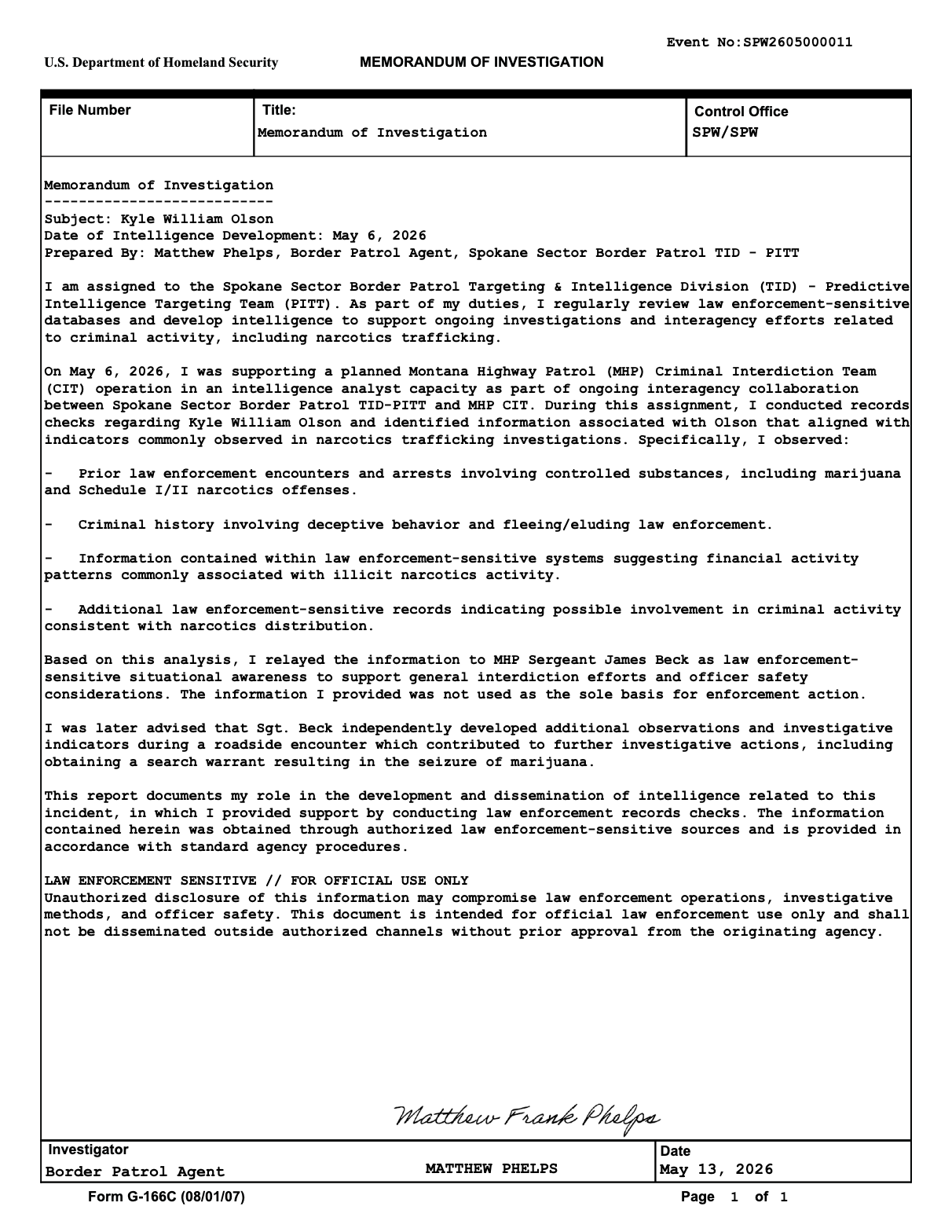
The DHS document obtained by 404 Media shows that Border Patrol is analyzing the financial activity of Americans to find people to pull over. The Associated Press’s investigation found the predictive policing program is also heavily using ALPRs to track potential targets’ movements.
It is not clear how exactly Border Patrol is monitoring Americans’ financial activity. Customs and Border Protection (CBP) declined to answer what financial activity the agency was monitoring, and whether it obtained a warrant or not.
A CBP spokesperson told 404 Media in an email: “U.S. Border Patrol uses intelligence-informed analysis and planning to support national security operations, allocate resources, and help identify potential threats and bad actors to public safety. These efforts are conducted consistent with applicable law, policy, privacy protections, and oversight requirements.”
“For operational security reasons, we do not discuss specific analytical methods, data sources, targeting criteria, investigative techniques, system capabilities, or deployment details. Public disclosure of such information could compromise law enforcement operations and investigations as well as creating safety risks for agents and the public,” the statement added.
Border Patrol’s predictive policing program has led to innocent people being pulled over and questioned. In the case of Alek Schott, who was pulled over on Interstate 35 by a Bexar County sheriff’s deputy in 2022, authorities claimed he had drifted between lanes and then tore apart his vehicle. They found nothing, according to the Institute for Justice, which represented Schott.
In the docket for that case is a copy of conversations between law enforcement officials, including Border Patrol agents. Putting one of those participant’s phone numbers into WhatsApp reveals a profile picture of a law enforcement patch. A chess piece with wings sits in the center, surrounded by lightning bolts. The patch reads, “Laredo Sector Tech Ops PITT,” indicating there is also a Predictive Intelligence Targeting Team in the Laredo Sector.
Border Patrol operates 20 sectors according to CBP’s website. CBP declined to answer whether any of these other sectors also have Predictive Intelligence Targeting Teams.
“The government’s increasing use of mass surveillance — whether that surveillance comes via ALPRs, financial records, or the like — coupled with predictive policing is a recipe for tyranny,” Rob Frommer, senior attorney at the Institute for Justice, told 404 Media. “We fought a revolution for the idea that we are citizens, not subjects. Yet schemes like CBP’s Predictive Intelligence Targeting Team treat all Americans as if they are potential suspects. This is not just wrong, it’s unconstitutional, and IJ will keep pushing courts and Congress to end this attack on Americans’ security.”