Chess.com Leak Exposes 7.3 Million Users – Evidence Points to Scraping

7.3 million Chess.com profiles leaked online: the data is genuine, but evidence points to large-scale scraping, not a server breach.
Free is a strange price for stolen data, and that’s exactly what makes this listing worth a second look. A 15.5 GB file containing over 7.3 million chess.com user records showed up on two data-leak forums this week, no cost, no ransom demand, just handed out. Ransomnews’s technical analysis confirms the data is real and recent. What it isn’t, on the evidence, is a hack.
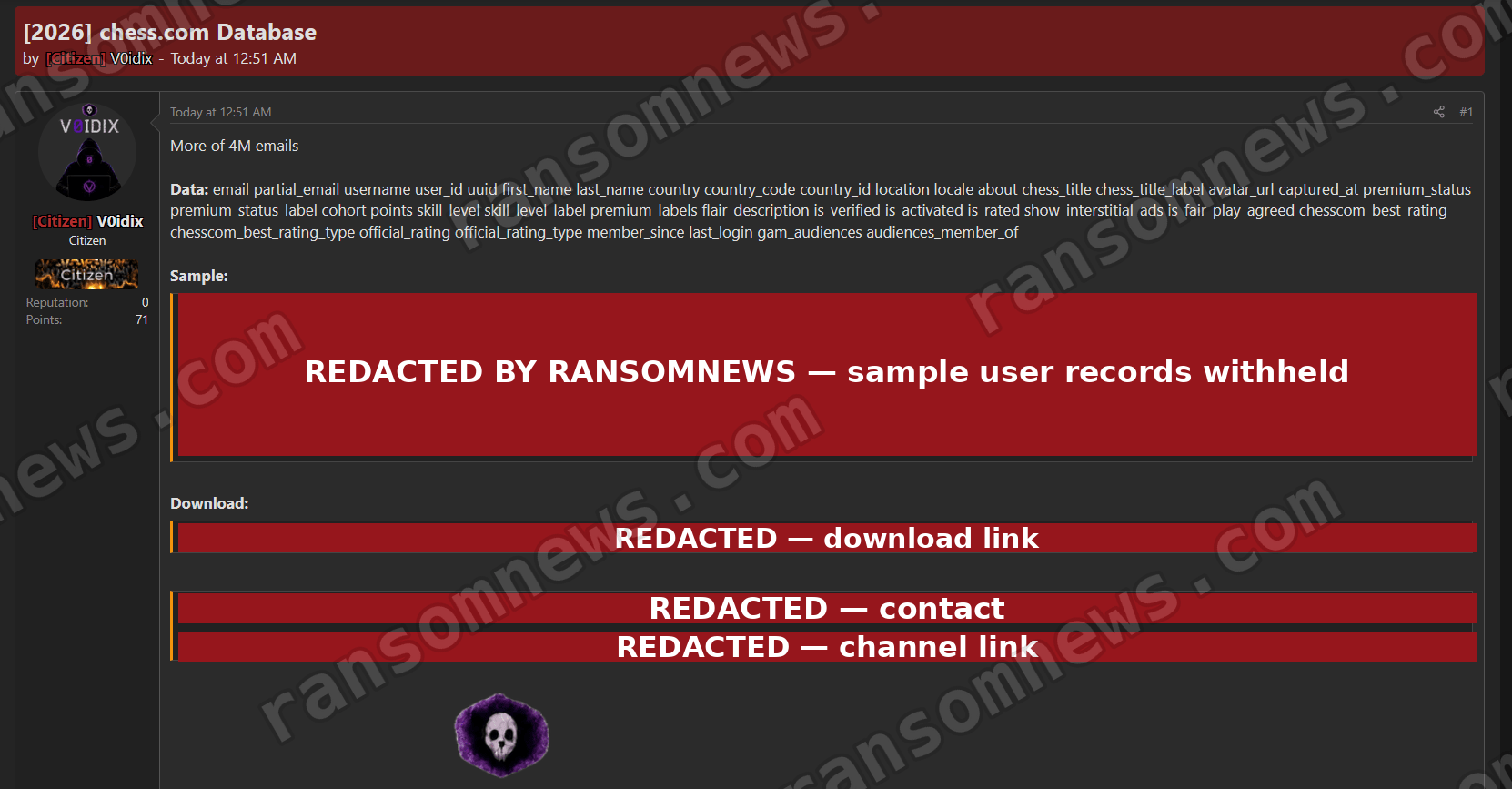
“The archive is a single 744 MB 7-Zip file that expands to a 15.5 GB tab-separated table: one header row and 7,337,395 records, each with 38 fields. The schema is chess.com-specific throughout. Alongside the obvious identifiers, email, partial email, username, user ID, UUID, first and last name, country, location and locale, it carries platform state: chess title, points, skill level, premium status and label, verification and activation flags, best rating and rating type, official rating, member-since and last-login timestamps.” reads the report published by Ransomnew. “Two fields at the end are the interesting ones. Every record has gam_audiences and audiences_member_of populated, Google Ad Manager audience segments, with values like coach-nudge experiment groups, trial eligibility, lapsed-user cohorts and rating-band targeting. Those are marketing-stack fields, not profile data. They do not appear in chess.com’s public API.”
The file carries email addresses, usernames, real names, countries, chess ratings, subscription tiers, and something odder: internal Google Ad Manager audience tags, the kind of marketing segmentation data that never shows up in chess.com’s public API. Roughly three-quarters of records include an email address. There are no passwords, no password hashes, and no payment data anywhere in the file, which matters a lot for how seriously affected users need to react.
Proving this data is genuine didn’t require touching chess.com’s servers at all. Every account UUID in the file is a version-1 identifier, the kind that embeds the exact timestamp it was generated, and researchers decoded that hidden timestamp across 200,000 sample records to compare it against each account’s registration date. The match rate came back at 100%, which isn’t something anyone could fake without possessing actual chess.com-issued identifiers down to the millisecond.
Three separate details point toward scraping rather than an actual system breach. The data wasn’t captured in one moment, it was stamped across nine consecutive days in daily batches, the pattern of a scheduled collection job rather than a single database dump. About 7.4% of user records appear twice, the same accounts revisited on different days, something that simply doesn’t happen inside a genuine database export.
This has happened to chess.com before, and the company was blunt about it at the time. Back in 2023, a similar leak of 828,000 records surfaced with a nearly identical field structure, and chess.com stated plainly,
“In November 2023 a threat actor published 828,000 chess.com records with a near-identical field set. Chess.com’s response then was unambiguous: as it told Hackread, “This was NOT a data breach.” continues the report. “Our infrastructure, member accounts, and data such as passwords are secure.” The data had been pulled by abusing the platform’s find-friends feature, feeding in externally sourced email addresses to resolve them against accounts. A second scrape affecting roughly 476,000 users followed. This 2026 file is the same technique at roughly nine times the scale.”
That earlier incident came from abusing the platform’s find-friends feature to resolve external email lists against real accounts; this new file looks like the same technique running at roughly nine times the scale.
One detail doesn’t fit a purely public-facing scrape, though. Advertising-audience segment data isn’t something chess.com’s open API exposes, and it appears on every single row in this file, which suggests whoever built this had access to an authenticated or internal-facing endpoint rather than just the public developer tools. That’s the specific question chess.com is best positioned to answer, and it’s the one that actually matters for understanding how this happened.
The account distributing the file, going by V0idix, isn’t monetizing anything here. The same handle has posted dozens of free database dumps across other unrelated companies, building reputation through volume rather than through sales, which fits a collector who harvests and republishes data rather than someone selling access to a fresh intrusion.
None of this means chess.com users should shrug it off just because passwords weren’t exposed. A verified email sitting next to a real name, country, skill rating, and subscription tier is more than enough raw material for a convincing phishing message about a membership renewal or a fair-play dispute. The right response isn’t panicking about a hacked account, it’s treating unexpected chess.com emails with more suspicion than usual and checking whether that same email address has turned up anywhere else, since reused credentials remain the far more dangerous exposure than anything sitting in this particular file.
Follow me on Twitter: @securityaffairs and Facebook and Mastodon
(SecurityAffairs – hacking, Chess.com)