Preface:
“The KhipuFieldGuide democratizes khipu research, making the wonder of khipus available to everyone.”
“Readers interested in visualizations and computational analyses of OKR data are encouraged to explore the Khipu Field Guide (KFG), a new project by independent researcher Ashok Khosla. In addition to highly-detailed symbolic renderings of over 600 OKR khipus, users can explore interactive graphics accompanying Khosla’s exploratory data analysis. The KFG investigations are a welcome addition to previous computational work on the OKR carried out by Carrie Brezine and Jon Clindaniel.”
“I love The Khipu Field Guide by Ashok Khosla, because it presents diagrams of khipus that are easier to analyze than photos.”
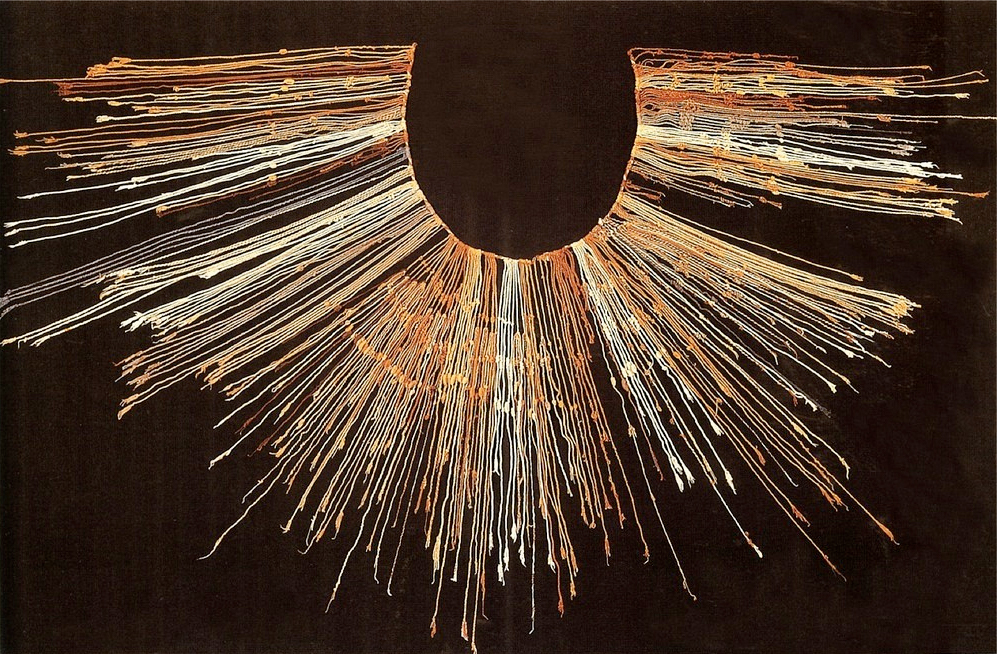
KH0279 - A “banded” khipu.

KH0279 - A schematic drawing of the same Khipu, arranged to show its primary cord, pendant cords, and subsidiary cords.
Welcome to The Khipu Field Guide - Travel back in time to the Inkan empire of the 14th through 16th century. Explore how the Inkas used cloth to communicate and record commitments. Journey with me, as I work with other khipu scholars, to decipher the enigma behind a knotted mop of camelid yarn.
This site has seven sections.
GUIDEBOOK
Start here, if you’re not familiar with how to read a khipu, the history of khipu research, or how the process of decipherment works.SKETCHBOOK
Use the web to view the khipu using a schematic likeness of the original cords and knots. Our highly curated database, the world’s largest collection, currently contains 703 khipus.NOTEBOOK
Ready to adventure into the technical details, and start deciphering? Put on your thinking cap and journey with me. Some of the decipherment work described here has been recently published by co-researcher Manuel Medrano and myself. Our article “How Can Data Science Contribute to Understanding the Khipu Code?”, in the professional archaelogical journal Latin American Antiquity, presents our unearthing of common decipherment patterns throughout this site’s khipus. Many of those patterns are revealed in the Notebook. More exciting pattern breakthroughs are on their way to being presented!TEXTOSBOOK
Textos Andinos, a two-volume book set written by Marti Pärssinen and Jukka Kiviharju, is a translation of original court documents from the Spanish archives, where the plaintiffs used khipus in their court recitations. Called “Paper Khipus”, by Manuel Medrano, these paper khipus were the subject of his Bachelor’s thesis project at Harvard.DATABOOK
With over two years of work curating and database restoration (affectionately known in the trade as yak-shaving), the Khipu Field Guide now contains the world’s most accurate and largest digital database of Inka khipus - currently 703 khipus. Digitizing is a difficult process. This page describes the painstaking, and still continuing, task of digitizing existing khipus, and restoring malformed digitizations using newly gained knowledge about khipu. For example, if you don’t know how to read Arabic, how can you tell it’s read from right to left? The problems are similar with khipu. Why do I believe some khipus have been accidentally recorded backwards? As you journey through investigations developed in the notebook, you’ll learn about the intriguing patterns that reveal khipu order, even when the khipu is broken, and missing its ends.BIBLIOGRAPHY
Much has been written about khipu. This fieldguide builds on Marcia and Robert Ascher’s work summarized in their wonderful book, republished in 1997 by Dover Books, entitled Mathematics of the Incas: Code of the Quipu. Want to learn more? Karen Thompson’s Bibliography work is a great place to start.ABOUT
The researchers behind the Khipu Field Guide.