3 Aug 2026
Fourteen years ago, Gary Bernhardt coined the term Functional Core, Imperative Shell . Like most good ideas in computing it was not entirely new, but his conception had great clarity, and it forms an excellent basis for talking about testing and determinism in existing systems.
Briefly, Functional Core/Imperative Shell architecture divides the code into two parts. The Functional Core is purely functional - that is no IO, and no destructive state updates. It is concerned with the business logic of the application. The Imperative Shell has comparatively little pathing, but maintains state, coordinates external dependencies, and deals with the outside world - that is to say IO. Its job is to query the core with values, receive values back as the result of some blackbox decision, and use that to interact with the outside world; whether that's writing to a database, sending a request, or updating a GUI.
The Shell and the Core in this model have distinct characteristics:
| Core | Shell |
|---|---|
| Makes decisions | Coordinates dependencies |
| Many branching execution paths | More linear execution |
| Isolated from the world | Integrates with the world |
This makes the core very amenable to testing. Since it's purely functional, the same inputs will always get the same results. Since it's isolated, there is nothing to mock or stub. And since it handles complex business logic, the tests can tell us a lot about how the system behaves.
Functional Purity and Determinism
A shorter way of describing the properties that make pure functions amenable to testing is that they are deterministic. That is - given a stream of inputs, a pure function always returns the same stream of outputs; their behaviour is repeatable. But pure functional programming is not the only way to get there. If we tilt our heads a little we can see that a stream of values and a sequence of assignments are different ways of expressing the same thing, and State Machines can bring us the same benefits. Consider the following code:
function add(ns) {
 return ns.reduce((a, b) => a + b, 0)
}

class AddMachine {
  #state = 0

  transition(input) {
    this.#state += input
  }

  get state() {
    return this.#state
  }
}
The function add is easy to reason about; it's pure and thus
deterministic. But the AddMachine is also deterministic - given
the same sequence of calls to the transition function, AddMachine
will return the same state. It being imperative does not change that.
const output = add([1, 2, 3])
const a = new AddMachine()
a.transition(1)
a.transition(2)
a.transition(3)

const output = a.state
Pure functional programming is a fine paradigm, but due to language or performance considerations, it is not always practical - I would not want to try it in C! But weakening the requirements from purely functional to merely deterministic, we retain the testability benefits of "Functional Core, Imperative Shell", while broadening its applicability. And so the title of this post: Deterministic Core, Non-Deterministic Shell.
Determinism can feel like a more abstract concept than functional purity. How do you know it when you see it? I find it's easier to start with what is not deterministic and work backwards. Here are some common examples of non-repeatable behaviour:
- Calling RNGs that aren't seeded
- Asynchronous and multi-threaded operations
- Communication over the network
- Communication with other processes
- Reading/Writing to local storage
- Database interactions
- Asking the OS for the date or time
All these belong in the non-deterministic shell. Whenever you find them in your business logic, you have a natural target for defragmentation - either splitting the function in two around them, or lifting them up a layer and injecting their result as a parameter. It's illustrative to think of the "shell" metaphor quite literally; it should surround the logic, querying the heart of the application to get what it needs.
Working with what you have
"This is all well and good", you might think, "but what use of it is to me, toiling away in the legacy & vibe-code mines of industry?". A fair accusation, imaginary reader; not everyone can be Foundation DB and make that distinction from day one (they actually went a step further, but that's a topic for another post). Determinism and non-determinism are highly entwined in almost every real life codebase I have seen, and I've seen my fair share.
But don't let perfect be the enemy of good! One way to think of your average (ie, terrible) codebase is that it has many deterministic cores. There are thousands, strewn through the slop as stars in the sky. The glass half empty take is these codebases are an irredeemable legacy mess. But glass half full is that there are many deterministic cores hidden somewhere inside, and maybe only a handful.
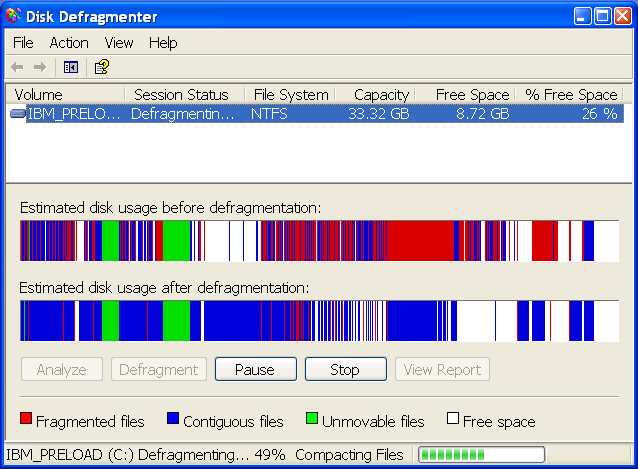
Users of older Windows systems may remember the "Disk Defragmenter"; it took files whose contents were scattered physically across the spinning hard disk and made them contiguous. In an era where read speed depended on physical distance on the media, this mattered a lot.

So one gradual approach for existing code is to practice the Defragmentation of Determinism. Identify it wherever you can - files, classes, even a few lines in individual functions - and start collecting them. The more determinism that can be grouped, the more easily testable functionality you have, and the more you can feel confident about the behaviour and reliability of the program as a whole. The surface area for "hard to test" (non-deterministic code) starts to shrink. On a large enough codebase you will likely never get to a single deterministic core, but even hundreds is better than thousands.
Unleash the State Machine Within!
Every nasty mess of a codebase I've seen has one or more much nicer deterministic state machines locked inside. I promise you they are there, even if it's not obvious. And once you find them, you'll be delighted with how much easier the software is to modify and test. Piece by piece, reliability can be wrought.