18 September 2026 · 3 min
People still tell me that CPUs are boring. That nothing much happens anymore.
Let us look at AMD Ryzen 7 processors from 2022 to 2024: the 5800X3D (Zen 3), the 7800X3D (Zen 4) and the 9800X3D (Zen 5). They are comparable 8-core chips with 3D V-Cache. I have written about them before, in How stagnant is CPU technology?
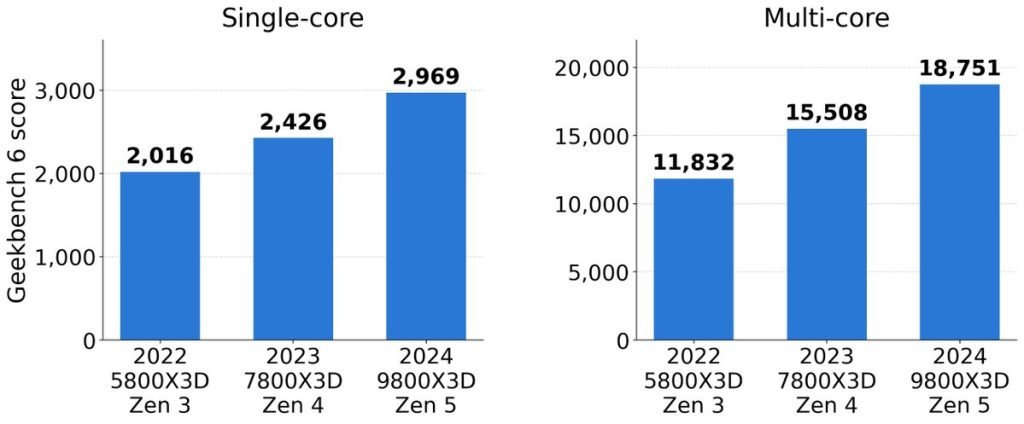
On Geekbench 6, performance went up by about 50% in two years.
| 2022 5800X3D Zen 3 |
2023 7800X3D Zen 4 |
2024 9800X3D Zen 5 |
|
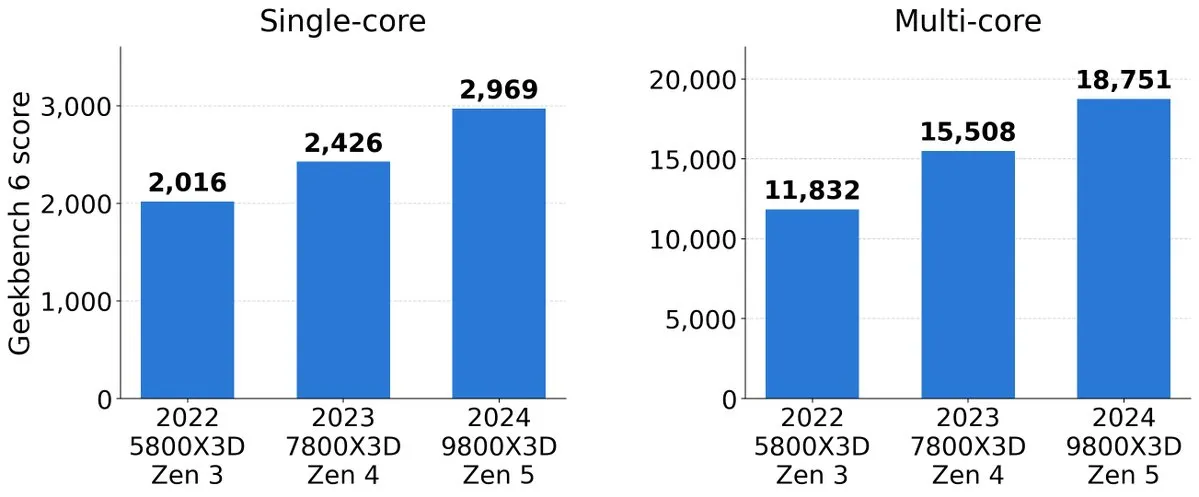
| Single-core | 2,016 | 2,426 | 2,969 |
| Multi-core | 11,832 | 15,508 | 18,751 |
The 2024 chip is 47% faster on a single core than the 2022 chip, and 58% faster with all cores.
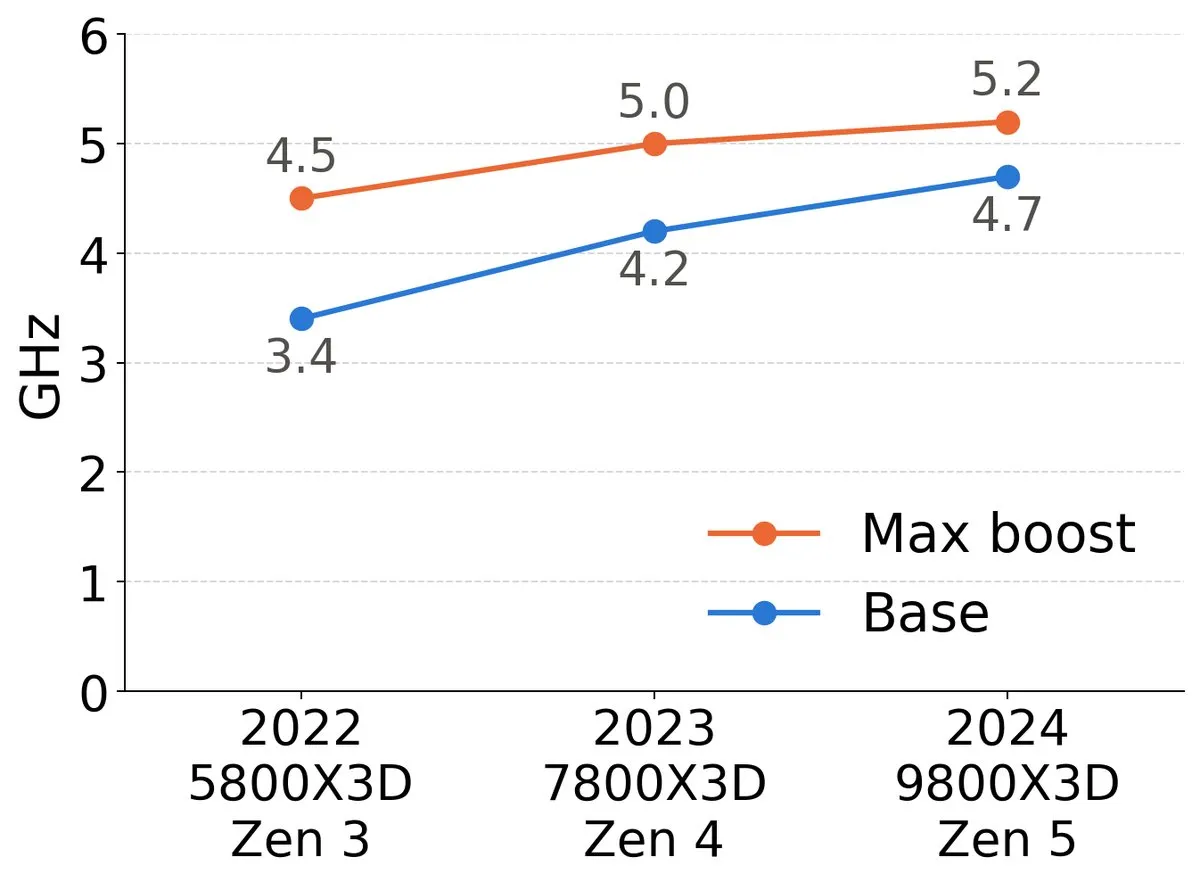
The clock did not do that. Max boost went from 4.5 GHz to 5.2 GHz, a 15% increase.
| 2022 Zen 3 |
2023 Zen 4 |
2024 Zen 5 |
|
| Base | 3.4 GHz | 4.2 GHz | 4.7 GHz |
| Max boost | 4.5 GHz | 5.0 GHz | 5.2 GHz |
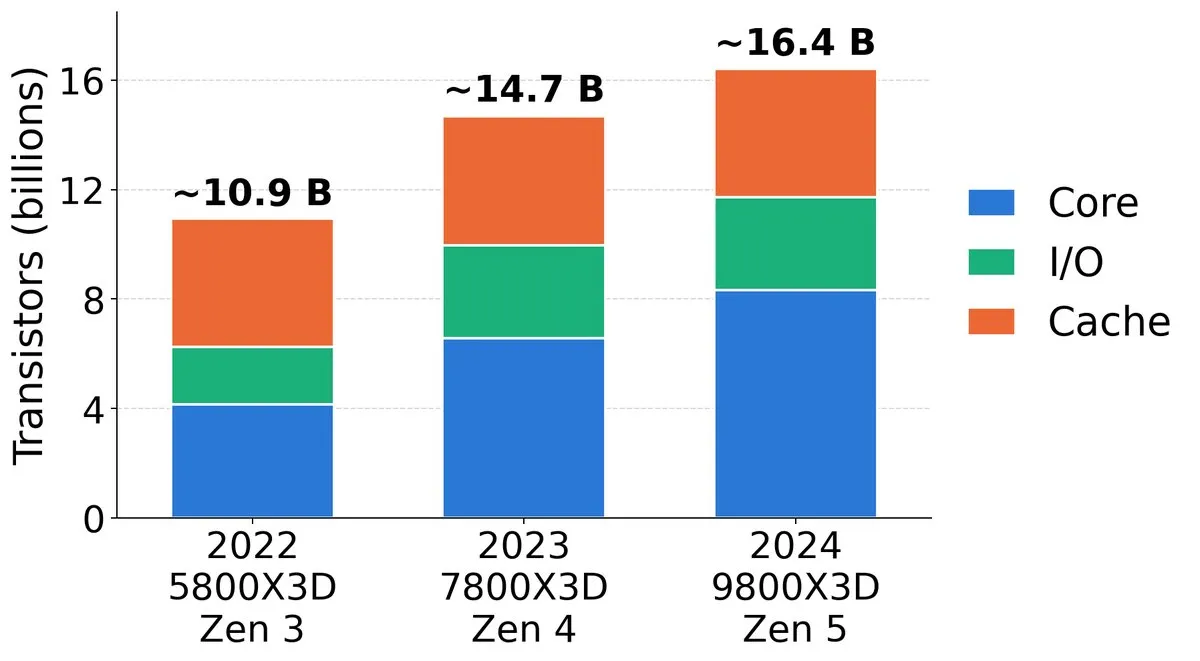
The number of transistors is way up, by about 50%, from roughly 11 billion to 16 billion. Most of the extra transistors went into the core, not the cache.
How do you turn extra transistors into extra performance?
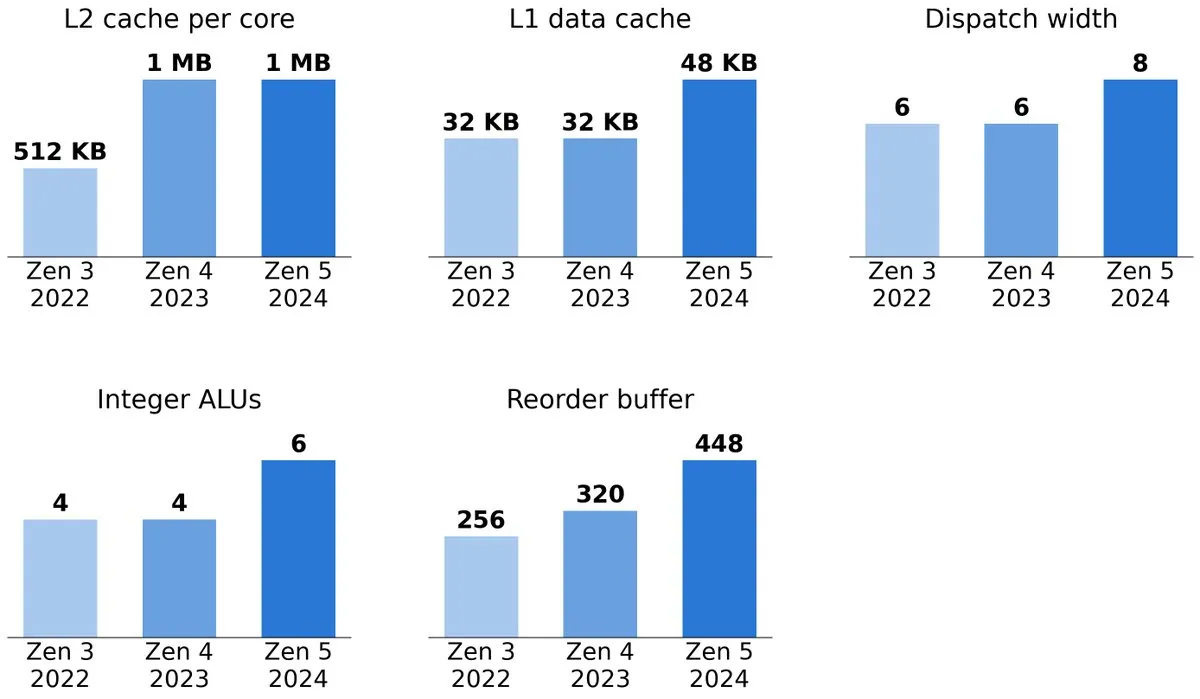
You make the core wider, and you give it more to work with. Dispatch width went from a maximum of 6 instructions per cycle to 8. The L2 cache per core doubled, from 512 KB to 1 MB. The L1 data cache went from 32 KB to 48 KB. Integer ALUs went from 4 to 6. The reorder buffer grew from 256 to 448 entries, so the processor can keep more instructions in flight and schedule them better.
| Zen 3 2022 |
Zen 4 2023 |
Zen 5 2024 |
|
| L2 cache per core | 512 KB | 1 MB | 1 MB |
| L1 data cache | 32 KB | 32 KB | 48 KB |
| Dispatch width | 6 | 6 | 8 |
| Integer ALUs | 4 | 4 | 6 |
| Reorder buffer | 256 | 320 | 448 |
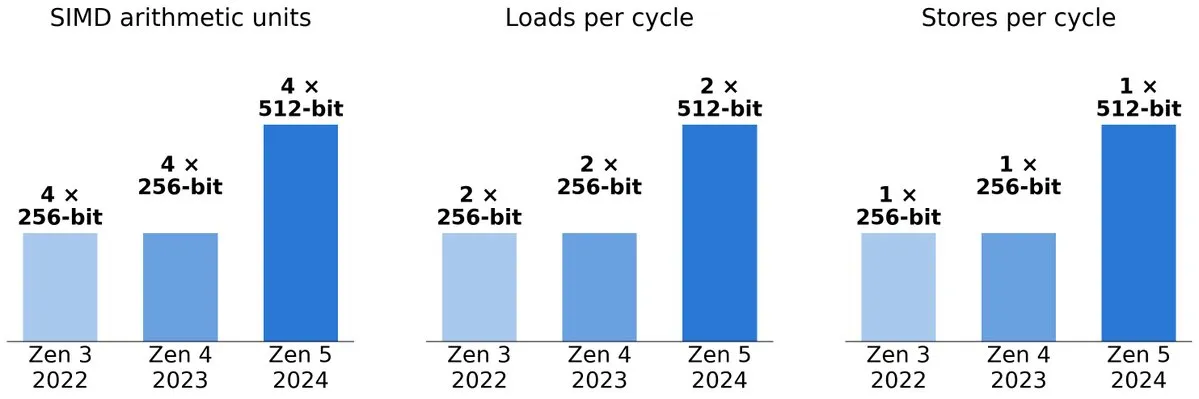
For data parallelism (SIMD), Zen 5 is a different machine. Zen 3 and Zen 4 had four 256-bit SIMD arithmetic units. Zen 5 has four 512-bit units. Loads and stores widened the same way: two 512-bit loads per cycle, one 512-bit store.
| Zen 3 2022 |
Zen 4 2023 |
Zen 5 2024 |
|
| SIMD arithmetic units | 4 × 256-bit | 4 × 256-bit | 4 × 512-bit |
| Loads per cycle | 2 × 256-bit | 2 × 256-bit | 2 × 512-bit |
| Stores per cycle | 1 × 256-bit | 1 × 256-bit | 1 × 512-bit |
I already made the point that processors are getting wider. This is what that looks like on a desktop chip you can buy.
What about the next step? Zen 6 is arriving. AMD is talking about a 256-core Epyc part (Venice) with a gigabyte of L3 cache. We do not yet know what the desktop cores will look like. It could be wild.
Further reading: AMD’s 256-core Epyc 9996 ‘Venice’ (Tom’s Hardware).
`; modal.addEventListener('click', function(e) { if (e.target === modal) modal.close(); }); modal.querySelector('#bibtex-copy-btn').addEventListener('click', function() { const text = modal.querySelector('#bibtex-target').textContent; navigator.clipboard.writeText(text).then(() => { const origText = this.innerText; this.innerText = "Copied!"; setTimeout(() => this.innerText = origText, 1500); }); }); document.body.appendChild(modal); const style = document.createElement('style'); style.innerHTML = `dialog::backdrop { background: rgba(0, 0, 0, 0.5); }`; document.head.appendChild(style); } // 1. Extract the URL const fullLinkHtml = el.dataset.fullLink; const tempDiv = document.createElement('div'); tempDiv.innerHTML = fullLinkHtml; const linkElement = tempDiv.querySelector('a'); const rawUrl = linkElement ? linkElement.href : ''; // 2. Compute the current access date const accessedDate = this.getCurrentAccessedDate(); // 3. --- NEW LOGIC: Extract ONLY the year (YYYY) --- // Gets the full date string, e.g., "November 23, 2025" const fullDateString = el.dataset.year; // Use regex to find the four-digit year at the end of the string const match = fullDateString.match(/(\d{4})$/); const publicationYear = match ? match[0] : '????'; // e.g., '2025' // 4. Generate BibTeX Data with the corrected year const safeTitle = el.dataset.title.replace(/[^a-zA-Z0-9]/g, '').substring(0, 15); // Use the clean year for the BibKey const bibKey = (publicationYear + safeTitle); const content = `@misc{${bibKey}, author = {${el.dataset.author}}, title = {{${el.dataset.title}}}, year = {${publicationYear}}, howpublished = {\\url{${rawUrl}}}, note = {Accessed: ${accessedDate}} }`; // 5. Show Modal document.getElementById('bibtex-target').textContent = content; modal.showModal(); } }; })();