
Wall Street is largely on board with the nuclear bull case. But investor patience is thinning with an industry that is enjoying both political support and demand from deep-pocketed customers, yet still struggles to this day to get any projects actually started.
We noted a similar sentiment with Barclay’s nuclear outlook, as investors increasingly want evidence of real delivery.
New research from Jefferies and Bank of America echo similar verbiage (Professional subscribers can read the full notes here at our marketdesk.ai portal).
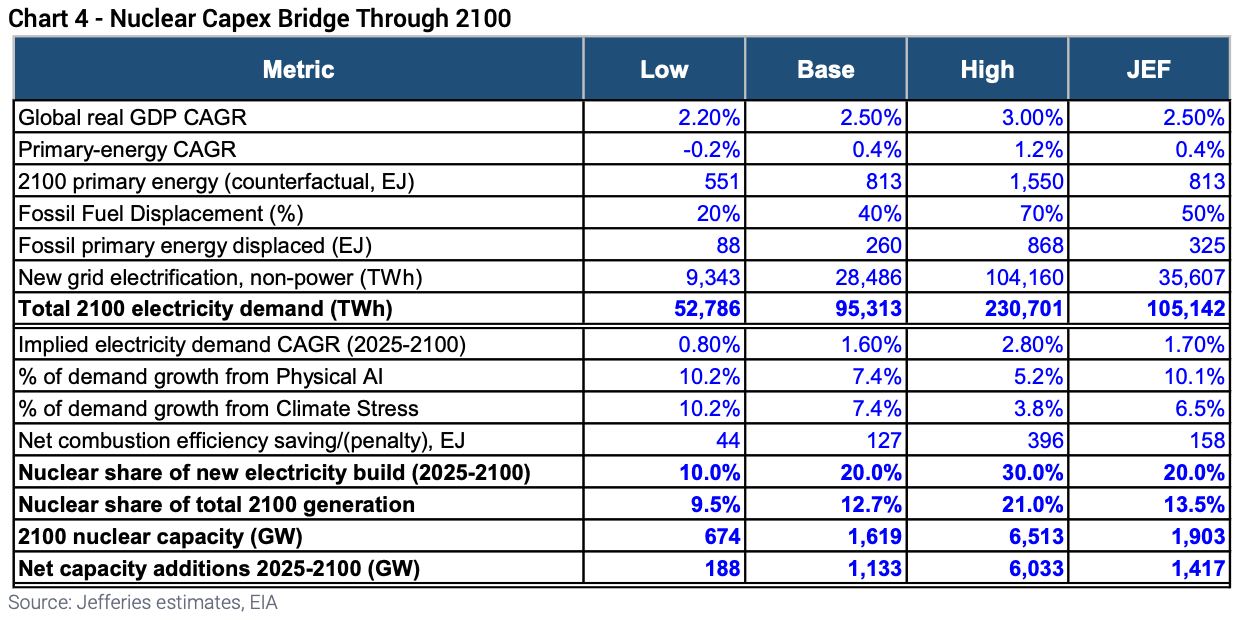
Jefferies' Laurence Alexander projects global nuclear capacity reaching 1,903 GW by 2100, (almost 5x from 2025 baseline). Their forecast also has solar capacity expanding roughly 22x, geothermal 18x, and wind 12x.
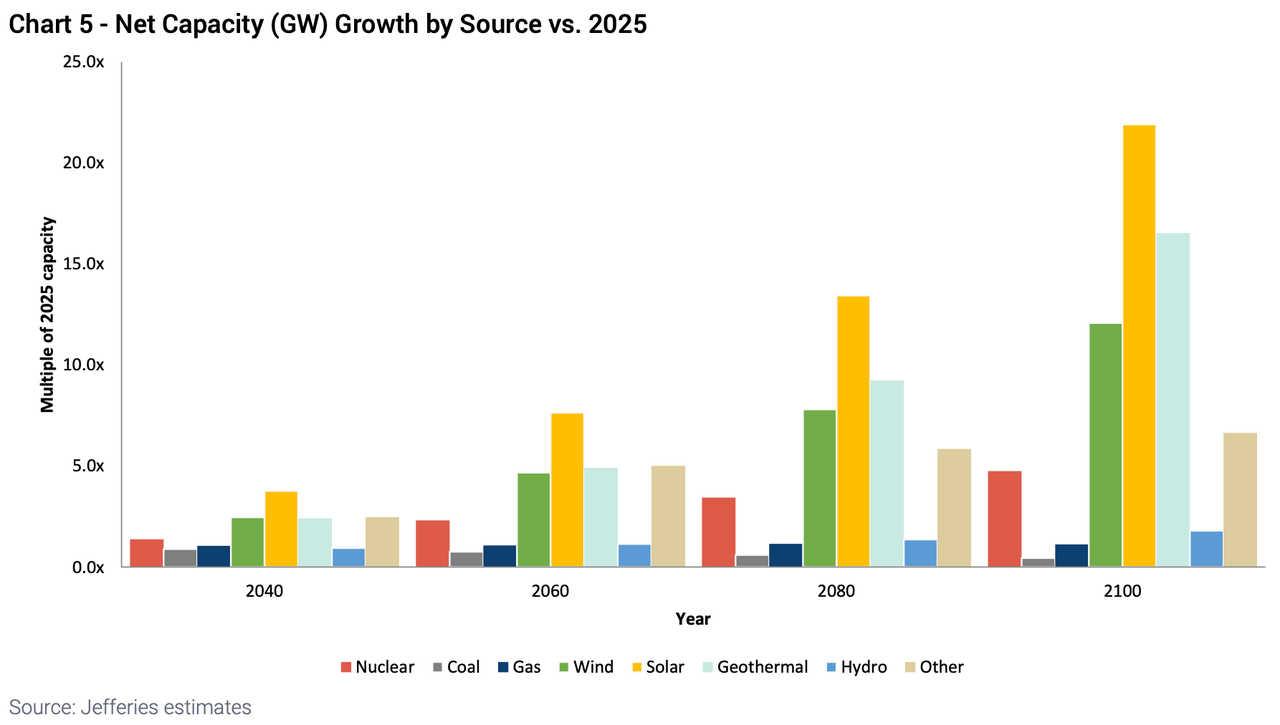
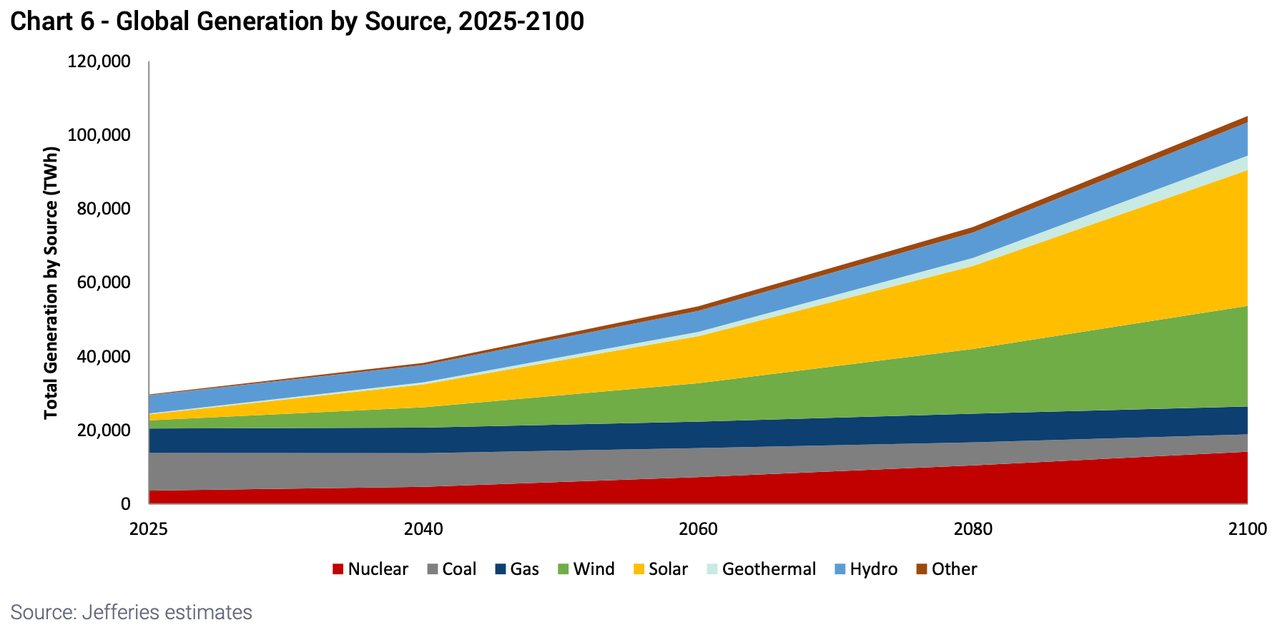
Jefferies frames the rising electricity consumption as leaving room for generation expansion growth across all four low-carbon sources, instead of one just taking over.
Most of the concerns come down to project financing. Massive upfront costs and years without revenue make nuclear particularly sensitive to financing costs. Government support is a way of bridging the gap, but standardized construction and repeat orders will be what really drives down execution risk.
BofA's conference recap highlights China's approach to repeatable fleet deployment, contrasted against Western developers' reluctance to break ground.
Representatives from nuclear companies in China stated their solution to rapid nuclear deployment was standardization, specialization, and centralization. Emphasizing that this must be done across all key areas, including engineering, construction, and talent, the less-than-democratic nation proves why China's success isn't exactly repeatable in the US.
At the recent World Nuclear Association Symposium, the fuel market found itself at the center of attention as one of the notable constraints of the ongoing nuclear renaissance.
Enrichment was the hot topic of the fuel chain. European enrichment giant Urenco noted their order book had grown from just under €9 billion in 2021 to over €21 billion recently.
We've commented repeatedly on not only the lack of enrichment capacity within the US, but the specific lack of unobligated enrichment capacity. Significant investment is still required across the nuclear value chain, but finding a way to create a fuel supply for America's national defense needs (unobligated) is even further behind.
BofA took notes on Amazon discussing contributing capital and expertise to X-energy, Equinix supporting developers, and Exxon exploring nuclear industrial heat. Grid connections, completed designs and allocating construction risk remain obstacles, while new reactors' timelines extend beyond the immediate data-center boom.
Jefferies favors Cameco, Kazatomprom, NexGen and Denison, while BofA prefers Constellation, Cameco, Oklo and Standard Nuclear.
Needham's Sean Milligan initiated NANO Nuclear with a Buy rating and $33 price target. He highlighted its $8.5 million acquisition of Ultra-Safe Nuclear Corp’s development work behind the 15 MW KRONOS design. The University of Illinois Urbana-Champaign project is in formal NRC construction permit review, with key milestones targeted for 2027.
Milligan argues that 9.9% initial enrichment could ease fuel sourcing compared with designs requiring approximately 19.75%, while $580 million of liquidity supports the licensing runway.