
Authored by Thomas Kolbe via American Thinker,
Caught between climate regulation and catastrophic energy-policy decisions, a growing number of high-tech companies in the EU are packing up and leaving. Through stock-market deals, two top quantum-computing companies, IQM and Pasqal, are gradually moving toward the United States. The bleeding of the European economy is now being accepted with remarkable resignation.
Not a week goes by without another disaster report from the economy. In the first half of the year, the German economy recorded a record number of insolvencies -- the highest insolvency figures since 2013. Thousands of industrial jobs are being eliminated as a result, and the economy continues to bleed. A political course correction toward strengthening the economic foundation still appears impossible. And this is only the beginning: the stranglehold of expensive climate policy, the restriction of fossil-fuel energy supplies, and rising regulatory costs are acting like an accelerant on the businesses of the euro economy. Those who can leave, do.
What is happening in Germany is being repeated elsewhere: in Finland, for example, where the company IQM is taking the leap onto the U.S. stock market. IQM specializes in superconducting quantum computers and develops the quantum processors required for them. The systems are being developed for research, high-performance computing, and industrial applications. The company merged with Real Asset Acquisition Corp., a kind of American shell company, and in early July moved to the Nasdaq under the ticker IQMX with a valuation of around $1.8 billion. This is not a classic sale of the company to the Americans -- the existing owners received no cash payment but remained invested in the company. However, this changes little about the outcome: capital, market power, and an increasing share of control over the company’s strategy will, in the future, be rooted in the United States -- American patents, American knowledge of future technologies, made in Europe.
A look at France shows a similar development. This is where Pasqal is based, a spin-off of the Institut d'Optique, founded in 2019. While global players such as IBM and Google rely on superconducting circuits, Pasqal found a different approach: the highly specialized team traps individual rubidium atoms with focused laser beams -- so-called optical tweezers -- inside vacuum chambers and arranges them in precise 2D and 3D lattices. With this principle, the company’s researchers appear to have succeeded in avoiding the production errors that have plagued other qubit technologies so far. The discovered method makes it considerably easier to scale the technology to ever larger numbers of qubits. Knowledge is power, especially in high technology. Given its complexity, the company’s innovation is probably only fully understandable to a few specialists.
Pasqal’s systems are going to data centers such as the Jülich Research Centre and to the Saudi energy giant Aramco. The applications extend across industries -- from energy company EDF to major bank Crédit Agricole, for which the race for cryptography and security technology has long since begun. From logistics optimization and materials simulation to risk analysis -- Pasqal is competing right at the forefront across the board.
One of the company’s co-founders was Alain Aspect, the French physicist who received the Nobel Prize in 2022 together with John Clauser and Anton Zeilinger for verifying the quantum entangelment of photons, thereby laying the scientific foundation for modern quantum technology. It is a good example of how university research and technological development can become intertwined at the corporate level. Yet as capital increasingly flows from the EU to America, these pillars of European academic and corporate culture are gradually disappearing.
In the case of Pasqal, the acquisition of the company by the shell company Bleichroeder Acquisition Corp. II on August 28 paved the way for its know-how to cross the Atlantic. The company is currently valued at around $2 billion -- but this is likely to be only a snapshot; its potential is enormous. With its patents, research results, and academic substance, Europe is losing its intellectual foundation -- all the more serious because the continent is energy-poor, politically cornered, and steering aimlessly through uncertain waters. Europe is simply no longer attractive enough for cutting-edge research, top-tier capital, and top talent.
Why, then, is quantum computing currently on everyone’s lips?
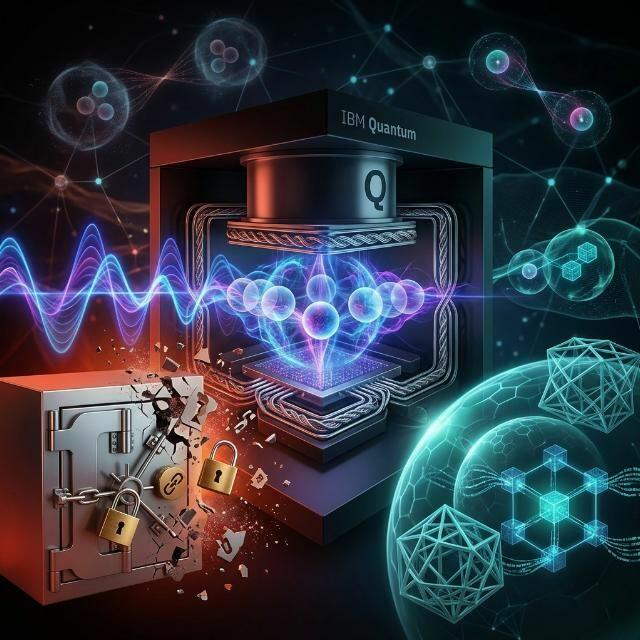
Quantum computing -- as demonstrated by the determination with which the American economy has gone hunting for patents -- is far more than merely the next step in conventional computer technology. Conventional computers think in switches: on or off, zero or one. Every bit is like a tiny lamp that is either lit or dark. Quantum machines, by contrast, work with qubits. These can not only be on or off, but both at the same time -- as well as infinitely many states in between, until the system is measured and the final result is determined. Through entanglement, qubits can be connected in such a way that the state of one immediately determines the state of the other -- regardless of how far apart they are. Where a classical computer checks one path after another, a quantum computer explores dozens, thousands, theoretically millions of paths simultaneously.
That does not make them better everyday computers. For texts, spreadsheets, or videos, the classical computer remains superior. But for tasks where the challenge is to find the right combination among astronomically many possibilities -- simulating new molecules, optimizing logistics networks, or breaking encryption -- a fundamental advantage emerges. In strategy papers from the United States, China, and the EU, quantum computing is explicitly identified as a key technology that will significantly advance fields such as materials research, pharmaceuticals, and cryptography.
Whoever controls the key technologies of the future controls global markets and gains geopolitical influence.
It is all the more tragic to see that in the EU, there has so far been little resistance, politically but also from within the business community, to ideologically driven, technology-hostile policies. The EU area now lacks almost all the conditions required to attract brilliant minds to high technology, encourage new companies to be founded, and enable investment and settlement in future-oriented clusters such as robotics, quantum computing, or artificial intelligence. Europe has specialized in saving the climate, and many on the continent seem indifferent to deindustrialization and the slowly emerging impoverishment of society. But Europe is facing Ayn Rand’s final bombshell: You can ignore reality, but you cannot ignore the consequences of ignoring reality.