
Authored by James Rickards via The Daily Reckoning,
It's past time to look beyond the AI hype. The stock valuations of the leading hyperscalers and frontier AI modeling companies are almost certainly in bubble territory. But the market will sort that out in time.
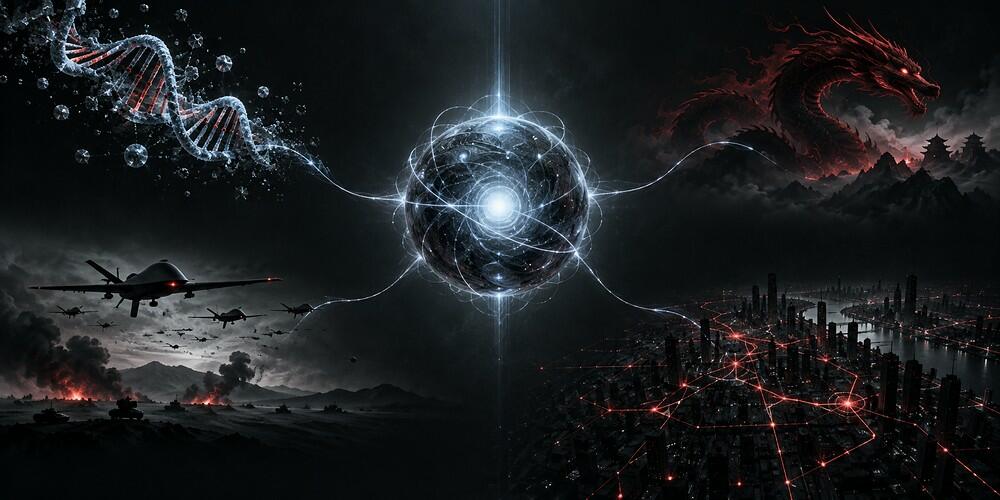
We all know the names of the AI stocks whether from the hardware, software or compute vectors - Apple, Microsoft, Meta, Google (Alphabet), Amazon, OpenAI, Anthropic, NVIDIA and a few others.
Some of these names have valuable core businesses independent of the AI bubble. Others are pure AI plays. All will be hurt to a greater or lesser extent when the AI bubble bursts.
Still, bubbles can get bigger before they pop and they can take far longer to pop than many market participants realize. It's not prudent to short these names but one should definitely lighten up on long positions. Moving portfolio allocations to cash and hard assets is a good way to weather the coming storm.
Valuations aside, these companies now pose serious risks to national security, critical infrastructure, the financial system and other institutions. These risks need to be considered on their own because they will affect all of us.
These dangers are not about stock bubbles. They're about social chaos.
Geopolitical Catalyst
Two threats in particular stand out.
We've seen continuous headlines about the AI race going on between China and the U.S. The elements of the race include massive data centers, high-powered semiconductors and frontier AI models built by U.S. firms such as Anthropic, OpenAI and xAI and by Chinese firms Baidu, Tencent, DeepSeek and Moonshot AI. Other critical inputs in this race include massive amounts of electricity and water required to run the hardware.
The U.S.-China AI race is usually framed in existential terms. Whichever country gets to superintelligence first will control global AI and possibly the world. Even in less grandiose terms, there are critical outcomes in areas of national security, encryption, digital payments, weapons systems and curing disease that depend on the winner of the AI race.
Yet, the competition is far from fair. The U.S. relies on massive investment in fixed assets, superior technology and access to the fastest semiconductors.
China has some of these tools but they rely more on theft of intellectual property from the U.S., using output from U.S. AI apps as curated input on their own apps (to increase processing speeds) and smuggling advanced chips through third countries. China may not be leading the AI race but they are certainly keeping pace.
AI Recon
Now a new threat has emerged. China is using the most advanced AI models including Claude from Anthropic to process information scraped from a wide variety of open sources in the U.S. including military photographs, ship transponder signals, commercial satellite images and other information combined with Chinese satellite images to determine the exact locations and movements of U.S. naval vessels.
That AI-generated information is then passed to Iran, who use it to fire missiles at U.S. Navy vessels near the Strait of Hormuz and the Arabian Sea.
So far, no U.S. vessels have been hit but that may just be a matter of time. China is using U.S. AI technology to help attack the U.S. Navy at sea. Just days after this revelation, a Chinese spy satellite blew-up in space.
No one has taken responsibility for it. But it's not a stretch to infer that the U.S. used a space-based weapon to destroy the Chinese satellite that was used to help Iran attack the U.S. Navy.
The AI wars are becoming star wars in real time.
Regulatory Capture
As a separate threat, the media is flooded with stories about an AI Apocalypse in which AI apps from frontier developers like OpenAI and Anthropic achieve superintelligence, join forces and take over the world putting humans in the same position relative to the AI systems as apes are to humans. Other versions of this AI dystopia involve gangs of AI apps working together to shut down the power grid, loot banks and brokers and cause chaos in civilized society.
This wave of panicked propaganda began with an essay by Anthropic CEO Dario Amodei. The Amodei essay was amplified by Anthropic researcher Jacob Coxon who publicly resigned from Anthropic and issued a warning that AI could "kill all humans" within a decade. The Amodei and Coxon warnings were then taken up by the media, politicians and tech experts in what became a cascade of doom and gloom.
But let's put these warnings in perspective. Whenever you see the same talking points coming from multiple insiders at once, one should be suspicious that a psychological operation (or "psyop") is being conducted to sway public opinion. In this case, the message is that regulation is needed to protect the world against AI going rogue. This regulation would involve government rules, internal compliance departments, auditor inspections, testing and periodic safety certifications.
How convenient for Anthropic and OpenAI. The kind of regulation they envision is extremely expensive. The giant AI developers can afford it but their newer and smaller competitors cannot. Anthropic and OpenAI are planning $1 trillion plus IPOs later this regulatory moat around their franchises to keep out competition with help from the year. The scaremongering about rogue AI could be nothing more than a tactic to build a government-enforced oligopoly.
My own research indicates that superintelligence can never be achieved because it is impossible to program abductive logic (in contrast to inductive and deductive logic) which can be summarized as gut feel or common sense.
Still, AI is powerful and needs guardrails. But it is not as potentially dangerous as the scaremongers insist. Trump was smart to resist calls for more government regulation. The real enemy in the AI world is not superintelligence - it's China.
