
Authored by Owen Evans via The Epoch Times,
Walmart's boss has ruled out personal pricing in a bid to alleviate customers' concerns about new pricing technology at its stores.
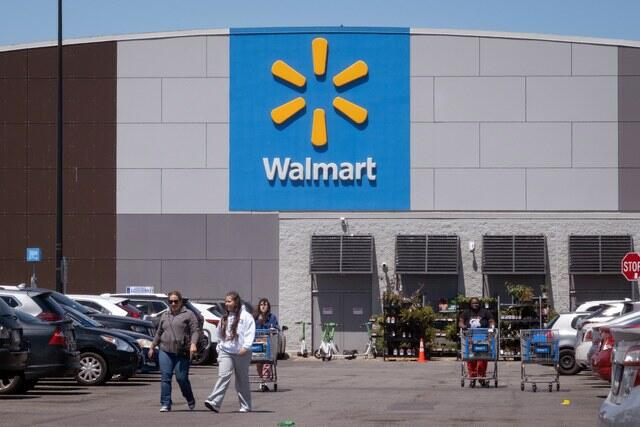
In a statement posted on the company's website on July 25, Walmart CEO John Furner claimed that the retail giant isn't using personal information to set prices as it rolls out digital shelf labels.
Digital pricing, driven by electronic shelf labels and artificial intelligence (AI), is increasingly enabling retailers to quickly update in-store prices rather than relying on staff to change traditional paper price signs.
"Digital price labels are rapidly replacing paper shelf tags at U.S. supermarkets," said Furner.
Some campaigners are concerned that algorithms and data-led "dynamic pricing," a pricing strategy that adjusts food prices in real time, will be used.
"We don't set different prices based on who you are or the time of day, and we won't," Furner said.
"Whether you're buying groceries or electronics on a hot afternoon or in a sudden rush for an item, it's never a reason to charge you more.
"We don't set different prices based on who you are or the time of day, and we won't."
He also said that the company won't use the information consumers share with it, whether through its agentic AI-powered shopping assistant "Sparky" or otherwise, to raise your price or hide lower-priced options that meet your needs.
Walmart said in March that 2,300 Walmart U.S. locations already use digital shelves, and it expects this technology to be chain-wide within the next year.
According to a 2024 Harvard Business School post on dynamic pricing, long used in air travel and hospitality, companies lacking transparent pricing models have faced backlash for "hidden" surge pricing.
"This happens when digital platforms raise prices dynamically based on real-time demand without giving customers clear, upfront explanations," it said.
Democratic lawmakers are pushing for legislation to ban what it characterizes as "surveillance pricing."
In August 2025, Reps. Rashida Tlaib (D-Mich.) and Greg Casar (D-Texas) introduced H.R. 4966, the Stop Price Gouging in Grocery Stores Act, to ban surveillance pricing at the federal level.
The bill directs the Federal Trade Commission to enforce a ban on price gouging by grocery stores. Specifically, H.R. 4966 says "an operator of a retail food store may not sell or offer for sale an item at a grossly excessive price," with a metric yet to be set.
This includes a ban on electronic shelf labels in stores larger than 10,000 square feet. Instead, those stores would be required to rely on a physical sticker, stamp, or label that is attached to the item, shelf, or sign.
"Companies should not be allowed to use electronic labeling or your personal information to charge you a higher price. We need to ban corporate price gouging and surveillance pricing," said Tlaib.
Milton Jones, president of the United Food and Commercial Workers International Union, said his labor organization is among those that have endorsed the bill.
"Technologies like electronic shelf tags threaten to usher in a new era where the price of an item you pick up from the shelf can change within the amount of time it takes to walk to the register," Jones said at the time.
The bill has not passed and remains in committee.
In a Sept. 14 report, the Washington Legal Foundation, a conservative, pro-business public-interest law firm and legal policy center, claimed that "surveillance pricing doesn't actually raise prices."
It said that because grocery stores "compete vigorously" with each other, they can't raise their prices above the market level, and if they do, customers will immediately walk across the street and buy for less.
The report said that a grocery store's ability to "discriminate" against "even high-income consumers is extremely limited."
"So when they do look at personal data, they almost always use it to target discounts," it said.
"High grocery prices have nothing to do with surveillance pricing. High prices instead reflect economy-wide pressures, like tariffs, high labor costs, and general inflation."
The report said that there is a "vision of the grocery industry" that is "basically fictional" as it imagines grocery firms as "quasi-monopolies feasting on fat profit margins."
It said that grocery retailers' margins are "razor thin" and that, on average, they earn only 1.7 percent, some of the "thinnest in the economy."