
Authored by Susan Crabtree via RealClearPolitics,
A national worker-rights group plans to go to federal court Monday to block a New York law it says was written to silence outreach to public employees about their right to leave their unions. The group argues the new law is an unconstitutional violation of free speech because it allows state government officials to shut down speech before a single word is conveyed.
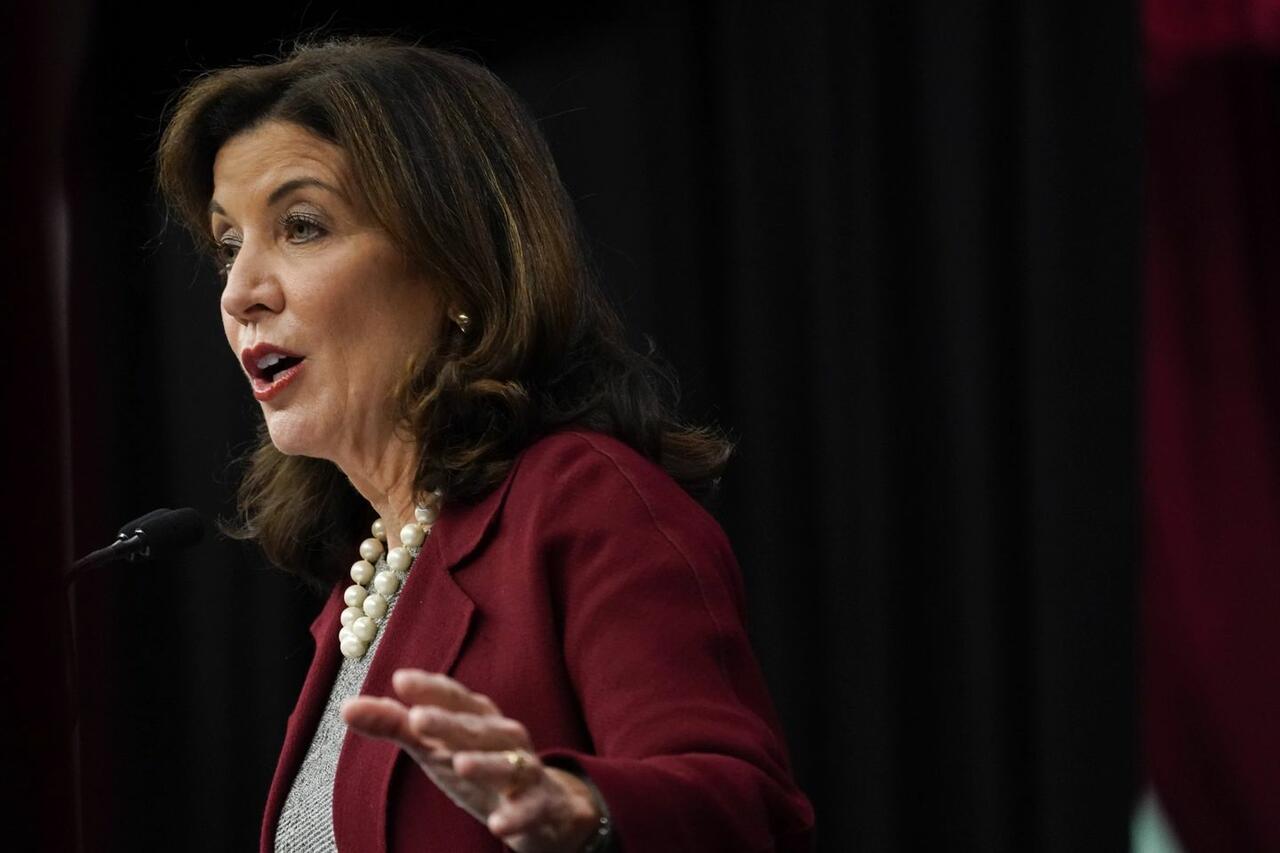
The Freedom Foundation is set to file its motion in U.S. District Court in the Northern District of New York asking for a preliminary injunction against the "Section 216" civil service law. Gov. Kathy Hochul signed the measure on Sept. 9. It took effect immediately.
The case sets up a high-stakes test of how far a state can go in policing speech aimed at its own workers. New York contends that the law simply targets fraud. The Freedom Foundation counters that it's a union-backed weapon targeting its highly successful education campaigns to show public sector workers how to cancel their union memberships.
Freedom Foundation CEO Aaron Withe has called the law a "hit job" aimed at ending the free-speech rights of his group. He said it "isn't about protecting anyone" except the unions.
Withe asserts that the law aims to stop the Freedom Foundation's education campaigns after the group's outreach has led to the largest decline in union membership in U.S. history. Some 300,000 people in the last six years have canceled their union membership, he said, and the anti-union messages are continuing to gain traction. If the cancellation trend continues, the Freedom Foundation expects 70,000 people to cancel their union membership this year alone.
"They're paying [an average of] $1,100 a year each, so you're talking about in one year $70 million being taken away from their annual revenues," he told RealClearPolitics. "And of course, most of that is happening in blue states because that's where the public employees are."
On the surface, the New York law purports to bar people and organizations from sending communications that falsely appear to be authorized by a union or union representative. It also gives Democratic Attorney General Letitia James the power to investigate, issue subpoenas, and ask a court to block communications deemed deceptive.
Courts can impose fines of up to $1,000 per violation, including against organizations based outside of New York. The Freedom Foundation says New York's version goes further than a similar Oregon law by giving unions a "private right of action" to sue out-of-state parties.
The Freedom Foundation's request for a preliminary injunction argues that the law gives state attorneys broad powers to investigate, intimidate and stifle speech before it occurs. The group has already halted its New York outreach while the fight plays out. The outcome could shape whether other Democratic-led states adopt similar measures.
Stopping speech before it occurs
At the heart of the challenge is what the Freedom Foundation calls an unconstitutional prior restraint on speech: government action that stops expression before it happens rather than punishing it afterward.
According to the Freedom Foundation's motion, the law "doesn't even afford the Foundation the privilege of being punished after it publishes something." The motion notes that Section 216 lets the attorney general take legal action if she believes someone is "about to engage" in speech that violates the law and seek a court order suppressing that speech before publication.
"The most egregious part of the whole thing is the fact that the new law is imposing prior restraint on our speech," Shella Alcabes, an attorney for the Freedom Foundation, told RCP.
Alcabes said the law lets James review the group's past work and issue investigative subpoenas "all so that she can gather information to determine whether we might somehow in the future violate this law - that's insane."
"That just means that before we've even spoken, our speech can be restricted," she said.
Alcabes also argued the group would be unlikely to lose if it were ever sued for impersonating a union, because its materials go out of their way to make clear who is speaking.
"Everything that we try to do is the opposite of what unions would want to do," she told RCP. "We want to tell everyone we're not a union and we're opposed to what they do."
The danger, she said, lies in the investigative powers the law hands the attorney general.
"In a lawsuit, we [would] never really lose," Alcabes said. "But with an investigation behind closed doors, who knows?"
That argument taps one of the oldest principles in American free-speech law. Since Near v. Minnesota in 1931, the U.S. Supreme Court has treated prior restraints as among the most serious threats to the First Amendment. In the 1971 Pentagon Papers case, New York Times Co. v. United States, the court said any such restraint carries a "heavy presumption" against its constitutionality.
The group also says the law's penalties are designed to intimidate. The motion argues that if the Freedom Foundation sent one educational mailer to every public employee in New York, it could face nearly $1.5 billion in sanctions.
The Freedom Foundation says the threat has already worked. It has shut down its outreach to public employees in New York in response to the law. Its motion says Section 216 has chilled the group's labor-rights advocacy.
"The First Amendment does not tolerate laws so clearly calculated to distort public discourse and punish disfavored speakers," the motion states. It asks the court to let the Freedom Foundation resume that advocacy.
A law that makes speech illegal
The Freedom Foundation says the law's real target is obvious: groups like itself that remind government workers of a right the U.S. Supreme Court affirmed eight years ago. In Janus v. AFSCME, the high court held in 2018 that public-sector employees, including public school teachers, cannot be forced to pay union fees. The ruling reasoned that union speech can involve political issues protected by the First Amendment.
The group has mailed and otherwise contacted New York public employees, including teachers, to tell them they can leave their unions and stop paying dues. According to the Freedom Foundation, nearly 7,500 New York public employees have used its materials to cancel their union memberships, including more than 1,400 so far this year.
"It exists because government unions in New York are terrified of an inconvenient fact: When public employees learn they don't have to pay union dues, a lot of them stop," Withe said. "So instead of making their case to their own members, union bosses ran to their friends in the legislature and got them to write a law that makes speech illegal."
"This is an anti-speech law aimed at one kind of speaker," Withe added. He noted that the law "lets Letitia James fine the Freedom Foundation for outreach the state decides 'impersonates' a union."
In his view, the group is simply telling public employees about their right to leave their union and stop paying dues. Withe also warns that the law sets a precedent that should worry people across the political spectrum.
"This is a special interest group that is limiting free speech that they disagree with," he said. "Where does that stop on the left and the right? Today it's targeting talking about union membership. Tomorrow, is it going to be talking about pro-life issues? I mean, where does this end?"
Round two after Oregon
Withe says New York's law was "copied" from an Oregon measure the Freedom Foundation is already fighting, and that the group will "make the same case here." That earlier fight has hit a procedural wall. A federal district court dismissed the Foundation's challenge to the Oregon statute on ripeness grounds, finding no union had yet filed suit, and the Foundation has appealed to the 9th Circuit.
The New York challenge may avoid that problem. By shutting down its New York outreach rather than risk penalties, the group can argue its speech is already being suppressed. It can also point to the law's "about to engage" provision as a threat to speech that has not happened yet.
State defends the law
Hochul's office says the law is about fraud, not free speech.
"Governor Hochul takes fraud of any kind seriously, which is why she signed the legislation prohibiting the false impersonation of union officials to protect workers from being misled by deceptive communications," Hochul spokeswoman Kristin Devoe said in a statement. "Employee organizations and unions play a crucial role in New York's infrastructure as a whole, and the Governor has always championed legislation that supports, protects and uplifts workers across the state."
The law's prime sponsor, Assemblymember Judy Griffin, a Democrat representing Nassau County, has said the bill closes a gap in the law and protects workers from people who knowingly impersonate unions to spread misinformation or interfere with lawful union activity.
Mario Cilento, president of the New York State AFL-CIO, praised the law for "holding individuals accountable for fraudulently claiming to be union representatives."
In court, the state is likely to press that framing and argue that the First Amendment has never protected fraud. States can generally bar people from impersonating others to deceive, and courts have upheld injunctions against speech already shown to be false or misleading.
New York will likely argue that Section 216 reaches only communications meant to trick workers into believing a union sent them. Under that reading, the Freedom Foundation's clearly branded mailers wouldn't be affected. The state may also argue that the law is neutral because it applies to anyone who impersonates a union, not to one group or one viewpoint.
The state may also try to get the case thrown out before a judge reaches the constitutional questions. That is how Oregon won the first round there. New York has not yet brought any enforcement action against the Freedom Foundation. Its lawyers could argue that the group's fears are speculative and that its decision to halt New York outreach was voluntary rather than compelled.
The Freedom Foundation counters that the law's "about to engage" provision and the threat of massive fines are exactly what make its challenge imperative now. It will argue that a speaker shouldn't have to risk financial ruin to find out whether its speech is legal.
Alcabes says the law was clearly written to target the Freedom Foundation even though it hasn't done anything to impersonate unions. In fact, the group's emails and other material it publishes repeatedly use phrases, such as "opt out today," so it's clear they are anti-union.
"At the end of the day, it's the prior restraint that's so scary because we would probably win every lawsuit showing that we don't impersonate unions," she argued.
Susan Crabtree is RealClearPolitics' national political correspondent.