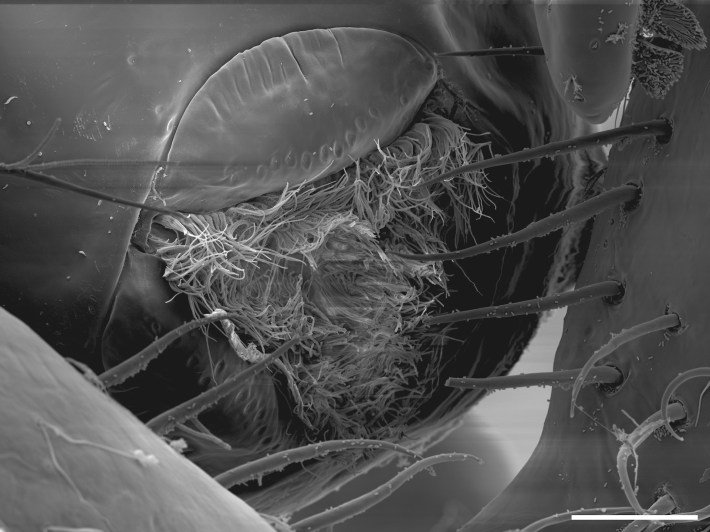
What has hairy feet, legs dotted with eggs, and a mouth loaded with tentacles like a Sarlacc from Star Wars?
That’s how researchers from the University of British Columbia describe seven such creatures from the Salish Sea in a new paper published in the journal Organisms Diversity & Evolution. They include five known species plus a couple of new ones, marking the first discovery in a century of new sea spiders in the region.
As ancient arachnids closely related to scorpions, spiders, and horseshoe crabs, sea spiders share some traits such as exoskeletons, jointed legs, and chelicerae-type mouthparts adapted for piercing or grabbing prey. But sea spiders also rank as weird for the way they sport up to 12 legs, breathe through their skin, and spawn eggs from their legs, traits they’ve honed during their 500 million years of ocean life.
Read more: “The Mystery of 111,000 Spiders Living in a Giant Subterranean Web”
“A lot of the shallow water species are quite small, and so they’ll live as parasites on larger organisms, and they use this weird apparatus called a proboscis to suck the juices out of their host,” explained lead author Cormac Toler-Scott.
The researchers collected specimens from sites that represented the range of sea spider habitats in the Salish Sea, from depths of 0 to about 60 feet, which would be considered shallow waters for sea spiders. Using scanning electron microscopy and DNA analysis, they classified the sea spiders by species, detecting the two previously undescribed ones in the process.
Callipallene pilosuspedes (“hairy feet”) joins 36 other species of Callipallene worldwide, which tend to be slender and without claws on the male’s “ovigers,” or the special appendages used by males to pluck eggs off females and stick them to their own body for rearing. It has a triangular mouth bounded by three lips and covered with sensory hairs that give it the Sarlacc appearance, albeit in miniature—after all, C. pilosuspedes is only about a centimeter long.
The other new species, Tanystylum kiixin, gets its name from an indigenous village near the discovery site. Its legs are too short and stiff for good hygiene, so it gets covered with debris. Amongst the body hairs and debris, the researchers found even tinier single-celled parasites, such that the sea spiders maintain ecosystems on their bodies.
Which is yet another reason why Toler-Scott and his fellow researchers consider these water-based arachnids “horrifyingly fascinating.” 
Enjoying Nautilus? Subscribe to our free newsletter.
Lead Image: Cormac Toler-Scott