When Russian air strikes knocked out Ukrainian power plants across the country earlier this year, most of the Black Sea port city of Mykolaiv in southeastern Ukraine was unable to pump fresh water to the city’s housing blocs. But in an easterly suburb of Mykolaiv, drinking water flowed from kitchen taps, as it has since last year thanks to a small off-grid solar field tucked inconspicuously into its midst. Paul Hockenos reports.
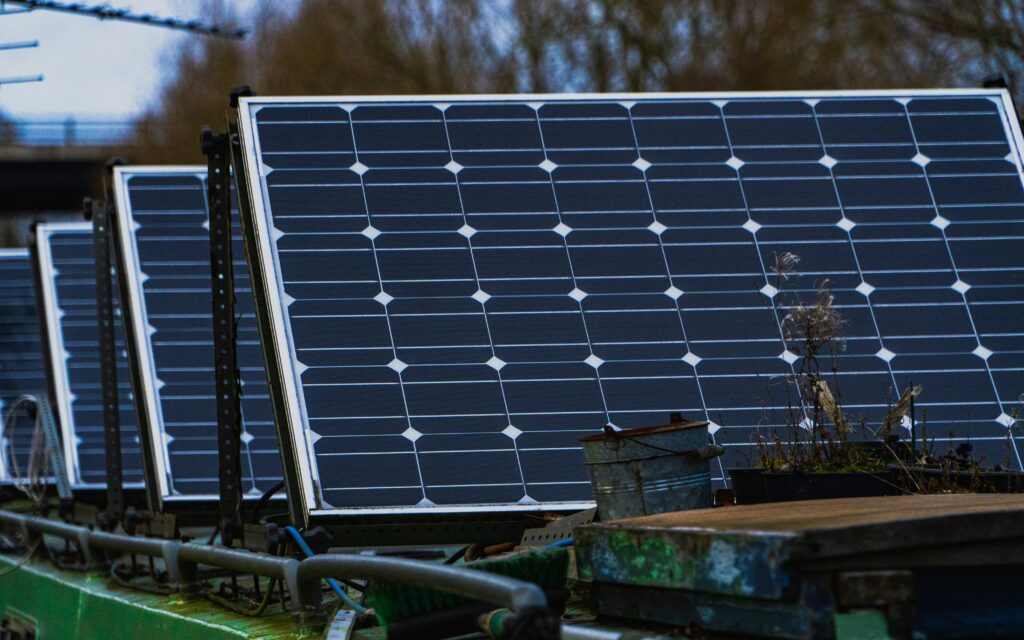
The two sets of elevated arrays and battery, funded by the Danish government, run the underground pump on its premises.
‘There’s just enough sun [in January/this winter thus far] to make it work,’ says Olena Kondratiuk, project manager of Ecoclub, a non-profit that assists municipalities in obtaining renewables.
The city of Mykolaiv, only 60 kilometres from Russian-occupied territory, had been battered in 2022 when the Russian army launched its full invasion of Ukraine, pummelling the city with missiles, rockets and cluster bombs. The shelling laid waste to homes, hospitals, schools and factories. The bombardment also impaired the central water supply system, leaving most of the roughly half-a-million-strong town near the frontline without regularly flowing water.
‘Of course I’m happy to have running water again, I don’t care how,’ an older resident named Iryna told me. Until the solar park commenced operation, her taps discharged salty water, accessed from a nearby estuary, when anything dripped from them at all. She either purchased drinking water or filled plastic jugs with fresh water from mobile public tanks, and asked neighbours to carry them up to her fifth-floor apartment.
Other districts of Mykolaiv – the city is a country-wide pioneer in renewables – also receive fresh water on account of distributed solar technology. Five solar-powered desalination systems turn saline or polluted water into drinking water – when the sun shines. At night and on cloudy days, they are powered by the central grid – that is, if it’s up and running. The system, one of the largest of its kind in Europe, can supply 250,000 residents with 1.2 million litres of drinking water a day. The Mykolaiv children’s hospital and the maternity hospital will steady their energy supply with solar panels in the course of this year, as are a dozen others elsewhere in the country.
Since the war’s onset, Russia has relentlessly targeted Ukraine’s energy infrastructure – for the most part, overwhelmingly bulky, old-school thermal plants and the vast country-wide grid – in an effort to lame the war effort and beat down its people. Last winter was the gravest yet: attacks against coal, gas, cogeneration and hydropower plants, as well as transmission grids and their substations, left giant swaths of the country with irregular electricity and heat as temperatures have plummeted to minus 20 degrees centigrade. Many schools and other public services that were unable to reopen after Christmas are still closed today. Economists estimate that total damage to Ukraine’s energy sector now exceeds $56 billion.
US environmentalist Bill McKibben argues that Ukraine’s autonomous power sources are ‘comparatively invulnerable to attack’. In our new era of drone warfare, writes McKibben, centralized and complex energy facilities are now ‘sitting ducks for drone attack’. Smaller, ‘scattered’ generation sources with batteries and independent transmission grids, like the Mykolaiv fields, are not only harder for Russia to strafe, but they’re much more quickly repaired, too. This is in contrast to petrochemical refineries, which McKibben calls ‘one of the most complicated machines humanity has ever constructed’, and often cover hundreds of acres. These are ‘filled with highly complex equipment and highly flammable hydrocarbons; hit one corner with a drone and the flames and the damage are likely to spread quickly’.
‘A coal power station [is] a large single target that a single missile could take out,’ says Jeff Oatham of DTEK, Ukraine’s largest energy investor. ‘You would need around 40 missiles to do the equivalent amount of capacity damage at a wind farm.’ And, like wind parks, a solar field functions even when part of it is out of operation.
Ukraine is revamping its energy system at warp speed for the purpose of energy security, not climate protection. ‘Ukraine’s energy transition is not a slogan,’ says Levgeniia Kopytsia, a Ukrainian energy analyst at the think tank Institute for Climate Protection, Energy and Mobility. ‘It’s a security-driven transformation, unfolding under extreme constraints. It priorities decentralization, flexibility, and speed of recovery.’ In wartime Ukraine, renewables and local grids are coldly calculated security assets, Kopytsia says, that can boost the system’s resilience – and in Ukraine this translates into saving lives.
Ukraine’s shift away from fossil fuels began before the full-scale invasion: its negotiations to join the EU require it to adapt to the bloc’s climate criteria, and in 2021, Ukraine pledged to be coal free by 2035. For security reasons, there are currently no public figures available for energy production.
According to the International Energy Agency (IEA), this past summer, Ukraine made ‘strong strides’ in rebuilding and bolstering its system’s resilience. The renewables rollout was – and still is – led by rooftop solar, small-scale utility PV generation and local storage, as well as biomass combustion.
Before Russia seized three of them in 2022, there were 34 wind parks in Ukraine with around 700 turbines – and more in the works. Ukraine has seven gigawatts of wind power in the pipeline, ready to go this year, should conditions be fortuitous. This would more than triple the country’s current capacity, which in 2022 constituted over 20 per cent of its renewable mix.
The relentless waves of aerial attacks on infrastructure prompted an epiphany in Ukraine’s energy sector: a new, younger set of energy managers – that replaced the Soviet-style old guard – are fully committed to distributed energy – the faster the better, they say. They intend to double the country’s renewable energy consumption in just four years’ time.
While the war has sidelined the rollout of the likes of large-scale projects, such as wind turbines, households, businesses and public institutions have been installing solar at an unprecedented rate. Ukraine’s YASNO, a utility supplying electricity and gas to millions of Ukrainians, says its customers are snapping up the solar and storage packages that it offers. An astounding fact: on sunny days, Ukraine even boasts energy surpluses.
The German Ukrainian Energy Partnership, a platform for intergovernmental dialogue on energy matters, estimates that Ukraine’s potential to add solar capacity in the next five years is equivalent to about 80 medium-sized nuclear reactors. ‘The sector is emerging as one of the fastest-developing renewable markets in Eastern Europe,’ according to its website.
‘Individual consumers want to get off the grid any way that they can,’ explains the Ukrainian energy expert Andriy Martynyuk. ‘It’s largely a grassroots phenomenon and a bit chaotic now.’ He argues that the demand for renewables will shoot up further when the prodigious state subsidies for conventional energy eventually fall away.
This boom, of course, begs for storage options, and there too Ukraine is racing forward. In short order, the country’s national grid operator invested in half a gigawatt of storage capacity last year – an impressive score, according to experts who note that it is just under a quarter of Germany’s total storage supply. The battery projects that in Europe take two years to roll out, in Ukraine happen in six months, reports the Financial Times.
Renewables aren’t the only source of distributed supply. Ukraine envisions large-scale diesel generators, biomass facilities and smallish gas turbines, including combined heat and power plants, as integral to its scattered energy supply. ‘Distributed generation is those facilities that have up to 20 MW capacity,’ explains Roman Nitsovych of DiXi Group, a Ukrainian think tank. ‘Gas-fired units have several advantages: guaranteed output of available power, fast start, and flexibility.’
No matter how intent Ukraine is about diversifying its energy system, it’s going to require a centralized grid. The larger supply options, like the gas-turbines and wind parks, require a functional transmission network, including the substations that the Russians regularly target. The Ukrainians’ playbook is to put them underground – just as it now does its schools – making them impervious to Russian weaponry.
The views and opinions in this article do not necessarily reflect those of the Heinrich-Böll-Stiftung European Union | Global Dialogue.