
Submitted by Peter Tchir of Academy Securities
Treasuries, European Sovereign, and even Credit. Something seemed rotten this week, with Thursday’s price action in all 3 of those markets triggering the need to focus on this more. Debt markets underpin the entire global financial system and when things don’t “look,” or “feel,” or “smell” right, it warrants our collective attention. Yes, “feel” or “smell” doesn’t seem compelling as some authoritative answer, but that doesn’t mean it isn’t worth exploring.
For the past few weeks, our biggest complaint on Treasury yields has been that neither Bessent nor Warsh is addressing the root causes of higher Treasury yields. The root causes have far less to do with economic variables, inflation, and Fed independence, and much more to do with a global supply glut. Not just of sovereign debt. Not just of corporate debt, but also corporate debt adjusted for average duration as companies who need to issue longer-dated bonds have dominated the flow.
- On the Treasury Department - I Am The House Now and 6 Billion Dollar Man. I am looking forward to seeing what Dave Zervos can bring to the table. Bringing a fresh set of eyes to the problem could be very helpful, as maybe he will see what we’ve seen: the admin is nowhere close to a Draghi style “Whatever it Takes” moment and has not been addressing the root cause.
- On Friday we ranted about The Absurdity of Jobs Data. (I received one “unsubscribe” which always guts me, but had multiple very positive responses; clearly we touched a nerve by, yes, analyzing the data, coming up with the “no hire, no fire” take everyone came up with, but we mostly lamented that we are all working with data we suspect is more of a guess than truly factual.) But we did highlight that we thought the positive move in Treasuries would fade by the end of the day, and the 10-year went from a low yield of 5.15% at 8:31am ET to almost 5.3%, closing at 5.27%.
We will take a quick look at each of these markets.
There Are No Treasury Bears
Ok, that sounds ridiculous. How can something that has been trading so poorly have no bears? Isn’t everyone bearish? The price of oil (and diesel) is bearish. The deficit is bearish. The long-term trajectory on total debt is bearish. The fact that interest payments on debt are now greater than discretionary spending is bearish. The global supply is bearish. The corporate supply is bearish. The fact that countries like Saudi Arabia have gone from being buyers of Treasuries, to needing a loan to fund their operations is bearish. Questions about the global reserve status of the dollar (which is overdone) is bearish. The fact that across the globe investors seem less inclined to own Treasuries on their balance sheet (corporate debt, debt denominated in their own currencies, etc. are preferred) is bearish. A Fed that isn’t independent is bearish. A Fed that is independent is bearish. Etc.
There is NO shortage of reasons to be bearish on Treasuries. Over the past month or longer we have presented many of these reasons. Our primary focus has been on supply and how much duration has been sucked out of the market by the corporate debt issuance. Not to mention that I believe we have set back-to-back records for the largest HY deal ever, and even a $10 billion corporate deal, which at one time would have caused some eyes to open, but now has become de rigueur. But more on corporates later.
Let’s get back to the matter at hand, the “claim” that No One is Bearish Treasuries.
I’ll offer up the T-Report as the first piece of evidence. In last weekend’s T-Report, despite giving more reasons for Treasuries to go higher, we made an effort to state we were neutral on Treasuries in Stocks +1, The House -1, The World ?. That didn’t stop us from recommending fading the bond market Friday morning, but we did not come into this week “pounding the table” to be bearish on bonds.
Yes, the T-Report is a tiny sliver of the research and commentary produced. But everywhere I looked, I saw bullish or neutral takes on the market. I do not remember a single guest on financial media that was pounding the table about shorting bonds here and now. Ok, there are couple of “end of fiat” people out there who were pounding the table, but they tend to always pound the table on that subject and are presenting a vision of global catastrophe without a tradable timeline.
I can tell you that when we were bearish and arguing to fight Bessent, Treasuries & Treaties, most of our conversations had been with investors buying Treasuries. We’ve attempted it a couple of times during this move (with some wins and some losses). The point being that while there might be a lot of material published on problems facing bonds, that doesn’t seem to match positioning at all!
One bond watcher is apparently bullish for the first time in 6 years. I cannot tell you the number of times that story made it into my stream, on social media, and work e-mails/Bloomberg msgs. You know what people who are short the market don’t do? They don’t forward to everyone they can, articles about this being the best buying opportunity in a decade. That is not how human nature works. Maybe everyone is so scared, while being short, that they felt the urge to share this story. Or, maybe, long and nervous, they were trying to convince people of the latter. That makes the most sense to me, and why I was trying to raise my hand and say “I’m neutral” not bearish.
How Can Yields March Higher if There Are No Bears?
I think the better question might be, how can they not? But, I guess before wading into analysis of “how” this could be happening, let’s just present the slide that shows it is happening! And the moves are getting “worse” even as we put FOMC behind us and oil prices have been receding. The move from 4.6% on 10’s as recently as August 25th, to 5.27% on Friday, is quite astounding. The speed of the moves is as problematic (or probably more problematic) than the levels involved. The one way nature of the move is perturbing, but I think following analysis is at play and helps us understand the move better.
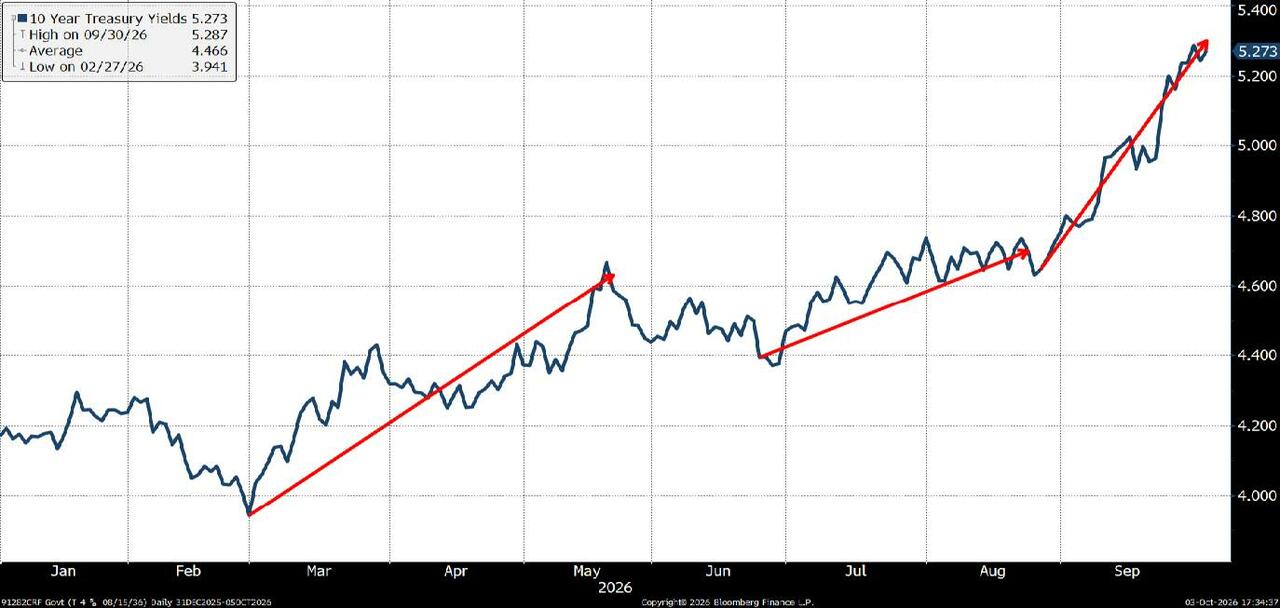
As a contrarian, it is easier to move markets against positioning than with positioning. If everyone was bearish and positioned that way, it would be a lot harder to push Treasury yields higher.
So, let’s lay out a scenario that I believe is at work below the surface.
A Lot of “low conviction” longs in the market.
Traders are long Treasuries for a trade. Asset managers are slightly overweight duration versus their benchmark. No position is particularly large (which is important) because the trend has clearly gone against you.
That would sum up my conversations, and even my own thoughts on trading this.
True “depth of liquidity” is low in the age of electronic/algo trading. Everyone (and every machine) is trying to scrape out a cent here or there on trading, making it look like there are massive amounts on the bid and offer at any time, but only a tiny fraction represents traders truly trying to commit capital at that level, and the rest is just jockeying for position.
Enter the “quant” funds. That is probably the wrong name, but I’m looking for traders without emotion. Something very systematic in nature. I’d lump what I often refer to as “windshield wiper” algos: algos that sweep back and forth looking to trigger stops, in this category.
The windshield wipers sweep back and forth trying to trigger movement. Buy a little. Buy a little more. Did the market move in your favor? No. Then sell it and get a little short (ok there are some shorts in the market, or else my idea wouldn’t work, but I still think it is a tiny fraction of the positioning). Sell a little more. Did it move? Yes. Then do not book profits. Sell more. Keep selling until selling doesn’t beget more selling!
There are some larger quant/systematic traders that will build big positions during this type of trading. These are the “quick” windshield wipers, but something with a broader tolerance for losses, while looking for big gains.
Unlike many traders (especially me), they are not quick to book a profit. When momentum is going, they push more. They grow their position even as the market moves in their direction.
They are agnostic (or emotionless) and only “know” that selling begets more selling and buying does NOT beget more buying.
Small positioning matters too. If you are at a hedge fund and long $100 million of 10s, you are quick to close out. If you are long $10 billion of 10s, you might try to fight whatever is pushing the market. In my experience, small position sizes make it easier to move markets, because no one has the conviction, nor the incentive to fight moves.
Many traders are momentum traders at heart. Momentum is consistently one of the top-performing strategies. So, even those who may have taken a swipe at getting long Treasuries will go short for a trade (yes, somewhat against my bold statement that there are no shorts, but this is more about during a move to higher yields than at the start of the day). So, day traders pile into momentum and the only momentum that has really worked is for higher yields.
If and when the selling stops creating more selling, the “emotionless” will cut their shorts just as quickly. We will get a vicious snap higher in price, lower in yields, and the worst will be behind us, but so far, there are so many reasons to be nervous about bonds that selling begets selling. Some of the bond market issues need to be resolved, with oil and diesel being the ones that have the best opportunity to “fix” themselves and end the current vicious cycle.
While Treasuries are facing a lot of hurdles, I strongly believe that underlying the price action is the sort of behavior described here. It is unclear that we are close to the end of selling creating more sellers. We may not get there until either we get conviction from the bulls that we are at a level that is worth supporting, or people start positioning themselves as bearish as they talk.
In the “for better or worse” category, TLT (a 20+ year Treasury ETF) has received large inflows and shares outstanding are now at their highest level since late 2024. That does kind of match the point that there are no bears. On the other hand, retail has done a great job “buying the dip” on equities, so they may be right here and are ahead of the “pros” because having stop losses might be great for risk management, but can prevent people from taking advantage of what might be really good buying opportunities. Retail bought the dip post Liberation Day, before the pros. Don’t underestimate their power, but at the same time, don’t believe “everyone is short” treasuries, as that narrative is just not true.
European Sovereign Debt
Rising global bond yields was on my radar. But whatever just happened between German bond yields and French and Italian bond yields was not.
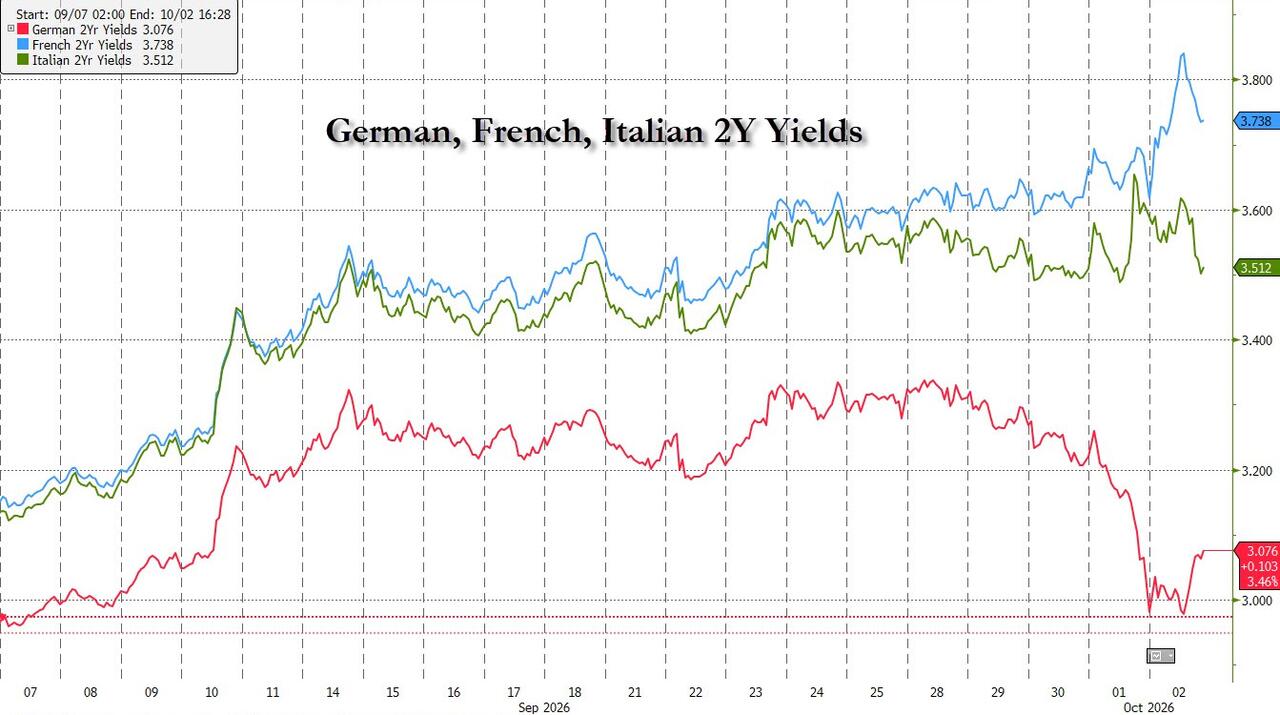
European bond yields rising as spending on defense and infrastructure increases, made perfect sense. What is harder to figure out is this move in French and Italian yields relative to German yields.
The French deficit is going to go above the EU “targets”. Looks like 5% instead of 3%. That helps explain the move higher in French yields (and Italian). But the move in German yields? Are we really having a “flight to quality” in Europe? And Germany, losing their industrial base, having a major shift in politics, is the “go to” place for safety? I guess, but it all seems odd.
Maybe investors were being “lazy” and were picking up the “extra” yield in France and Italy for the same “risk” as Germany, only to realize the risk might not be the same, and were forced to unwind?
That seems plausible.
I don’t want to bring up Frexit or all the other weird words that were tossed around after Brexit, but maybe not only is Europe starting to embrace ProSec™ each of the larger companies is starting to do what they think is right for their country? That the construct that gave countries the size of Hungary (with their Russian leaning political influences) almost as much power in some votes as France, Germany, Italy, etc., doesn’t work as countries start taking steps towards vertically integrated nations. Even vertically integrated “blocks” likely need the biggest and best prepared countries to take leadership and drive the group forward.
Macron seems more comfortable “speaking up” for Europe – the release of diesel from Europe’s SPR seems like a good example of that.
I don’t know what is going on here, but it does not seem good. This fairly rapid, “repricing” of relative credit risk in Europe could be nothing, but I suspect it is hinting at a deeper problem:
- More poor positioning, facing more unwinds. Again, these unwinds have real world repercussions as Italy and France face a tougher road to borrowing to build out their infrastructure, defense, and nationalistic programs.
- Another round of markets, and maybe even the populace questioning how integrated the EU really wants to get, especially economically. It seems like just a few weeks ago we were discussing efforts for Europe to fund Europe and suddenly, markets are seriously differentiating the credit of Germany and France in 2 years? This is likely an over-reaction to what we are seeing, but maybe this “tail risk” that has been tucked away for years, needs to be thought about again, if not taken seriously?
The broader trend of European yields higher fit our overall macro view and made sense.
This recent divergence caught our eye as something “off” and worth paying attention to. I’m not in alarm mode or anything, but who would have thought markets need yet another thing to worry about? And yet here we are.
Any “cracks” in global bond norms deserve attention and I think this qualifies as some sort of a crack. Maybe just a crevice, certainly not a canyon, but a crack, nonetheless.
Credit Spreads
There is an entire cottage industry dedicated to calling for the “next” GFC. It often starts with worrying about BBB spreads, or sometimes structured/opaque credit, because those seem to be areas big enough to scare people, and difficult enough for the average person to understand, that it is easy to scare them.
My background is in credit, but I rarely write about it lately, because it has been soooooo boring! I’m not going to go all doom and gloom, but for the first time in ages, I better dust off some of my tools to look at credit. We will look into this more closely next week, but again, just like the European bond market, something is going on that deserves some attention.
While I won’t go all doom and gloom, I will throw out one piece of “shade”. I remember being trained in high yield and being told that the RJR deal was the biggest high yield bond deal ever. That despite being “absorbed” it marked the top.
Bond markets are much bigger and more sophisticated now. There is “less” of a differentiation between high yield and investment management, though I’m till astounded how big that break can be. The difference between the average BBB- company and BB+ company is minimal (and there are times that people can argue, that due to rating agencies being slow to upgrade to IG or downgrade to HY, the better credits might be lower rated). Due to investment guidelines, in funds, or regulated entities some differentiation between the two markets still exists. I believe we just had 2 of the largest high yield bond deals ever? Again, these deals were well telegraphed, but PSKY 8.875% 2nd lien bonds due 2034 (BB composite rating), that were issues at par, traded below 95% on Thursday and 96% on Friday, to close the week at 96.5%. A 3.5% loss on $4 billion of bonds will leave a mark ($140 million to be exact) on bond buyers, especially the “fast money” crowd, but even long only won’t be happy with that.
One thing that greatly reassured me, and lets me believe I can wait until Monday or Tuesday to do a deeper dive into credit (this weekend is too nice in the metro area to be stuck inside typing), was that both HYG and JNK (two large HY ETFS) were trading at NAV. Any time the credit ETFs trade at a discount to NAV, is a danger signal in my book. It means there are market dislocations, and trading at a discount tends to create more selling. That might seem counterintuitive, but we’ve explained the ETF Death Spiral™ in detail, and it continues to be an incredibly useful indicator. So when I see ETF down 2.5% or so in a month, and hitting new lows, you want to see how they are trading versus NAV. Both are trading very “normally” which is good. The same is true for LQD (long dated IG) and VCSH (short dated credit). These are all saying “orderly liquidity”! Not quite the same as “nothing to see here”, but close.
The CDX index has widened from 50 to 60 in a two weeks. The Bloomberg Corp OAS has only moved from 75 bps to 82 bps. I feel obligated to mention it, but as something that is “observed” rather than traded, I want to pay more attention to the CDX index for now.
CDX traded up to almost 70 in March at the start of the war, so that is “good” we are only at 60.
One thing I don’t like is that while the S&P 500 traded marginally higher on Thursday and had a strong day on Friday, the CDX index which is often correlated with the S&P 500, was wider on Thursday and basically unchanged on Friday. If you told me what the S&P 500 had done, I’d have guess wrong on what the CDX index had done. While “decoupling” is a bit strong, when you are looking for early signs of something “bigger” like we’ve already seen in treasuries, just saw in European sovereign debt relative value, it is not nothing.
Bottom Line
We often hear from other market participants that they want to pay attention to fixed income. That they understand that fixed income is a behemoth and often difficult to understand. But that if fixed income cracks, equities have trouble doing well. They say that, but they really don’t like their positive narratives being interrupted.
VIX is barely above 15 (well below it’s average of 18 for the year). The MOVE index, the bond market equivalent of VIX (not quite, but close enough for now), is at 107. Just below its peak of 115 in March. Well above its 1 year average of 74.
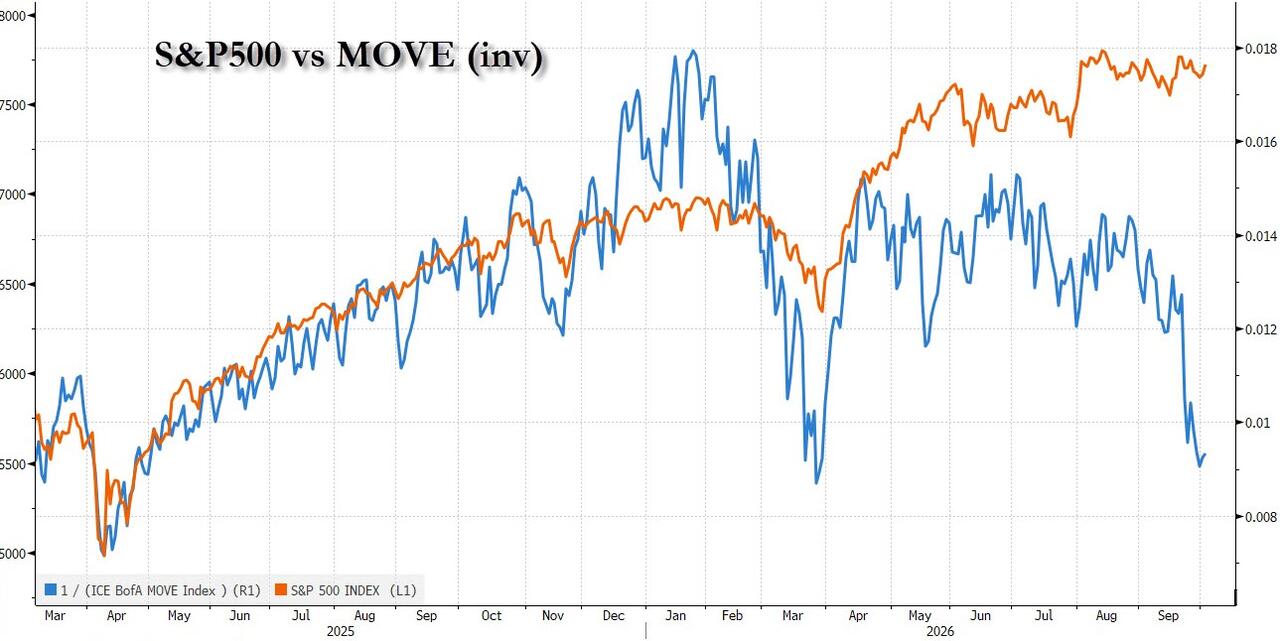
I’ll start the week neutral on rates, since “fade the move” worked so well on Friday, but I’m nervous.
Whatever just happened in European sovereign makes me nervous. Credit doesn’t make me nervous, but for the first time in years I’m paying some serious attention to spreads.
A deal with Iran, more news on the compute front, can help, but away from all of that, equities seem to be ignoring some fixed income market moves (and not just the headlines on long bond yields) that equities might wish they’d pay more attention to.
Call me nervous, not scared, and extremely happy with this weekend’s weather (in the Northeast)!
Fixed income is sending some sketchy signals, and to the extent positioning is wrong, those signals risk turning into something bigger