"What happens when Claude is no longer the most intelligent model?"
"What happens if Muse just gets really bad tomorrow?"
"What if OpenAI just jacks up the prices of these models?"
These are all arguments I've heard for when people say that they're building an existing product with a model picker.
And to that I say "bull."
“No vendor lock-in” is the weakest answer that you can give when your product is a clone of a successful product with a model picker.
I'll tell you why.
Today any product that employs AI (or AI agents) to do anything for a specific use case is a custom harness. @ycombinator said as much recently in one of their Paper Club talks recently. And it also looks like most of the latest YC batch is building a custom harness for one particular use case. And I agree. I think this is the right way to go as well.
However what's new is a whole suite of products whose whole pitch is that you can do the same thing that you can do with one of the products from these frontier labs "but you can choose from our list of 420,69 models that we offer". Think Claude Code, but with other models. Think ChatGPT working with other models. Think Grok bot with other models.
And the only claim for the existence of such products is that one day Anthropic or OpenAI will jack the prices up until the model is unaffordable or the model will just become unusable.
The other claim is that open-source models exist and that they're cheap and hence we should be using them.
The problem with all these claims is that they assume that we use frontier models because we trust the companies or because the price is right.
That's not why.
We use them because we want the best model available. We want GPT-6 Astra, Claude Fable 5.1, and Opus 5.5. They're really good models and open-source models are not even close. We only talk about these open-source models around the time they're launched and they slowly fall off because the frontier models are just so good and accessible.
I was against Claude Fable.
I thought it was too expensive.
I thought Kimi K3 could do everything.
Then I did get around to using Fable. I found out that Fable is the best solutions engineer that I could ever ask for and nothing else I've used is even close and that's telling because I've used almost all of them. Astra is a really really good coworker and nothing else has come close in that sense either.
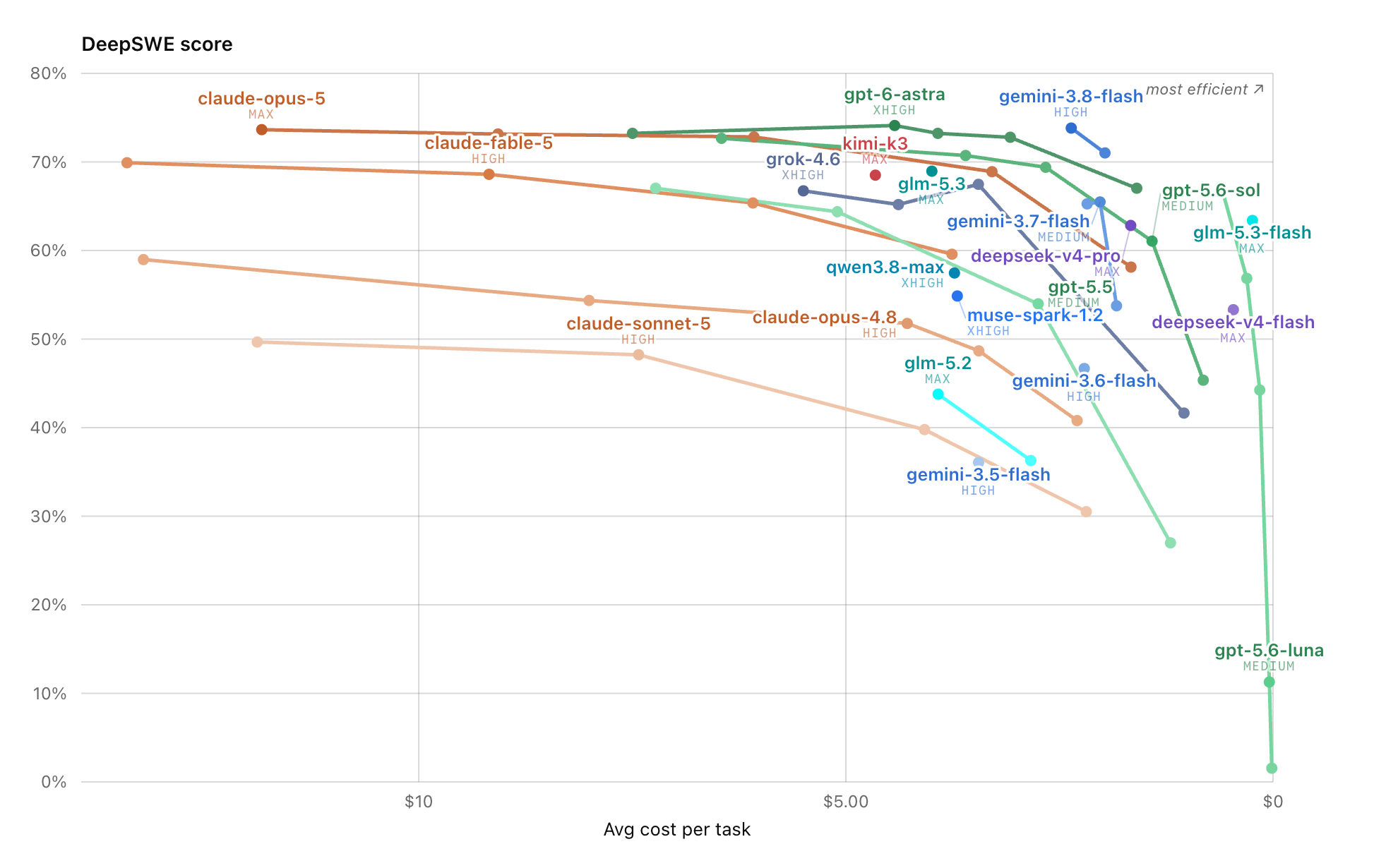
Benchmarks say the same thing: open sources are closing the gap but they are still nowhere near the frontier models as they exist today.
Building a product on the weaker models and pitching the model list is the worst bet you could make. Everybody just wants the best performance. Nobody cares about the model tier list underneath.
People should have access to the best performance at all times and it means getting access to the best possible model for the task at all times. They should not have to switch to a cheaper model to get the job done.
Cheaper today still means that the output is (sometimes, slightly) worse. If it wasn't, open source would already be the default.
We used to judge models on cost per million tokens. We now judge them on cost per task and that's the number I trust. A lower cost per task wins even when the cost per million tokens is a bit higher, model-wise.

Cost per task. DeepSWE score against average dollars per task.

Cost per million tokens. Price per million tokens, by intelligence class, over time.
What matters is the product. What's the right UX for task X? What has my user been stuck on every time they try to do operation Y? How do we get them past that?
The one product that's absolutely killing this today, in my opinion, is Codex or ChatGPT work. You still know which model it uses underneath but honestly the average user is better off not knowing because it conforms to the right user experience for whatever you ask. If you want to generate an image, it pops up this beautiful image experience where you can annotate and tell your agent what it needs and what it needs to do. If it's a document that you want to edit, now it opens up in OpenAI spaces, etc.
If OpenAI weren't a model lab they wouldn't really even give the user the option of a model picker. The job is to hand the user the result. They do that no matter which model is selected underneath.
Anthropic is moving the same way. Their computer use has gotten really good. Companies winning outside the lab are doing the same thing. I like T3 Code. It makes software engineering pleasurable. I plan in it. I architect in it. The agents write the code.
Paper got the product experience right as well. I'm a software engineer and with Paper I can design on a canvas, use whatever agent I have, and share it. Most of the time I don't care which model it is. It works inside Codex, inside Claude Code, or any other harness of my choice.
I used to track every Apple release and basically every tech product between 2010 and 2021 but then I stopped because most of them got good enough that buying any of them today would be fine. I can still get the job done. I only pay attention when something is actually new. Models are heading the same way. Which model you use matters less than what you build with it.
Build a product people love to use. Make the best product win.
I am also not saying we shouldn't use open-source models. I like them. They're cheap and they work. Use them. All I'm saying is it doesn't matter which one you end up using, as long as the job gets done.
The outcome is far more important for our users than letting them choose which model they want to use.