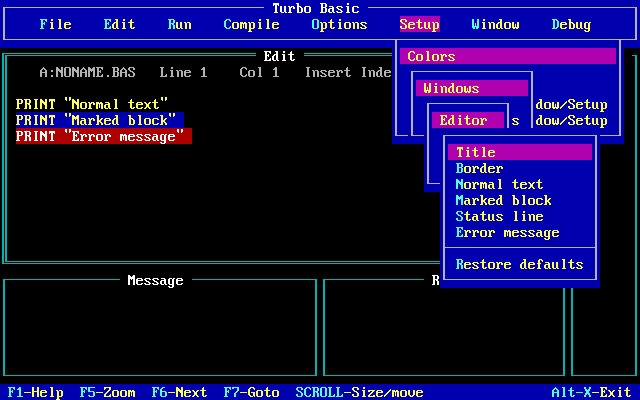
Turbo BASIC started life as BASIC/Z and written by Robert "Bob" Zale. It was the first interactive compiler running on the CP/M operating system, but in 1987, Borland purchased it and published it for MS-DOS. It was sold only for a couple of years, before being discontinued, so Bob bought the rights back to continue it under the title PowerBASIC.
Aside from being a compiler rather than just an interpreter, it also permitted much larger executable programs to be created. GWBASIC was limited to .BAS (BASIC interpreter code) files of no larger than 64 KB. With Turbo BASIC you could create files of any size as long as it fit into available memory.
One of the most popular features of Borland's compilers was that they featured an IDE, or Integrated Development Environment. At the time, some referred to these as "Edit-Compile-Run" development environments. While it may not seem any better than, say, GWBASIC, in these days a compiler was a professional tool and it was more typical to use your favourite text editor to write code and then run the compiler and linker from the command-line to create a .EXE file. Within the IDE you could write and format your source code, configure all of the compiling options such as memory usage and then either run it "in-memory" or compile it to an executable. When compiling, it would create an object code file as well - an intermediate file between the high-level language you program in and the binary executable file. These would have a .OBJ file extension.
While in Borland's control, several versions were released.

Borland Turbo Basic version 1.0
The first version was of course v1.0. For anyone who had already written BASIC programs in GWBASIC or QBASIC, you could load its .BAS files into Turbo BASIC and it would be around 90% compatible with the exception of just a few commands. You would need to save the file in GWBASIC using this syntax to ensure it was in ASCII mode: SAVE option "myprog",A
Later that same year, Borland released the last version, 1.1 - believed to simply be a bug-fix release of v1.0. Click here for the original User Manual.
In 1987 Borland released a series of complementary "Turbo Toolboxes" that would work with Turbo BASIC:
The Turbo Basic Database Toolbox, announced last week, adds muscle to the language's traditional weakness by providing access, sort, and screen I/O routines for database programming. It uses long integers for record numbers, supporting databases of over 2 billion records. The product also support the B+ tree method of index files, as well as data file import from ASCII, Dbase version, and Reflex.
The Turbo Basic Editor Toolbox includes both a control-character-driven multiwindow, multifile text editor and a text editor with pull-down menus. Both are RAM based, resulting in quick file access.
The Turbo Basic Telecom Toolbox provides the routines required to build a communications program. It includes an asynchronous communications tutorial and routines for controlling ports and screen handling.
The three packages, available in the third quarter for $99.95 each, include complete source code."
InfoWorld, 27th July 1987
Borland International were initially headquartered in Scotts Valley, CA:

Enterprise Technology Center, Scotts Valley, CA, just off Highway 17 in the Santa Cruz mountains
The 7-building campus was built at the height of Borland's success in 1993, and comprised a massive 444,000 square feet of office space, an Olympic-sized swimming pool, tennis and basketball courts, indoor and outdoor amphitheatre and ornate water features. It cost nearly $120M to build the campus for its 1,200 employees. The campus was acquired by a Chinese invester in 2013 for 1/10th of its original cost.


