
There is a comforting story going around credit desks about Oracle's data center problems: if the buildings are late, the capex is late too, and that buys the balance sheet some time.
Morgan Stanley isn't buying it.
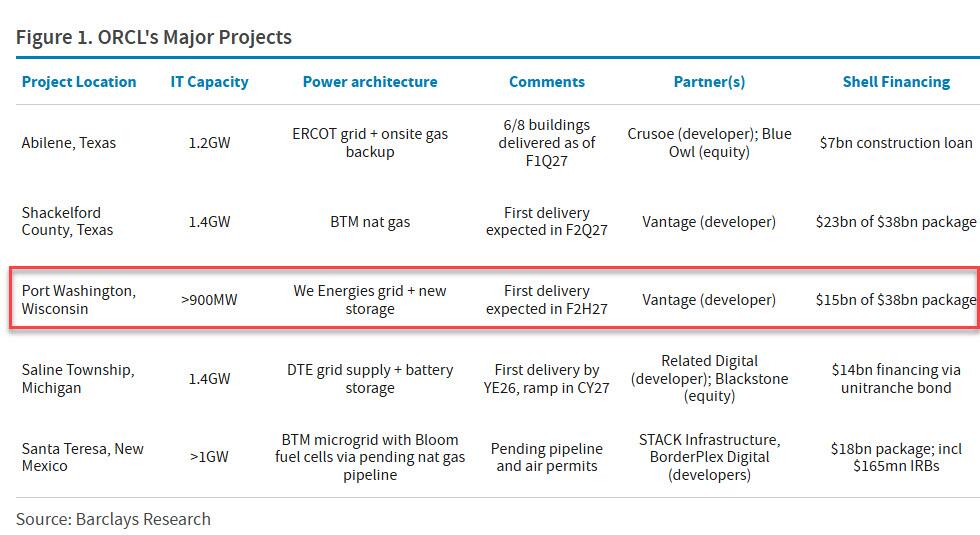
In a new note titled "ORCL Credit: Lighthouse in the Fog" (available to pro subs), MS credit analysts Lindsay Tyler and Benjamin Guerrero pick up where we left off on Tuesday, when we reported that Oracle's 1.3GW "Project Lighthouse" campus in Port Washington, Wisconsin was next in line to slip after Project Jupiter's force majeure.
Their conclusion was blunt: a delay, Tyler told Bloomberg in an interview, "also means delayed monetization and delayed proof of concept, delayed revenue, delayed cash flow." For a company with over $600 billion of future revenue tied to AI data center construction, that's the whole investment case.
That matters because of who is saying it. Tyler is the analyst who told clients to buy protection on Oracle a year ago, back when its 5Y CDS cost about 125bps, and who warned at the time that it could hit 150bps and then approach 200bps "as the new year progresses." On Thursday Oracle CDS closed at a record 261bps, which implies a more than 20% probability of default over the next five years. For an "investment grade" company.
Let's take a closer look at what MS says a delay actually costs Oracle, why the site that worries us most is the one that's almost finished, and why the "capex relief" crowd may be counting the wrong thing.
2H27? Try Mid-2028
The Wisconsin story will be familiar to regular readers. Lighthouse is one of two Vantage campuses being built for Oracle to lease: four buildings, about 902MW of critical IT load, contracted in September 2025. The shells are going up just fine. Oracle even put a drone shot of the site in its June earnings deck to show off its "massive progress":
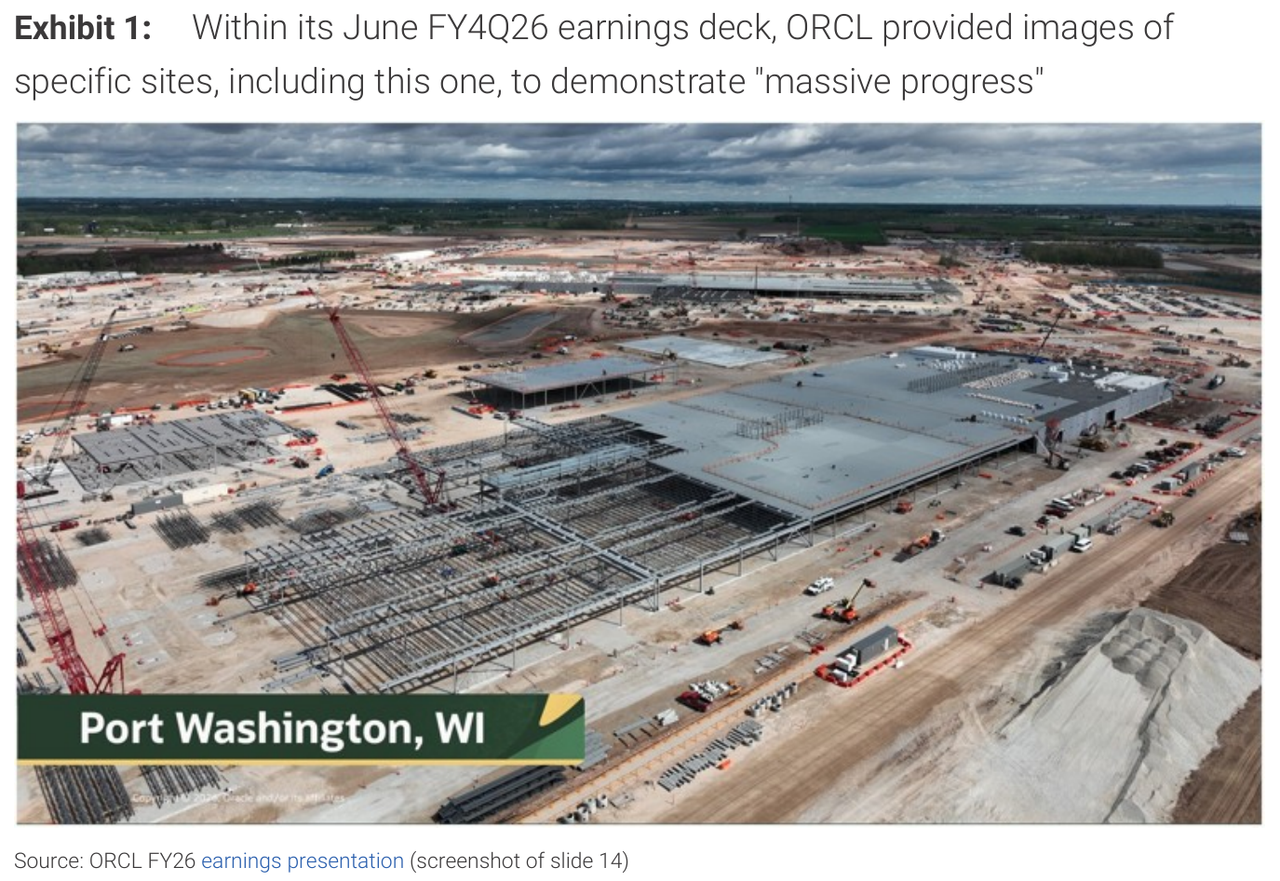
The problem, as we explained Tuesday, is that there is nothing to plug them into. The campus needs Wisconsin PSC approval for new ATC transmission lines to bring grid power via We Energies (a WEC subsidiary). The PSC revoked its completeness finding on ATC's application in August, the case was closed, and ATC refiled on a new docket, restarting the clock. Citing the Aterio analysis we broke down this week, MS writes that there is "a material risk that meaningful load is not available until mid-2028." That compares with Oracle's June guidance for initial delivery in 2H CY27, and its September earnings call description of the project as "very much on track and going well."
Very much on track... in the same way Jupiter was "on schedule" when Oracle sent its developer a force majeure notice.
MS also flags a detail we flagged on Tuesday: WEC said Oracle's S&P downgrade triggered additional collateral, "with the current rating already requiring full credit support." In other words, Oracle is posting cash to the utility for power it won't get until 2028.
And Wisconsin isn't alone. MS points out that power, not construction, is the bottleneck at both Lighthouse and Jupiter, and that Oracle (or a subsidiary) appears to be the directly contracted party for power at both.
At Jupiter, the fix now involves trucks: as we reported yesterday, Oracle is weighing hauling compressed natural gas to the New Mexico campus by road until Energy Transfer's rerouted pipeline shows up next year, at roughly four times the price of pipeline gas. The stock slid as much as 6% on the headline, prompting the obvious question:
*ORACLE MAY TRUCK GAS TO SITE IN PLACE OF DELAYED PIPELINE *ORACLE SHARES EXTEND DECLINE TO AS MUCH AS 6.1% Did OpenAI come up with that?
— zerohedge (@zerohedge) October 8, 2026
None of this should come as a shock. Back in December, Bloomberg reported that some Oracle data centers for OpenAI were being pushed to 2028 from 2027. Oracle denied it, and the stock rebounded. Ten months later the bank with a sell on the debt is talking about mid-2028. Funny how that works if you just pay attention to the denials.
Why A Delay Is Not "Capex Relief"
The bulls' argument is simple: if the power is late, the GPUs are late, and Oracle spends less cash for a while. Barclays made this case after Jupiter, noting that roughly $30 billion of hardware capex is "typically spent 2-3 months ahead of the asset going live," which is why it declared the force majeure credit-neutral the day before Oracle CDS blew out to a record.
Tyler concedes that a delay "could push associated GPU and infrastructure spending to the right, which could be helpful from a technical supply lens." Then she lists four reasons why that is the wrong way to look at it:
1. Revenue and cash-flow realization would be deferred, extending the period before confirmation that ORCL's substantial investment and contracted backlog are translating well into meaningful financial results.2. Delays could make the eventual balance-sheet and cash-flow impact more lumpy. If multiple halls are construction-ready by the time power is secured, ORCL could face more concentration in GPU capex (i.e., cash needs) and lease liabilities (i.e., balance-sheet obligations).
3. Just as there is limited visibility into the underlying lease and financing documents, there is also limited visibility into the contractual terms supporting ORCL's RPO. It remains unclear whether customers have specified compute delivery timelines or what remedies may apply for delays.
4. We consider whether any execution-risk overhang may spread to customer behavior and in turn pressure prepayments, an important potential future funding source for ORCL, either by affecting new RPO signings or customers' willingness to re-contract.
Point two is the one that should keep bondholders up at night. The capex isn't cancelled, it's bunched. If four Wisconsin buildings are finished and waiting when the transmission line finally shows up in 2028, Oracle has to fill all of them with GPUs and start paying rent on all of them at roughly the same time, quite possibly while Jupiter's halls are coming online too. Delay doesn't shrink the bill; it compresses it into fewer quarters.
And Oracle's cash needs are already stretched. Oracle borrowed roughly $43 billion in fiscal 2026 (ended May 31) and expects to raise another $40 billion of debt and equity in the current fiscal year, according to its filings. In her September 11 note "ORCL Credit: New Bookings, Old Bills" (available here for pro subs), Tyler estimated that Oracle's parent funding needs "may require two large bond deals by FY28-end even if ORCL receives ~$40bn more customer prepayments":
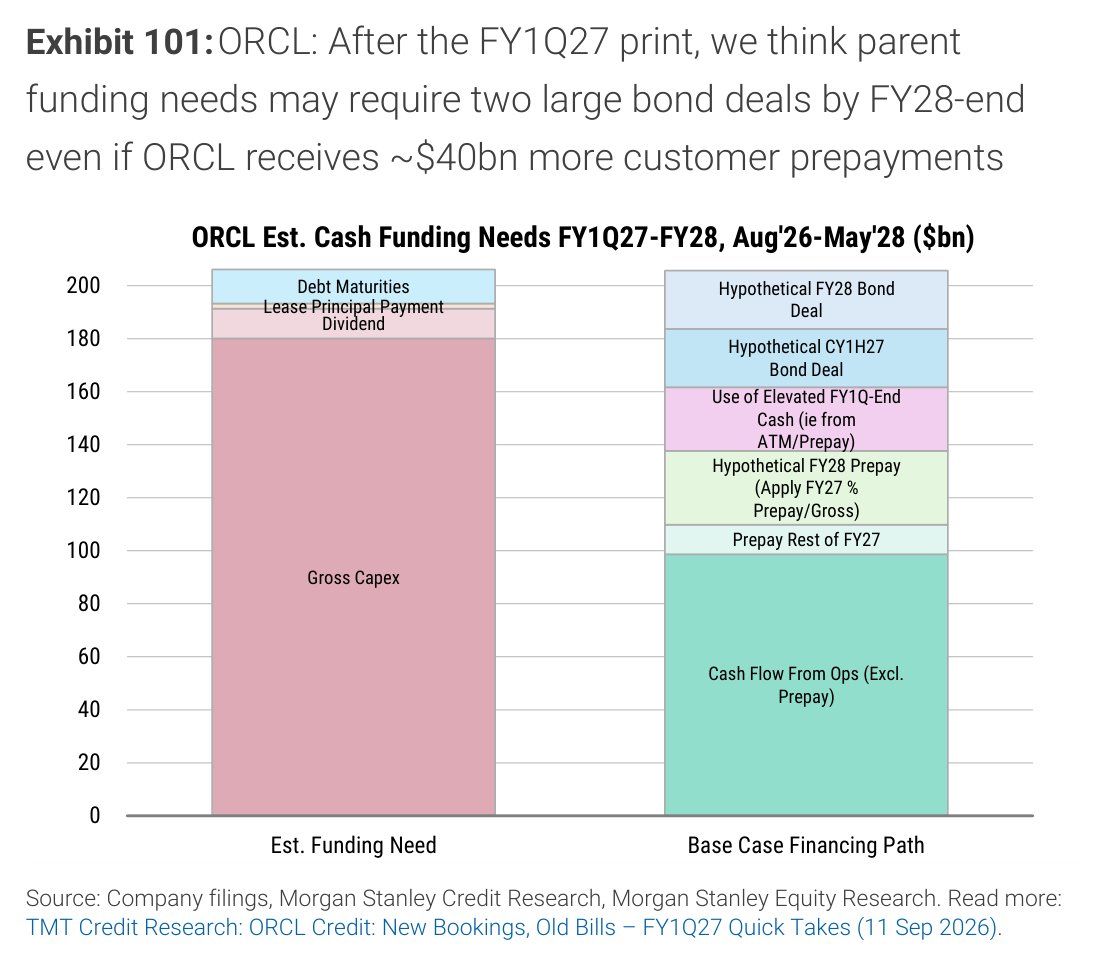
Which brings us to points three and four. Prepayments from customers (read: OpenAI) are one of the biggest funding sources in that bridge. If delays make customers less willing to prepay, or to sign up again when the contract rolls, the "new bookings" part of the equation shrinks while the "old bills" do not. And as Tyler notes, nobody outside Oracle knows what its $600 billion-plus RPO actually says about delivery dates, or what happens if they're missed.
Investors are being asked to take on faith a backlog roughly the size of Sweden's GDP.
The Site That Worries Us Most Is The One That's Almost Done
Here is the part of the note that got less attention in the Bloomberg write-up, and the part we think matters most. MS reminds clients that Lighthouse and Shackelford County, Texas are funded through the ~$38 billion Vantage construction loan first reported in September 2025, which is part of about $65 billion of shorter-dated loans for Oracle-tied sites, on top of the $14 billion Related Digital (RDMICH) bond backing Michigan:
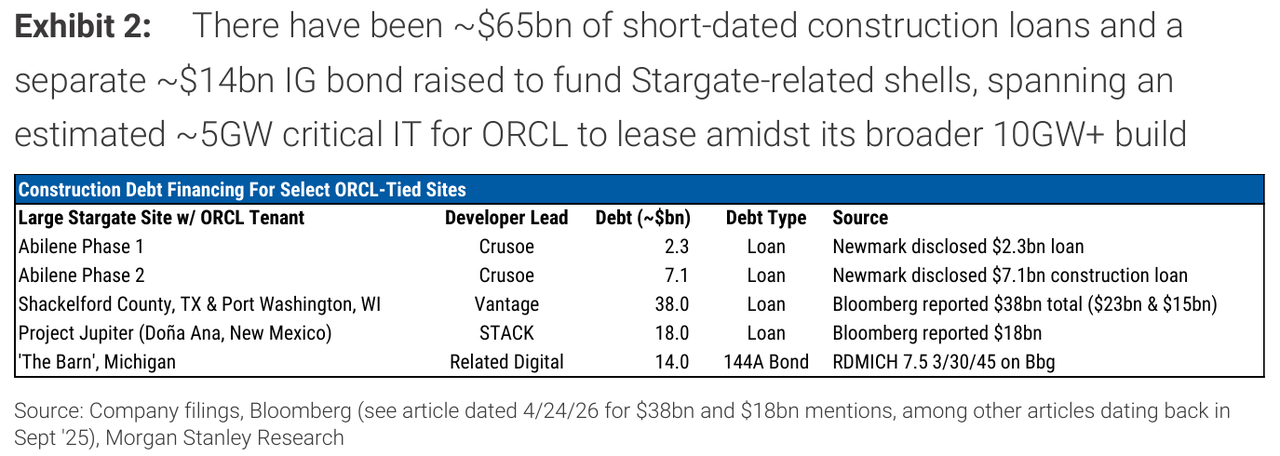
As with Jupiter, Tyler writes, "limited visibility into the financing and lease documents makes it difficult to assess how delay consequences, if any, would be allocated among developers, ORCL, lenders, and other counterparties." Then comes the money line:
We continue to consider whether greater focus on project delays could spill into ORCL CDS hedging, and whether execution concerns – alongside higher rates and a growing DC construction debt pool – could complicate the eventual refinancing of Abilene debt into longer-dated paper as the project nears completion (6 of 8 buildings delivered).
Abilene is the flagship Stargate site and the one that actually works: six of eight buildings delivered. But its $9.4 billion of construction loans are, per our covenant comps, interest-only and all due in 2028.
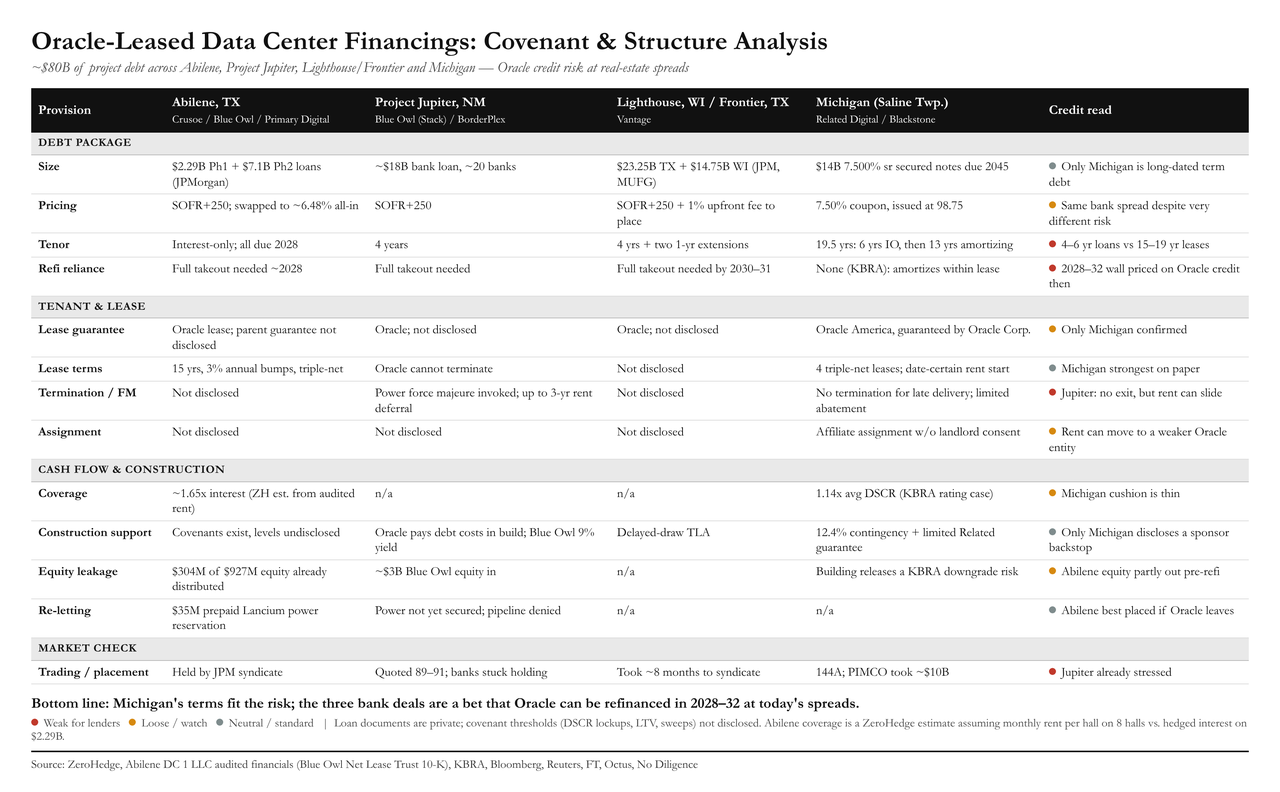
That paper has to be taken out with long-dated debt priced off Oracle's credit, and Oracle's credit is now trading at junk-like levels with the 10Y Treasury yield having hit 5.33% last week, the highest since 2002. Translation: the problem isn't just the sites that are late; it's that the late sites make the finished site harder to refinance.
Here is how the roughly $79 billion stacks up by site. Note how much of it sits on campuses where the power is late:
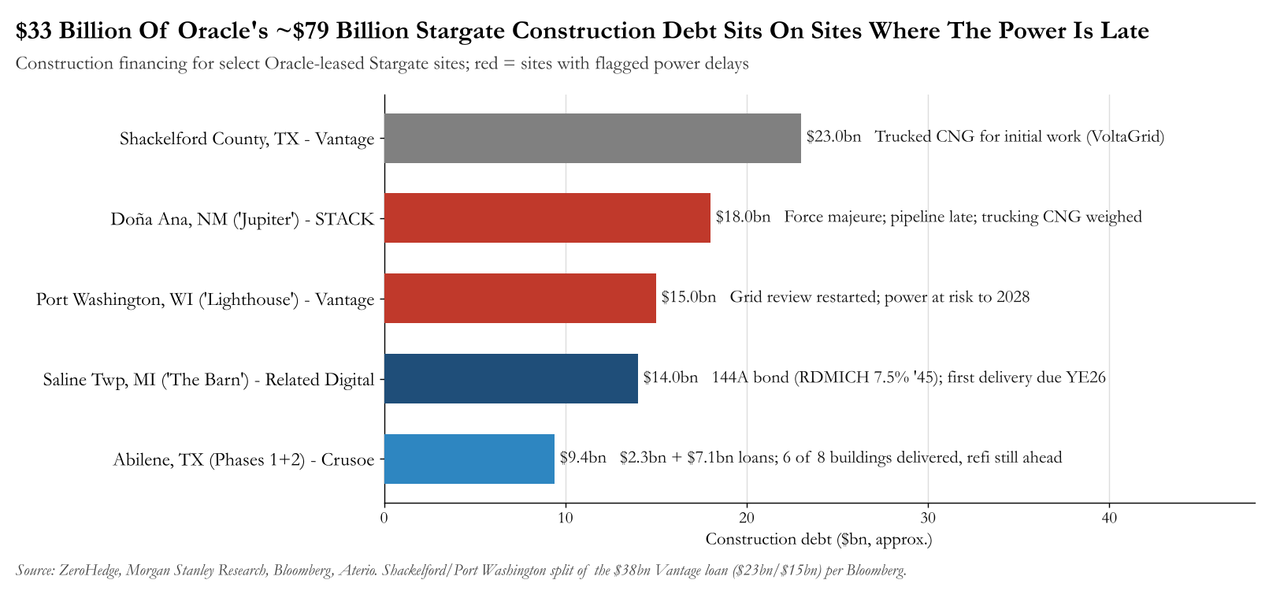
Put differently, $33 billion of construction debt, or about 40% of the total, sits on the two sites where power delays have now been flagged, and that's before counting Shackelford, where Oracle is already trucking in gas for initial work. Three of the four bank deals are short-dated loans against 15-19 year leases, i.e., a bet that Oracle can be refinanced in 2028-2032 at today's spreads. Today's spreads are not what they were when those loans were signed.
The Hedgers Are Already Here
As for whether delays "spill into ORCL CDS hedging," the market seems to have answered that one before the note hit inboxes. A year ago MS argued that construction loans on Oracle-leased sites would become a major source of CDS demand, as banks stuck with the loans hedged their exposure. That is exactly what has happened. Goldman's credit desk said last week that AI single-name CDS volumes are up 400% year over year, with Oracle at the top of the list, and on Thursday morning we put out this chart as Oracle's entire credit curve repriced:
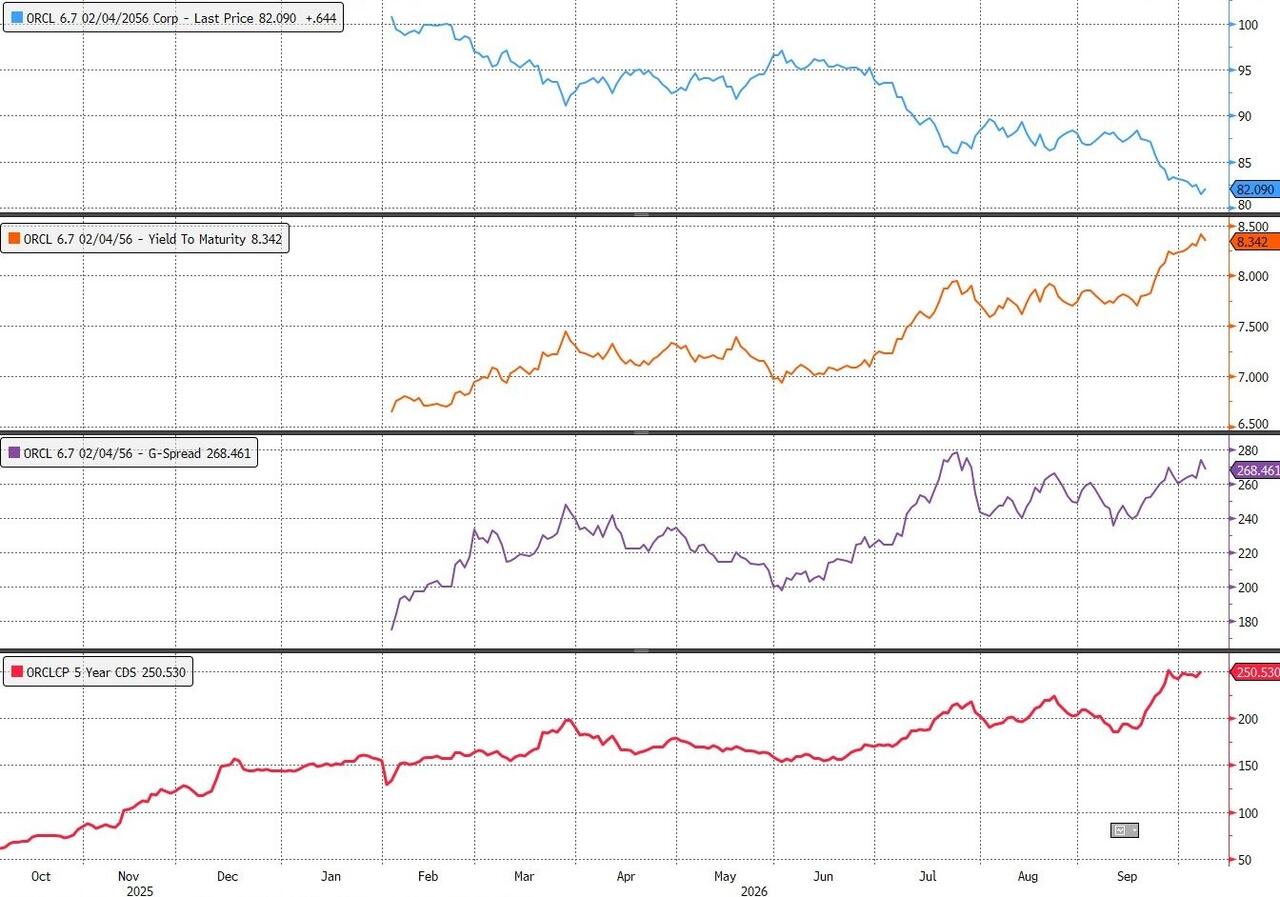
By Thursday's close, CDS had widened another 10.5bps to a record 261bps, more than double where MS first told clients to buy protection, while the 2056 bonds sit around 82 cents and yield over 8.3%. For context, Oracle CDS hit what were then "Lehman crisis levels" last December. It is now roughly 100bps wider than that.
Nor is it just Oracle's own problems. As we noted yesterday, Oracle is in talks with Apollo and Goldman to fund a big chip purchase through an off-balance sheet vehicle, joining SpaceX and Broadcom in what we called the AI chip-debt SPV stampede. That may ease near-term borrowing at the parent, but it also adds yet another layer of Oracle-linked paper competing for the same credit buyers who will one day be asked to refinance Abilene.
Bottom Line
To be fair to Oracle, Lighthouse's timing is still "broadly consistent" with Vantage's 2028 full-campus completion target, as MS notes, and the bank stresses its negative view "pre-existed the project delays" and is based on fundamentals. But that is precisely the point: the fundamentals were already stretched before the gas had to come by truck.
As Goldman's TMT desk put it after Jupiter, third-party-developed AI infrastructure "is not always the bond-like asset class it can appear to be." Morgan Stanley's note shows why: every month of delay pushes out the revenue, bunches up the capex, and makes the eventual refinancing of the one finished campus a bit harder.
Having warned that AI is now a debt bubble too since last October, we think the capex-relief camp has it backwards. Delays don't cut the bill, they only push it into the 2028 refinancing window, right when Abilene's loans come due. The next tests: the PSC's completeness ruling on ATC's refiling, due October 19, and whether Oracle's fiscal second-quarter results in December bring a funding plan or just more pictures of steel. Then again, the last time Oracle was asked about delays, it simply denied them.
Much more in the full Morgan Stanley "ORCL Credit: Lighthouse in the Fog" and "ORCL Credit: New Bookings, Old Bills – FY1Q27 Quick Takes" notes, both available to pro subs.