原文
kcgi is an open source CGI and FastCGI library for C/C++ web applications. It is minimal, secure, and auditable. To start, install the library. Then read the deployment and usage guides.
Hello, World!as an HTTP response to a CGI request.
For fuller examples, see sample.c (C and CGI), samplepp.cc (C++ and CGI), sample-fcgi.c (C and FastCGI), or jump to the Documentation section.
kcgi supports many features: auto-compression, handling of all HTTP input operations (query strings, cookies, page bodies, multipart) with validation, authentication, configurable output caching, request debugging, formatted writers (JSON, XML, etc.) and so on. Its strongest differentiating feature is using sandboxing and process separation for handling the untrusted input path.
current release
installation
First, check if kcgi isn't already packaged
for your system, such as with
pkg_add kcgi (OpenBSD),
pkg install kcgi (FreeBSD),
brew install kcgi (brew),
pacman -S kcgi (Arch Linux),
and so on. If so, install using that system.
If not, kcgi has been built and run on GNU/Linux (musl and glibc), OpenBSD, NetBSD, FreeBSD), Solaris, OmniOS, and Mac OS X (only Mojave and newer!) on i386, amd64, powerpc, arm64, and sparc64. Download kcgi.tgz and verify the archive with kcgi.tgz.sha512. To run bleeding-edge code between releases, the repository is on GitHub. In both cases, build and install instructions may be found on the repository page.
The only hard build-time dependency is BSD make
(bmake on Linux)
and zlib.
If you're running the regression tests (see
Testing), you'll also need
libcurl.
deployment
To use kcgi, you'll need a web server
capable of running CGI or FastCGI.
Apache,
nginx, and OpenBSD's
httpd(8)
have all been used extensively, with the latter two natively over
FastCGI and via the slowcgi wrapper.
To compile kcgi applications, use the package configuration. Linking is similarly normative.
% cc `pkg-config --cflags kcgi` -c yourprog.c
% cc yourprog.o `pkg-config --libs kcgi`
Well-deployed web servers, such as the default OpenBSD server, by default are deployed within a chroot(2). If this is the case, you'll need to statically link your binary (or pull all shared libraries into the shadow root).
% cc -static yourprog.o `pkg-config --static --libs kcgi`
FastCGI applications may either be started directly by the web
server (which is popular with
Apache) or externally
given a socket and kfcgi(8) (this method
is normative for OpenBSD's
httpd(8) and suggested
for the security precautions taken by the wrapper).
documentation
The kcgi manpages, starting with kcgi(3), are the canonical source of documentation. The following is a list of all manpages:
Alternatively, the following are introductory materials to the system:
In addition to these resources, the following conference sessions have referenced kcgi.
- Dzonsons, Kristaps. Role-based Access Control in BCHS Web Applications. Proceedings of AsiaBSDCon, Tokyo, Japan, March 2018. (Slides, video.) paper.)
- Dzonsons, Kristaps. Secure BSD Web Applications in C: Practical Strategies. Proceedings of AsiaBSDCon, Tokyo, Japan, March 2017. (Slides.)
- Dzonsons, Kristaps. Secure BSD Web Application Development in C. Proceedings of AsiaBSDCon, Tokyo, Japan, March 2016. (Slides.)
- Dzonsons, Kristaps. kcgi: securing CGI applications in C. Proceedings of AsiaBSDCon, Tokyo, Japan, March 2015. (Slides, paper.)
And the following relate to extending standards:
implementation details
The bulk of kcgi's CGI handling lies in khttp_parse(3), which fully parses the HTTP request. Application developers must invoke this function before all others. For FastCGI, this function is split between khttp_fcgi_init(3), which initialises context; and khttp_fcgi_parse(3), which receives new parsed requests. In either case, requests must be freed by khttp_free(3).
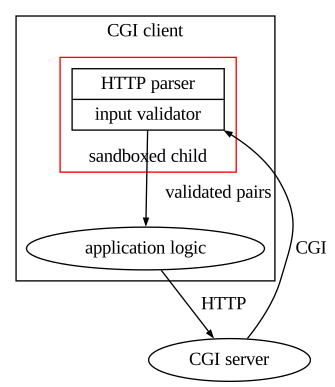
All functions isolate the parsing and validation of untrusted network data within a sandboxed child process. Sandboxes limit the environment available to a process, so exploitable errors in the parsing process (or validation with third-party libraries) cannot touch the system environment. This parsed data is returned to the parent process over a socket. In the following, the HTTP parser and input validator manage a single HTTP request, while connection delegator accepts new HTTP requests and passes them along.


This method of sandboxing the untrusted parsing process follows OpenSSH, and requires special handling for each operating system:
- seccomp(2) (Linux)
-
This requires a seccomp-enabled Linux kernel and a
recognised hardware architecture. It is supplemented by
setrlimit(2)limiting. - pledge(2) (OpenBSD)
- This will only work on OpenBSD >5.8.
- sandbox_init(3) (Apple OSX)
-
This uses the sandboxing profile for
pure computation
as provided in Mac OS X Leopard and later. This is supplemented by resource limiting viasetrlimit(2). - capsicum(4) (FreeBSD)
-
Uses the capabilities facility on
FreeBSD 10 and later.
This is supplemented by resource limiting with
setrlimit(2).
Since validation occurs within the sandbox, special care must be taken that validation routines don't access the environment (e.g., by opening files, network connections, etc.), as the child might be abruptly killed by the sandbox facility. (Not all sandboxes do this.) If required, this kind of validation can take place after the parse validation sequence.
The connection delegator is similar, but has different sandboxing rules, as it must manage an open socket connection and respond to new requests.
testing
kcgi is shipped with a fully automated
testing framework executed with make regress. To test
your own applications, use the
kcgiregress(3) library.
This framework acts as a mini-webserver, listening on a local port,
translating an HTTP document into a minimal CGI request, and passing
the request to a kcgi CGI client. For
internal tests, test requests are constructed with
libcurl.
The binding local port is fixed: if you plan on running the
regression suite, you may need to tweak its access port.
The testing framework is used by the GitHub Actions to make sure that all commits pass the regression tests on all supported systems (including with compiler sanitisation).
Another testing framework exists for use with the
American fuzzy lop.
To use this, you'll need to compile the make afl target
with your compiler of choice, e.g., make clean, then
make afl CC=afl-gcc. Then run the
afl-fuzz tool on the afl-multipart,
afl-plain, and afl-urlencoded binaries
using the test cases (and dictionaries, for the first) provided.
performance
Security comes at a price—but not a stiff price. By design, kcgi incurs overhead in three ways: first, spawning a child to process the untrusted network data; second, enacting the sandbox framework; and third, passing parsed pairs back to the parent context. In the case of running CGI scripts, kcgi performance is bound to the operating system's ability to spawn and reap processes. For FastCGI, the bottleneck becomes the transfer of data.