During the Second World War, the British Royal Navy experimented with the idea of using ice reinforced with wood pulp to build an aircraft carrier.
The composite material, known as Pykrete, was apparently as strong as concrete, as long as it could be kept frozen.
The ship would've effectively been a floating, custom-made, strengthened iceberg for planes to take off from and land on – but with rising costs and better options becoming available, the project was eventually abandoned.
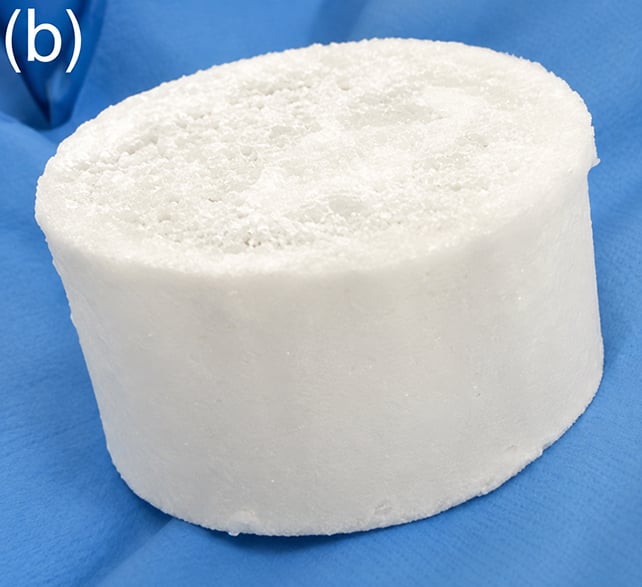
Now researchers led by a team from the Hebrew University of Jerusalem in Israel have extended that idea from the 1940s to create what they're calling BioPykrete.
By adding plant-based crystals and a bespoke protein to ice, they've created something that's 10 times stronger than regular ice and able to absorb 70 times more energy before breaking.
A study of the new material has been published in Colloids and Surfaces B: Biointerfaces, and the team behind it hopes that it may one day be used as a building material.
"We wanted to go beyond simply mixing fibers into ice and instead control how the different materials connect at the molecular level," says biochemist Ido Braslavsky, from the Hebrew University of Jerusalem.
"The result changes not only how strong the ice is, but also how it breaks. Instead of suddenly shattering, it can absorb much more energy and deform gradually."
The intended application isn't for aircraft carriers this time, but rather for construction projects in remote, cold areas where conventional building methods aren't easy to apply – like the Arctic and Antarctic.
With no concrete or steel required, and with ice and plant-based cellulose as the main ingredients, this could be a building material with a low carbon footprint that's also biodegradable.
"While the construction industry is a cornerstone of the global economy, it remains one of the most significant environmental polluters, responsible for substantial carbon emissions and massive resource depletion," write the researchers in their published paper.
"Biotechnology offers a transformative pathway to mitigate this impact by developing novel, sustainable biomaterials."
It's going to be a while before BioPykrete can be used as a construction material, however. This study was a small-scale proof-of-concept test, and further research will be needed to look at how BioPykrete stands up over long periods and under changing conditions.
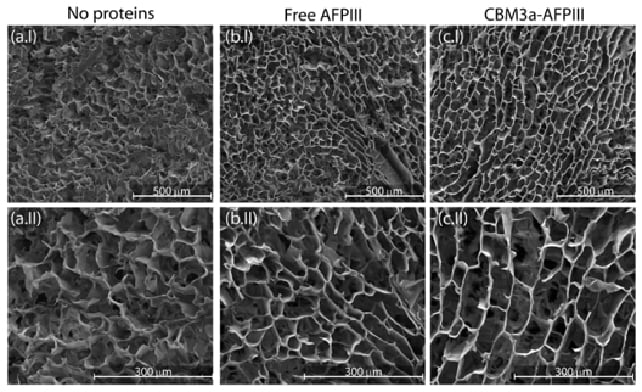
Instead of wood pulp's larger, disordered fibers, the researchers used cellulose nanocrystals here.
Cellulose is the main structural material in plants, and in nanocrystal form, it can act as a microscopic strengthening agent for other materials, including ice – essentially stopping cracks from spreading easily.
The protein used here was called CBM3a-AFPIII, a combination of an antifreeze protein (AFP) and a carbohydrate-binding module (CBM). Its job was to act like glue, keeping the cellulose nanocrystals and ice bonded together.
It's a clever approach, and the researchers think that by tweaking their ingredients and methods, they might be able to improve their 'super ice' even further.
"Optimizing solidification kinetics and freezing protocols, alongside developing diverse AFP-CBM variants, could yield even higher-strength composites," write the researchers.
Besides further tests of the durability of the material, the researchers are also keen to take a closer look at how cracks propagate through BioPykrete, to confirm that the underlying strengthening mechanisms are what they think they are.
Further down the line, this approach could open up a whole new landscape for materials used in packaging, construction, and more: Using a custom protein to bring two unlikely compounds (ice and cellulose) together.
"By bridging the gap between recombinant protein design and structural engineering, we have developed a high-performance material specifically engineered for the rigors of the world's most extreme environments," write the researchers.
The research has been published in Colloids and Surfaces B: Biointerfaces.
This article was fact-checked by Rebecca Dyer and edited by Rebecca Dyer. While we pride ourselves on our process, we are only human. If you spot a mistake, please let us know.